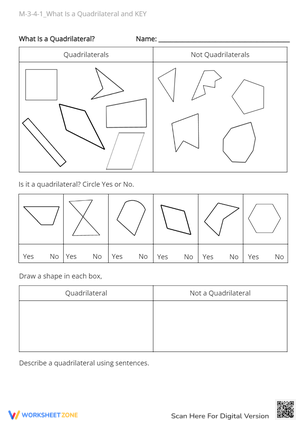
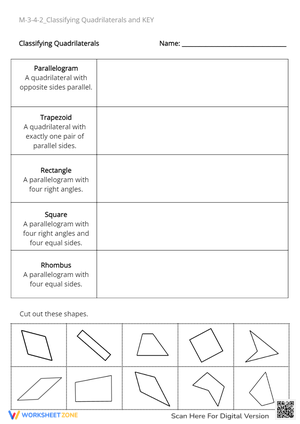
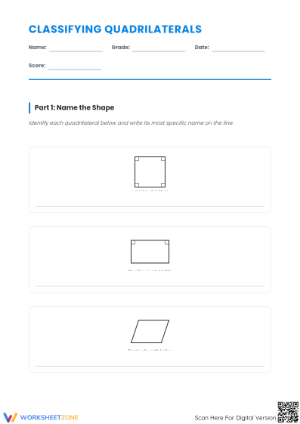
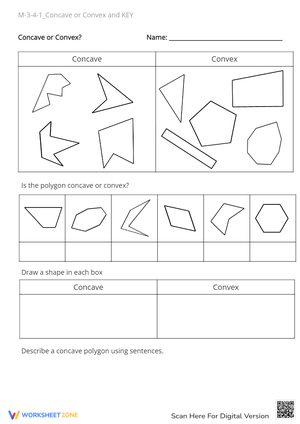
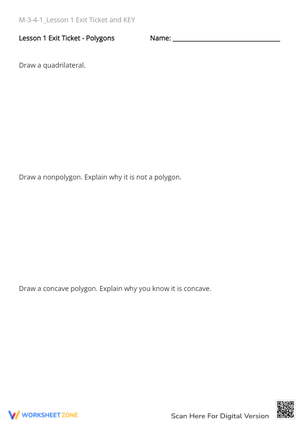
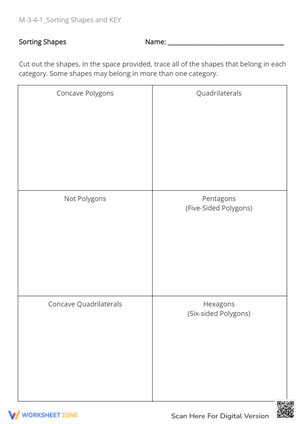
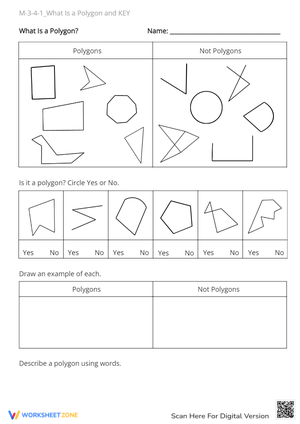
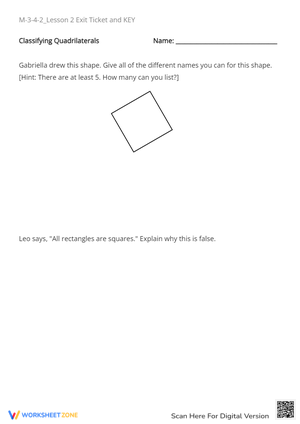
These quadrilaterals pdf worksheets for 3rd grade give teachers print-ready geometry practice that moves well past simple shape naming into the attribute-based thinking Grade 3 standards actually demand. Each worksheet targets the work of comparing, classifying, and explaining — not just circling the square. The set is print-and-go, but the tasks push students to reason about what makes a four-sided figure belong in the quadrilateral family.
The Specific Skills Each Worksheet Targets
Quadrilaterals sit at an interesting intersection in third-grade geometry. Students arrive already knowing what a square and rectangle look like, which means recognition tasks alone won't stretch their thinking. These worksheets start at recognition and then push deliberately toward classification and justification.
- Recognizing closed four-sided figures: Students mark which images show a complete quadrilateral and cross out open shapes or figures with curved sides.
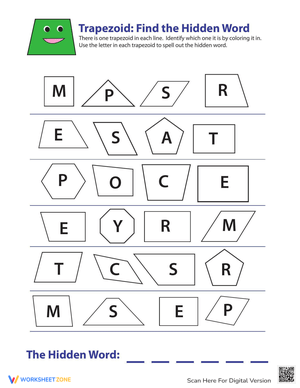
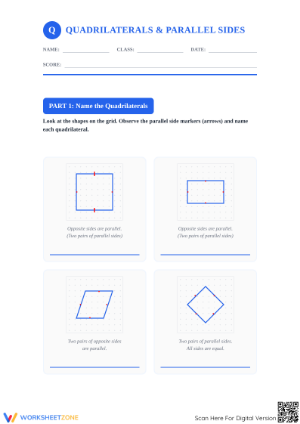
- Naming members of the family: Squares, rectangles, rhombuses, trapezoids, kites, and parallelograms all appear — students identify and label each.
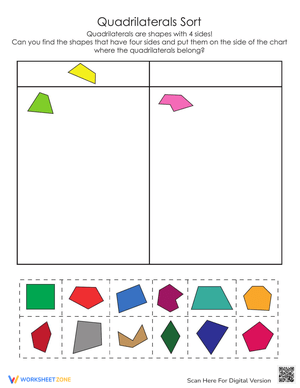
- Sorting by visible attributes: Right angles, parallel sides, and equal side lengths become the sorting criteria, not just the general shape silhouette.
- Comparing pairs of shapes: Structured prompts ask students how a rhombus and a square are alike, or how a trapezoid differs from a parallelogram.
- Drawing from constraints: Students construct their own quadrilateral given a specific rule — four equal sides, one right angle, two sets of parallel sides.
- Writing justifications: Short sentence frames help students explain why a shape belongs in a category using terms like vertex, side, right angle, and parallel.
That drawing task is worth noting. When a student has to produce a quadrilateral that fits a given rule rather than identify one from a printed picture, you immediately see whether the understanding is genuine. Students who truly grasp the definition draw something that works. Students who are pattern-matching from memory freeze or draw a generic rectangle regardless of the constraint.
Mistakes Students Make That These Worksheets Help You Catch
The most persistent error in third-grade quadrilateral work is orientation confusion. A student who correctly identifies a square every time will often mark the same shape "not a quadrilateral" when it appears rotated 45 degrees and resembles a diamond. The shape hasn't changed — only its position on the worksheet has — but students who are pattern-matching from memory rather than applying the definition get tripped up here consistently. These worksheets include shapes at non-standard orientations specifically to surface that confusion before it follows students into later units.
A second error involves the relationship between subgroups. Many students accept that a square is a square and a rectangle is a rectangle without connecting that both belong to the same broader family. When asked to sort shapes into "quadrilateral" and "not quadrilateral," they will sometimes place a long, narrow rectangle in the wrong group because it doesn't look like the prototypical four-sided shape they picture. Including non-examples alongside real quadrilaterals — an open figure, a triangle, a five-sided polygon — forces students to apply the definition rather than rely on shape memory. That single design choice produces more durable learning than five extra recognition tasks would.
A third pattern we see in actual student work: over-dependence on printed labels. When a word bank is provided, some students use it as a lookup table rather than building genuine recall. These worksheets pair vocabulary support on introductory tasks with label-free classification prompts on later ones, so students can't lean on the list indefinitely.
Fitting These Worksheets Into Your Planning Week
The most effective way to use these resources is in short, targeted bursts across several days rather than one extended geometry session. Spaced retrieval — returning to the same concept in brief increments — produces much stronger classification accuracy than a single long sitting. A 10-minute identification task on Monday, a sorting task on Wednesday, and a draw-and-justify task on Friday gives students three exposures to the concept without turning the week into a geometry marathon.
Within a single lesson, sequence matters. Use a recognition or naming worksheet as the follow-up to a mini-lesson, when teacher-led instruction is fresh and students need to consolidate what they just heard. Save the comparison and justification tasks for later in the week, once students have had time to absorb the vocabulary. Exit tickets work especially well here — a half-sheet asking students to name one quadrilateral and write one sentence explaining why it fits the definition takes about 6 minutes at the end of a math block and gives you immediate information about who has the concept and who is still guessing from appearance.
For math centers, pair a sorting worksheet with a set of cut-apart shape cards. Students physically move shapes into categories and then record their groupings on the worksheet. That physical manipulation slows the decision-making in a useful way — students who rush to write "square" without thinking have to pause when they're holding an actual card and deciding where to place it.
Standard Alignment
CCSS.MATH.CONTENT.3.G.A.1 asks students to understand that shapes in different categories may share attributes, and that shared attributes can define a larger category. Quadrilaterals are the direct example the standard references: students should recognize rhombuses, rectangles, and squares as quadrilaterals and as special parallelograms. These worksheets address that standard by moving students from simple identification into the attribute comparison the standard actually calls for.
This standard sits in the Geometry domain for Grade 3 specifically because students at this age are ready to think categorically rather than purely perceptually. In second grade, the focus is basic shape recognition. Third grade is where the logical relationship between shape families becomes an explicit learning target. Worksheets that only ask "which one is a rectangle?" stop short of what the standard requires. The tasks here consistently push students to compare across shapes and explain the relationship — which is the work the standard describes.
Adjusting the Set for a Mixed-Ability Class
For students still building basic shape recognition, reduce the number of shape types per worksheet to squares, rectangles, and one irregular quadrilateral. Add a labeled visual reference — a small chart showing each shape name beside a clear image — that students keep on their desk during the activity. The goal at this stage is connecting vocabulary to visuals without the cognitive load of six unfamiliar shape names at once.
For students who move through recognition tasks quickly, remove the word banks entirely and add open-ended prompts: Draw two different quadrilaterals that are not squares or rectangles, and explain how you know each one belongs in the quadrilateral family. That task requires application of the definition, not recall from a memorized list. Students who are ready for it find it genuinely engaging rather than repetitive.
One honest note: the drawing-from-constraints format can frustrate students who struggle with fine motor control or spatial visualization. For those students, providing dot-grid paper removes part of the physical barrier and lets the geometric thinking come through more clearly. It's a small adjustment, but it changes what the worksheet actually measures for that group.
Frequently Asked Questions
What exactly is a quadrilateral, and how do I explain it to third graders?
A quadrilateral is a closed 2D shape with exactly four straight sides and four vertices. For third graders, the clearest entry point is counting: four sides, four corners, all the way closed. Once students have that foundation, you can introduce the idea that many different-looking shapes — squares, rectangles, rhombuses, trapezoids — all fit that definition and belong to the same family.
How are these worksheets different from the geometry pages already in my textbook?
Most textbook geometry pages in Grade 3 stay at the recognition level — circle the square, name the shape. These worksheets push into classification and justification, which is what CCSS.MATH.CONTENT.3.G.A.1 actually requires. They also include non-standard orientations and deliberate non-examples, two features that textbook pages frequently skip but that make a real difference in whether students build lasting understanding or just pattern-match on the unit assessment.
Can I use these for assessment, or are they practice only?
Several worksheets in the set work as formative checks. The exit-ticket format tasks and the draw-and-justify prompts give you clear evidence of whether a student understands the definition or is guessing from appearance. These quadrilaterals pdf worksheets for 3rd grade aren't a substitute for a formal unit test, but the justification tasks produce student writing you can use directly to plan your next instructional move.
Do these work for students who need extra support with vocabulary?
Yes. Early worksheets include vocabulary supports — word banks, labeled diagrams, and sentence frames. Students who need repeated exposure to terms like parallel, vertex, and right angle get that through the introductory tasks. The vocabulary support thins out across later worksheets intentionally, moving students toward independent use of the terms rather than permanent reliance on a reference list.
How much class time does each worksheet take?
These quadrilaterals pdf worksheets for 3rd grade typically run between 8 and 15 minutes each, depending on task type. Recognition and naming worksheets move faster; comparison and drawing tasks run longer. Teachers who spread the set across a unit rather than using it all in one sitting get the most out of the range — shorter worksheets fit warm-up and exit ticket slots naturally, while the longer ones hold up as the main independent activity inside a math block.













 Interactive Worksheet Maker
 Quiz Maker
 Word Search Maker
 Crossword Puzzle Maker
 Word Scramble Generator
 Sentence Scramble Generator
 Handwriting Worksheet Generator
 Name Tracing Generator
 Fill In The Blank Generator




 BACK TOSCHOOL