3rd Grade Trapezoids printable worksheets
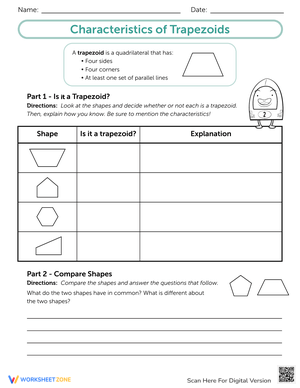
These 3rd grade trapezoids printable worksheets give teachers a focused set of practice resources for the quadrilateral that trips up third graders more reliably than any other — the trapezoid. Students at this grade are expected to categorize shapes by attributes, not just name them, and the trapezoid is where that expectation gets genuinely tested. The set covers parallel side identification, orientation recognition, and sorting within the broader quadrilateral family.
The Specific Skills Targeted
Each worksheet addresses a distinct skill rather than cycling through the same recognition exercise repeatedly. Together, the resources cover:
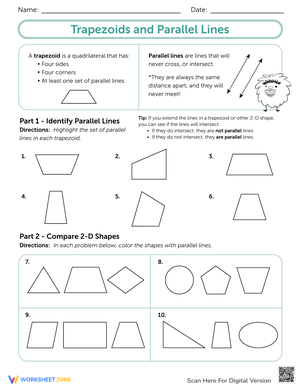
- Identifying the parallel sides in a trapezoid and marking them with arrows or tick marks
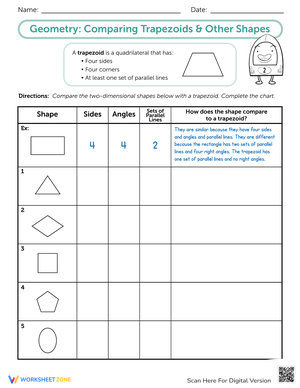
- Using attribute checklists to verify side count, vertex count, and parallel pairs before naming the shape
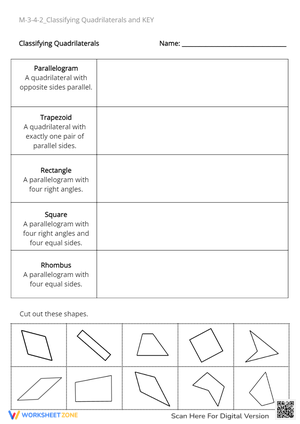
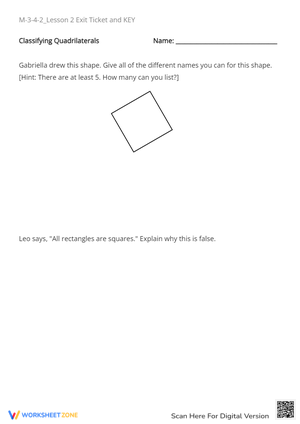
- Sorting a mixed collection of quadrilaterals — rhombuses, parallelograms, rectangles, and others — into trapezoid and non-trapezoid groups
- Recognizing isosceles trapezoids by their equal non-parallel legs and symmetric base angles
- Distinguishing right trapezoids from rectangles through parallel-side analysis
- Drawing trapezoids on dot paper and grid paper in multiple orientations, including inverted and tilted positions
- Matching real-world objects — bridge trusses, lamp bases, architectural cross-sections — to their trapezoidal shapes
The orientation work matters more than it might look on paper. Third graders who can identify a flat-bottomed trapezoid in a textbook will often write "not a trapezoid" when that same shape appears rotated 90 degrees. The drawing exercises on grid paper address this directly: students produce the shape in multiple positions, which is more demanding and more diagnostic than simple recognition.
Mistakes Students Make That These Worksheets Surface
The most consistent error at this grade is misclassifying a right trapezoid as a rectangle. Students have spent the previous year building confidence with right angles, and the moment they spot two of them in a quadrilateral, the rectangle category fires automatically — they skip the parallel-side count entirely. An attribute checklist built into the worksheet forces the step they want to bypass: count the parallel pairs. A rectangle has two; a right trapezoid has one. When students actually mark each potential pair and confirm that only one qualifies, the distinction holds in a way that verbal explanation alone does not produce.
Orientation errors run a close second. The sorting worksheets across this 3rd grade trapezoids printable worksheets set include tilted and inverted versions of every trapezoid type precisely to interrupt the visual habit of relying on a standard flat-bottomed image. A line-extension exercise — where students use a ruler to extend two sides and watch whether they converge — shifts them from appearance-based to property-based thinking, which is the deeper goal of the CCSS geometry strand at this level.
There is also a subtler error worth watching: students sometimes mark all four sides of an isosceles trapezoid as parallel because the equal leg lengths look balanced and symmetrical. Having students physically extend the non-parallel legs on the worksheet until the lines clearly converge resolves this faster than any verbal explanation. Equal length and parallel direction are two different properties, and students need to see that difference with a ruler in hand.
Building These Worksheets Into Your Lesson Plans
The most effective sequence starts with the attribute-checklist worksheets before any sorting or drawing work. Using a checklist during the introductory lesson builds the habit of verifying parallel pairs rather than guessing by silhouette. Once that habit is stable — usually within one or two practice sessions — the sorting worksheets work well as a Monday warm-up during the quadrilateral unit, or as a 10-minute center task while pulling a small group for targeted instruction.
For math centers, laminating the sorting worksheets and providing dry-erase markers lets students reuse the same resources across multiple rotations. Pair the grid-paper drawing worksheets with a brief geoboard task first: have students stretch a rubber band across pegs to form a trapezoid, then rotate the geoboard and ask whether the shape is still a trapezoid. Students who complete that geoboard step before moving to paper make noticeably fewer orientation errors — the physical experience of the shape surviving rotation transfers directly to the worksheet drawing task in a way that simply describing orientation does not.
The 3rd grade trapezoids printable worksheets set works particularly well as a formative check near the end of the quadrilateral lesson sequence. The sorting exercises expose exactly which students are still relying on visual memory rather than attribute reasoning — a distinction that matters when planning the next round of small-group instruction. The real-world matching exercises also pair well with a brief observation walk where students photograph trapezoidal shapes in the school building before returning to complete the activity.
Standard Alignment
CCSS.MATH.CONTENT.3.G.A.1 requires students to understand that shapes in different categories may share attributes, and that shared attributes define larger categories. In classroom terms, a student needs to explain why a trapezoid belongs to the quadrilateral family and simultaneously explain how it differs from a parallelogram — not just circle the correct answer. The sorting and attribute-checklist exercises in this set put students in exactly that position: they must articulate the distinction using precise vocabulary like parallel, vertices, and quadrilateral before they can complete the task. That level of explanation is what the standard is actually after by the end of third grade, and it is what the multiple-choice items on most state assessments are indirectly testing.
Adjusting the Worksheets for a Range of Learners
Students still working to solidify parallel line understanding benefit from worksheets where the parallel sides arrive pre-highlighted in one color, narrowing the task to counting pairs and confirming the vertex total. Attribute checklists with sentence frames — "This shape has ___ pairs of parallel sides. It is / is not a trapezoid because ___." — give those students a structured path through the reasoning without removing the reasoning entirely. The goal is not to simplify the concept but to reduce the number of things competing for attention at once.
Students working above grade level can use the same sorting worksheets to explore the inclusive versus exclusive definition question. Ask them to identify which shapes in the sort qualify as trapezoids under the inclusive definition (at least one pair of parallel sides) but not under the exclusive definition (exactly one pair). This is genuine mathematical thinking, not busywork, and it previews the definitional precision that shows up in later geometry coursework. The drawing worksheets extend naturally for these students by removing the grid entirely, requiring freehand trapezoids in four different orientations. Without the grid as a guide, they must internalize the parallel-side rule rather than trace around it.
Frequently Asked Questions
What is the difference between a trapezoid and a parallelogram?
A parallelogram has two pairs of parallel sides — both pairs of opposite sides are parallel and equal in length. A trapezoid has one pair under the exclusive definition, or at least one pair under the inclusive definition used in most CCSS-aligned programs. Since a parallelogram satisfies "at least one pair," the inclusive definition technically makes parallelograms a special type of trapezoid — a point worth addressing directly in class discussion rather than glossing over. The 3rd grade trapezoids printable worksheets sorting activities are labeled to support either definition, so teachers can direct students to whichever rule their curriculum applies.
Will students encounter trapezoids on grade-level math assessments?
In CCSS-aligned states, Grade 3 geometry assessment items routinely ask students to categorize shapes by attributes and explain which properties place a shape in a given category. Trapezoids appear in shape-sorting and attribute-matching contexts. Students who have practiced identifying tilted and inverted trapezoids consistently outperform students who only worked with flat-bottomed versions, because assessment items do not limit themselves to one orientation.
How do students reliably check for parallel sides without a protractor?
Line extension with a ruler is the most accessible method at this grade. Students place the ruler along one side, extend the line across the paper, and repeat for the opposite side. If the two extended lines stay the same distance apart, the sides are parallel; if they converge, they are not. On grid-paper worksheets, students count the squares between two sides at several points — if the count stays constant, the sides are parallel. Both methods put the verification in students' hands rather than asking them to judge by appearance, which is what makes the habit transferable to unfamiliar figures.
Do the worksheets distinguish between isosceles and right trapezoids?
Yes. Both variations appear across the set — in identification tasks, sorting activities, and drawing exercises. The isosceles trapezoid is paired with symmetry work so students can confirm the equal leg lengths by folding or reflecting the shape. The right trapezoid is contrasted directly with rectangles using attribute checklists. Students who only ever practice with the symmetric, flat-bottomed version develop blind spots for the other types, so the variation across these worksheets is deliberate rather than incidental.
Clear All