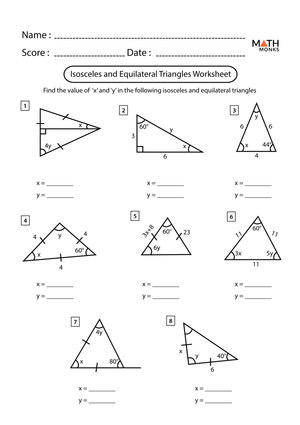
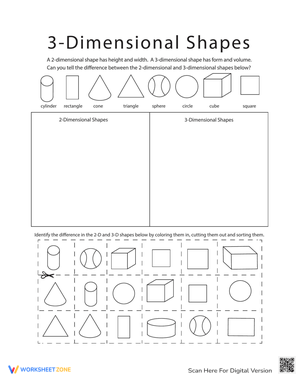
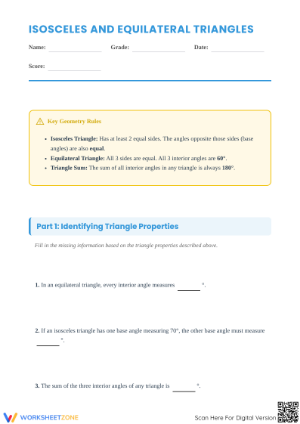
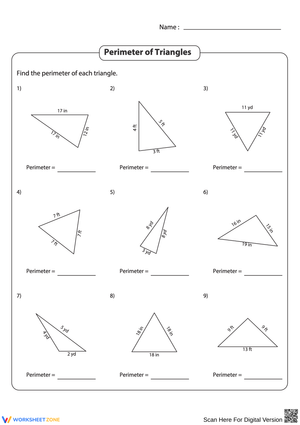
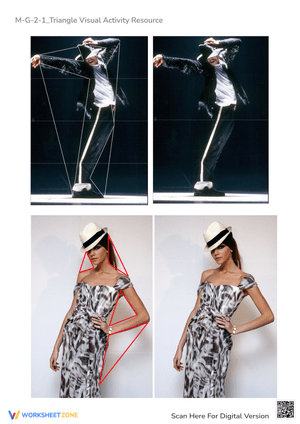
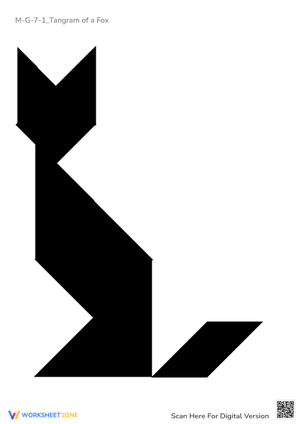
These 3rd grade triangles printable worksheets resources give third-grade teachers five task types that move students through the full arc of triangle instruction — from basic shape identification through attribute sorting, triangle counting, and independent drawing — without requiring new materials or extended setup time. Each worksheet is ready to drop into a lesson, a center, or a homework folder the same day.
The Specific Skills Each Worksheet Targets
The 3rd grade triangles printable worksheets set addresses the single most common gap in early geometry instruction: students who recognize one familiar-looking triangle and reject all others. Each worksheet is built around a different layer of triangle understanding, and together they move students from visual guessing toward attribute-based reasoning.
- Triangle vs. non-triangle identification: students circle or mark shapes that qualify, working through examples that are tilted, elongated, or unusually proportioned alongside deliberate non-examples
- Attribute sorting: students group shapes by side count and closure, building the vocabulary of sides and vertices through repeated decision-making rather than memorized definitions
- Counting triangles in a figure: careful observation tasks that reward attention to detail and work as short, self-contained practice students can start without a reminder
- Tracing, drawing, and labeling: production tasks where students show they understand the defining rules — not just recognize a familiar-looking shape
- Mixed-attribute comparison: students examine two visually different triangles and explain in writing what they share, targeting the categorical thinking 3.G.A.1 requires
Frequent Student Errors Worth Watching For
The most predictable mistake at this grade is what teachers sometimes call the prototype problem. Students decide whether a shape is a triangle based on resemblance to the equilateral example they first encountered — typically a neat, symmetrical shape sitting flat on its base. Show a very wide, nearly flat triangle and many third graders will reject it; rotate that same shape 45 degrees and the objections increase. The identification worksheets address this directly by including tilted and non-standard triangles among the answer choices, making it harder for students to rely on visual memory alone.
A second error surfaces with open figures — three line segments that nearly meet but don't quite close. Students who count three sides will often mark that shape as a triangle without noticing the gap. This is the exact boundary the standard draws: a triangle is a closed shape. Building one open-figure non-example into every sorting task surfaces that confusion early. The sentence-frame response prompts on the drawing worksheets are especially useful here — a student who writes "it has 3 sides" and stops has not yet internalized closure as a required attribute, and that gap is visible on the worksheet before the lesson ends.
Fitting These Worksheets Into Your Weekly Lesson Plans
The identification and sorting worksheets fit naturally into the 10–12 minutes of guided or independent practice that follows a direct-instruction opening. A sequence that works: show two or three shapes on the board — at least one tilted triangle, one standard non-example like a rectangle, and one open three-sided figure — then release students to the identification worksheet. Check responses together before moving to the sorting or drawing task. That progression distributes the cognitive load across the lesson rather than front-loading all the new information at once.
For math centers, the sorting and counting worksheets work without teacher proximity because the directions are self-contained. Students can start and finish each worksheet independently, which makes them reliable during small-group reteaching when a teacher's attention needs to stay with a handful of students.
The drawing and labeling worksheet is the strongest exit ticket in the set. A student who draws two triangles that look genuinely different from each other — one narrow and tilted, one wide and flat — and correctly labels the sides and vertices has demonstrated the conceptual understanding the standard targets. A student who draws the same equilateral triangle twice, just at different sizes, has not. That distinction is easy to spot in a quick scan of the class set and worth noting before the next geometry lesson.
Standard Alignment
These worksheets address CCSS Math 3.G.A.1, which asks students to understand that shapes in different categories may share attributes, and that a shared attribute can define a larger category. The standard names triangles and quadrilaterals explicitly as classification targets, and it is one of two geometry standards students encounter in Grade 3 — meaning this is not enrichment material but the core geometry work of the year. The non-example tasks are not decorative; they are where 3.G.A.1 shows up most clearly in student reasoning. When a student explains why an open three-sided figure is not a triangle, or why a rotated triangle still qualifies, that is the attribute-based classification the standard describes.
Differentiating the Set Across Ability Levels
Students who need more support should start with the identification worksheets before moving to sorting or drawing. Reducing the field to four or five shapes and adding a sentence frame — "This is a triangle because it has ___ sides and is ___" — removes the language barrier without changing the geometric focus. Tracing before drawing matters here: production is harder than recognition, and keeping the initial demand manageable leaves more attention available for the attribute itself.
On-level students work through the identification and sorting worksheets without modification. The built-in writing prompts give teachers sufficient evidence to assess understanding without a separate tool. For students ready for a challenge, the comparison worksheet is the right entry point: ask them to draw three triangles that look as different from each other as possible, then explain in two sentences what makes all three the same shape. That constraint — maximize visual difference, then argue for sameness — targets exactly the categorical thinking the standard demands. The 3rd grade triangles printable worksheets set does not require different materials across levels, just different entry points and different expectations for the written response.
Frequently Asked Questions
Do these worksheets cover triangle types like equilateral, isosceles, or scalene?
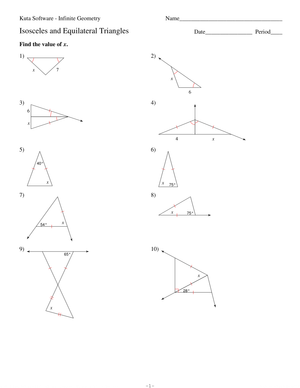
No — the focus stays on the two defining attributes every third grader needs: three straight sides and a closed shape. Classifying triangles by side length or angle measure is a middle-grades task. Keeping the worksheets within the scope of 3.G.A.1 means students are not pulled past the standard before they have a firm grip on the foundational definition.
How long does each worksheet take to complete?
Most students finish each worksheet in eight to twelve minutes. The drawing and comparison worksheets run a few minutes longer when students engage with the written explanation prompt. That range makes each worksheet workable as a warm-up, a center rotation, or a quick formative check at the end of a lesson.
Are these worksheets useful for intervention groups?
The identification and sorting worksheets work well in small-group intervention because the visual format reduces verbal demands and the task is concrete enough to prompt out-loud discussion. A group can sort shapes together, argue about the tricky non-examples, and then record individual answers — a sequence that gives the teacher useful observation data in real time. For that purpose, these 3rd grade triangles printable worksheets resources hold up better in intervention than open-ended drawing tasks, which place more language production demand on students who are still building geometric vocabulary.













 Interactive Worksheet Maker
 Quiz Maker
 Word Search Maker
 Crossword Puzzle Maker
 Word Scramble Generator
 Sentence Scramble Generator
 Handwriting Worksheet Generator
 Name Tracing Generator
 Fill In The Blank Generator




 BACK TOSCHOOL