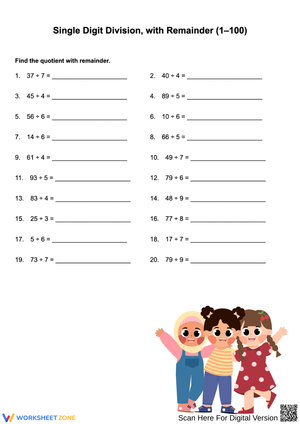
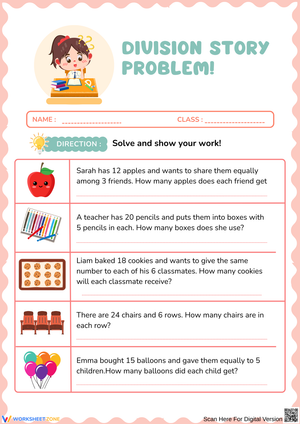
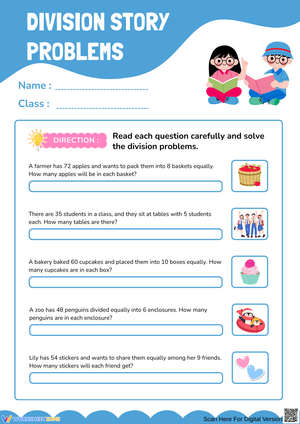
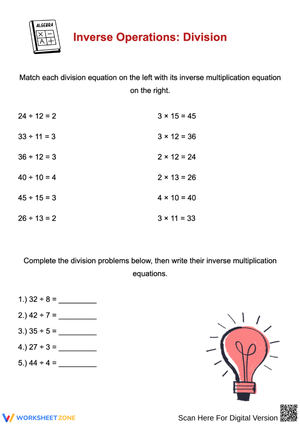
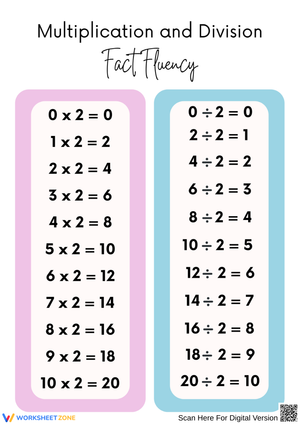
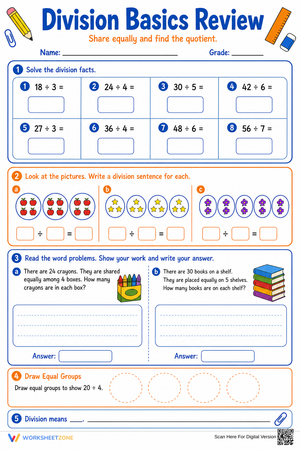
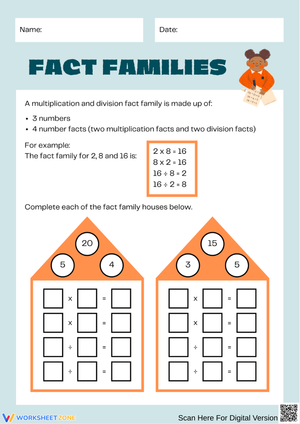
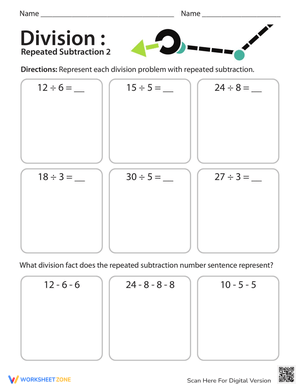
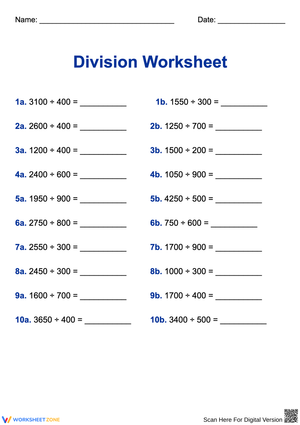
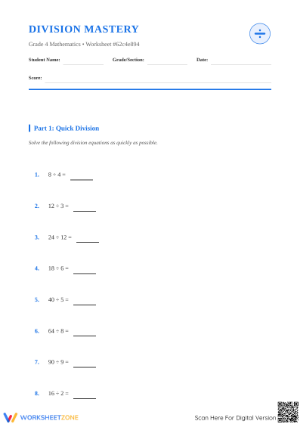
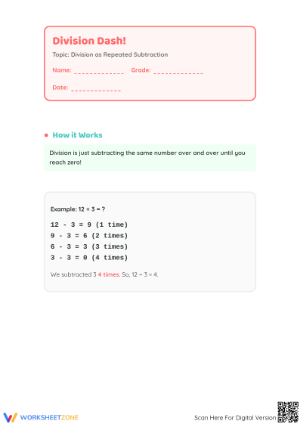
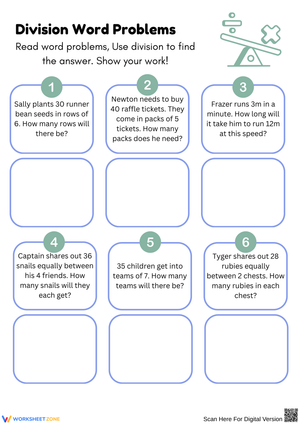
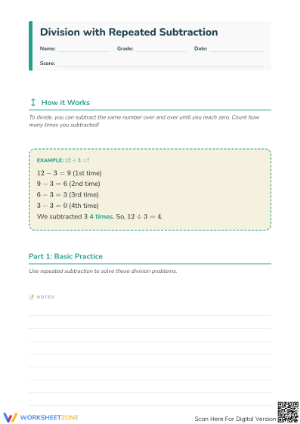
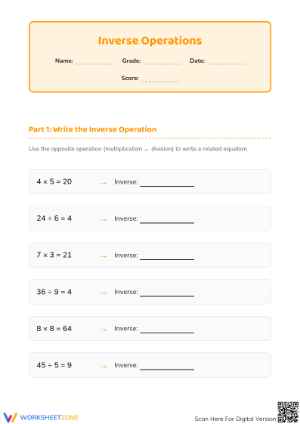
These division printable worksheets for 3rd grade give teachers a ready set of practice resources for the moment students move from counters and cubes to pencil-and-paper work with the division symbol — a transition that tends to expose exactly which students understand equal groups conceptually and which are pattern-matching without meaning.
What Students Practice Across the Set
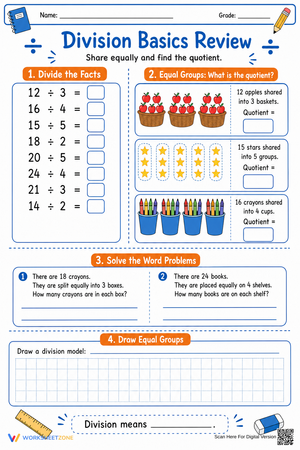
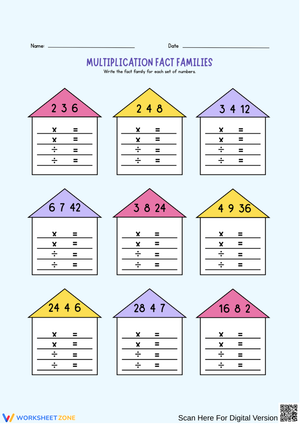
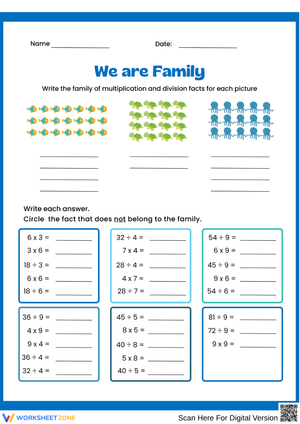
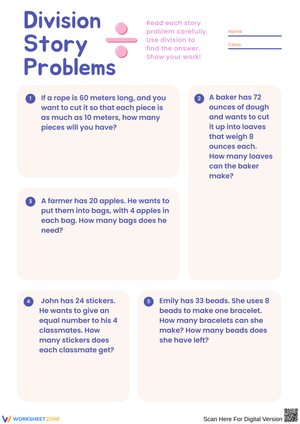
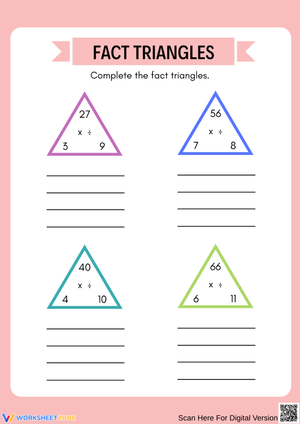
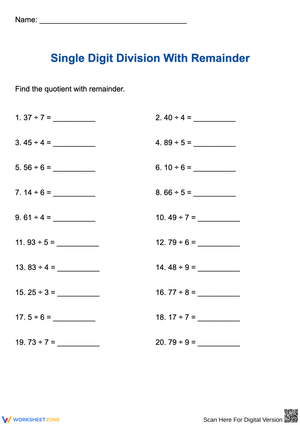
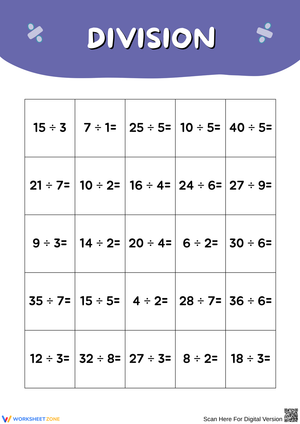
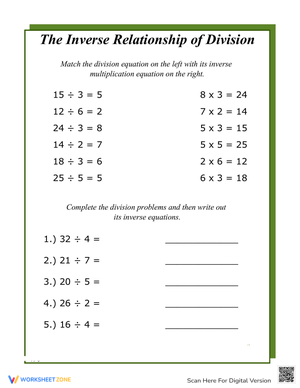
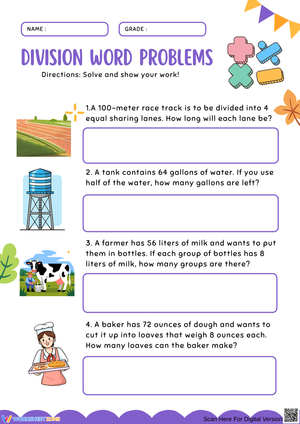
Each worksheet targets one of the core entry points into division at this grade level. The set covers equal-groups problems where students draw circles to represent groups and mark dots inside them, arrays where students identify the quotient by reading rows or columns, and fact-family exercises that ask students to write all four related equations from a single set of three numbers. Word problems appear throughout, split between partitive scenarios — a total shared among a known number of groups — and measurement scenarios where students determine how many groups of a known size can be made.
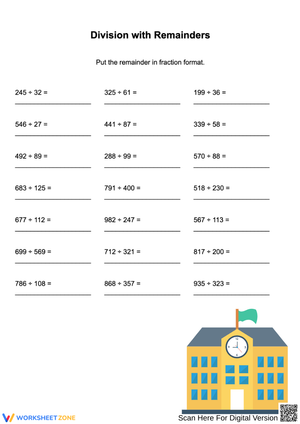
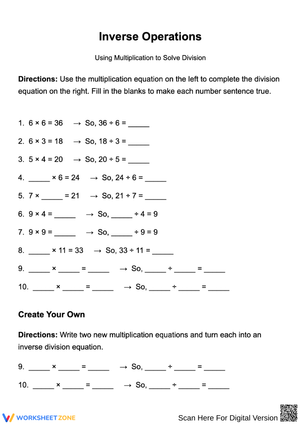
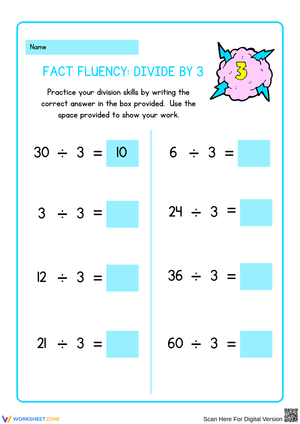
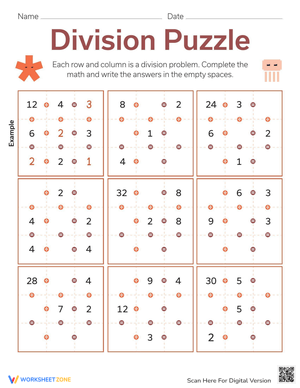
Missing-number equations, like 24 ÷ __ = 6, show up in the later worksheets. These push students to think flexibly rather than executing a fixed procedure every time. Students also practice relating the division sign to the fraction bar, which plants early groundwork for the fractions work that follows later in the year.
Frequent Mistakes to Catch Before They Harden
The error that surfaces most persistently looks like a calculation mistake but is actually a conceptual one. A student who knows 3 × 6 = 18 will write 18 ÷ 3 = 3, pulling the divisor back out as the answer. They are retrieving the multiplication fact correctly but misidentifying which part of it answers the question. Asking that student to read the equation as a sentence — "18 split into 3 groups, how many in each group?" — almost always produces the correction without any arithmetic reteaching needed.
A second trouble spot is the distinction between the two types of division situations. When a problem says "24 cookies, 4 cookies per bag, how many bags?" students who have only seen fair-share models stall. They recognize division is involved but cannot find the entry point. The word problems in the set deliberately alternate between both types, which surfaces this confusion early enough to address before the unit assessment.
Students working with arrays also tend to count total cells rather than cells in one row. They arrive at the product as their answer and cannot understand why it is marked wrong. Pointing to a single row and asking "how many are in just this row?" usually redirects them in seconds — the array is already drawn correctly, they just need help reading it.
How to Build These Worksheets Into Your Division Unit
The equal-groups worksheets work well before you introduce the ÷ symbol formally. Students draw, count, and record their findings in words — "3 groups of 5" — and only then see the equation that matches what they drew. Running this sequence for two or three days means the symbol carries meaning when it arrives, rather than landing as an abstraction students have to decode from scratch.
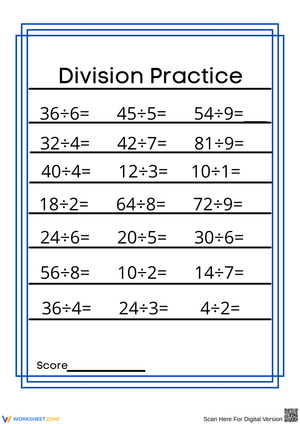
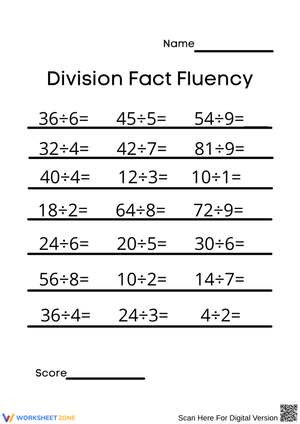
The fact-family worksheets are strong material for the ten minutes after morning meeting when students need a settled, focused task before direct instruction begins. Four fact families, eight equations — most third graders finish in about seven minutes, which leaves time to review two or three answers as a class before the lesson starts. These division printable worksheets for 3rd grade also hold up well as Friday review after a multiplication week, since putting × and ÷ side by side reinforces the inverse relationship while both operations are still fresh. Word-problem worksheets are most useful mid-unit, after students have the procedural basics but before fluency is solid. At that stage, the language demand in word problems does real work — it forces students to slow down and identify what they know versus what they are finding.
Standard Alignment
3.OA.A.2 calls on students to interpret whole-number quotients as the number of objects in each share or the number of equal shares. The equal-groups and array worksheets address that standard directly, giving students repeated practice with both interpretations rather than defaulting to one. 3.OA.B.6 asks students to understand division as an unknown-factor problem — knowing that 8 ÷ 4 = __ is equivalent to asking what 4 × __ = 8. The fact-family worksheets and missing-number equations target this standard, and most teachers position them alongside multiplication review in the unit sequence precisely because the two standards reinforce each other when taught together.
Adapting the Set for a Range of Learners
For students who are still uncertain with basic facts, the equal-groups and array worksheets provide a concrete way in. They can draw, count, and verify without having to retrieve a memorized fact, and the visual structure of those worksheets gives slower processors space to work without the pressure of a dense computation page.
Students with solid fact fluency can move directly to the missing-number and word-problem worksheets, where the challenge shifts to flexible thinking and reading comprehension rather than basic recall. For the highest-achieving students, pairing two related word problems and asking them to write a third that fits the same structure extends the work without requiring a separate resource. These division printable worksheets for 3rd grade carry enough range across the set that most classrooms can assign different starting points without printing separate materials for each group.
Frequently Asked Questions
When in the year do these worksheets fit best?
Most third-grade pacing guides place division in the third or fourth unit, after students have built multiplication fluency. That timing matters because the fact-family worksheets depend on students already knowing their × facts reasonably well. If multiplication fluency is not yet established, expect to spend extra time on the fact-family pages and prioritize the equal-groups and array worksheets first.
Do students need hands-on experience before working with the worksheets?
Not as a strict requirement, but the transition goes better when students have used counters or cubes for at least a few lessons first. A student who has physically distributed 15 objects into 3 groups before seeing the ÷ symbol reads the equal-groups worksheets very differently from one encountering the concept for the first time on paper. Two to three concrete lessons before the first worksheet in the set is a reasonable baseline.
How do these worksheets support formative assessment?
The most useful formative data from these division printable worksheets for 3rd grade comes from error patterns on the fact-family and missing-number worksheets, not from computation scores alone. A student who consistently writes 18 ÷ 3 = 3 is showing a specific conceptual gap that a correct score on the equal-groups worksheet can easily obscure. Collecting one fact-family worksheet mid-unit and sorting papers by error type takes about ten minutes and reveals almost exactly which students need a reteach on the divisor-quotient distinction before the end-of-unit assessment.













 Interactive Worksheet Maker
 Quiz Maker
 Word Search Maker
 Crossword Puzzle Maker
 Word Scramble Generator
 Sentence Scramble Generator
 Handwriting Worksheet Generator
 Name Tracing Generator
 Fill In The Blank Generator