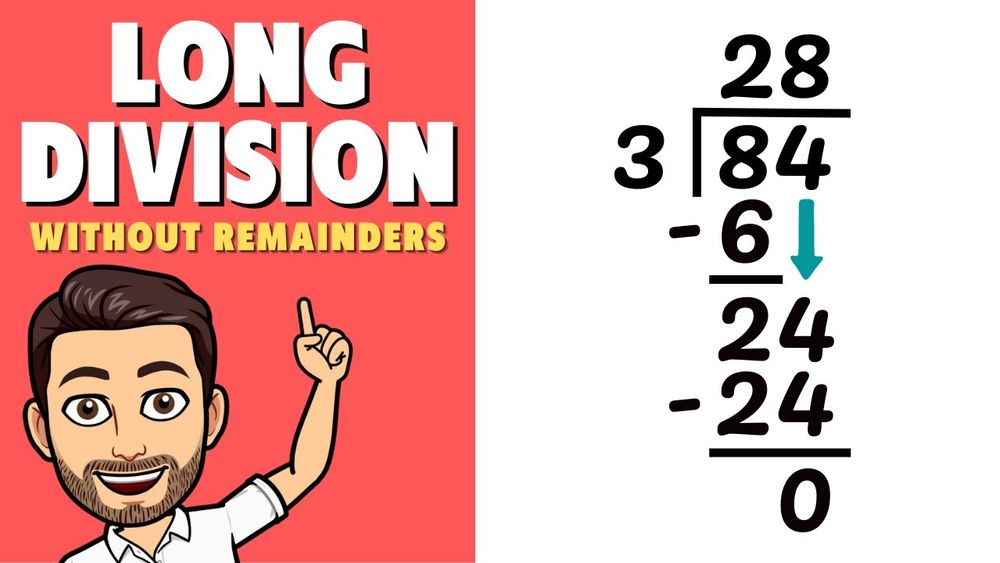
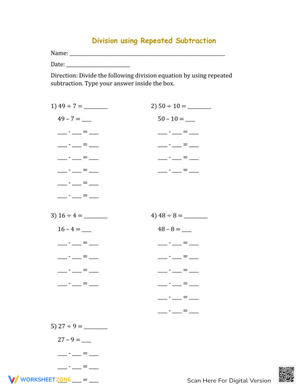
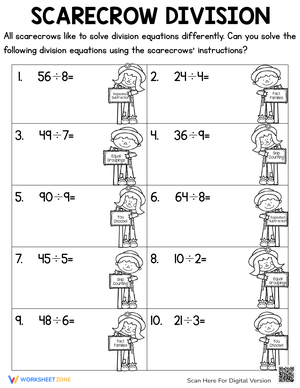
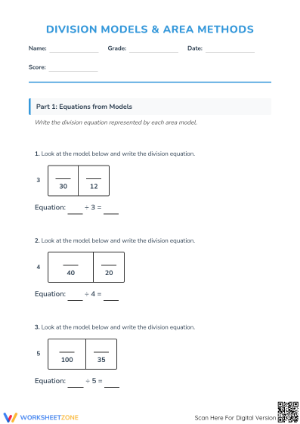
These division strategies printable worksheets for 3rd grade put four concrete methods in students' hands — equal groups, arrays, repeated subtraction, and fact families — at exactly the point in the year when students have multiplication facts in memory but haven't yet learned to run them backward. Each worksheet targets one strategy, so teachers can introduce methods one at a time and confirm genuine understanding before moving on.
The Four Methods and What Each Worksheet Asks Students to Do
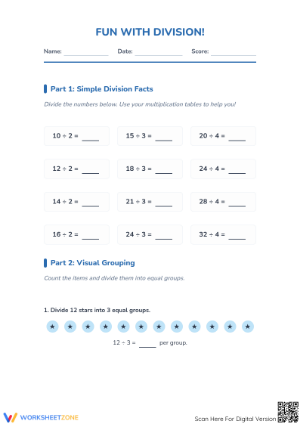
The equal-groups worksheets show a dividend at the top and a row of empty circles below it. Students draw items one by one into each circle until the total is distributed, then record the quotient. This sounds straightforward, but watch what happens when students hit a divisor they're less comfortable with — they start distributing unevenly, placing three items in the first circle and two in the second, losing the fair-share logic entirely. The worksheet's structure catches that early: there's no room to fudge it when each circle must be filled equally before moving on.
Array worksheets ask students to shade rows on a pre-drawn grid to match a division equation, then write the related multiplication sentence underneath. The explicit pairing is deliberate. A student who solves 18 ÷ 3 by shading six columns immediately sees 3 × 6 = 18 staring back at them. That back-and-forth between the two operations is one of the most important conceptual moves in third-grade math, and the worksheet makes it visible rather than telling students to "remember" the connection.
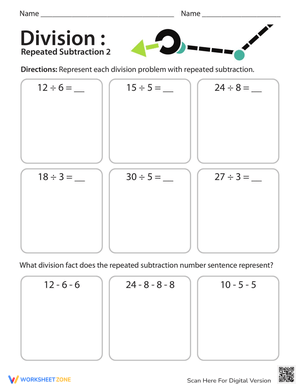
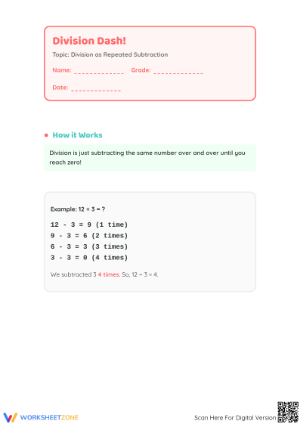
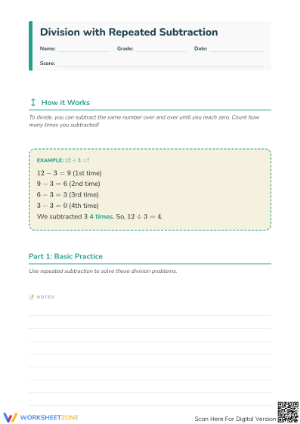
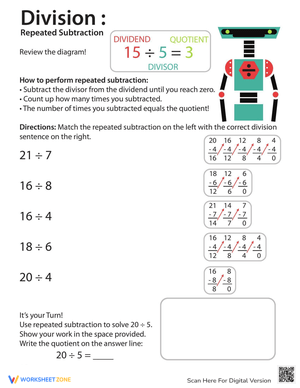
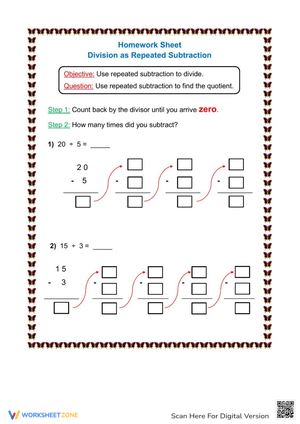
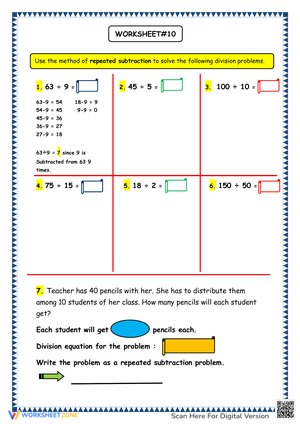
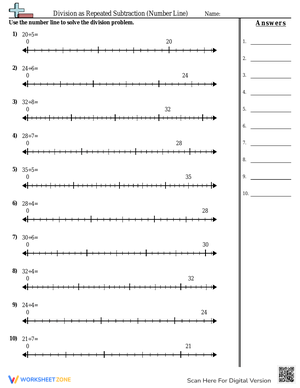
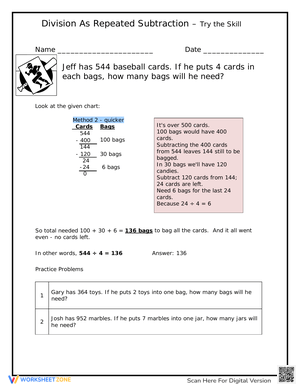
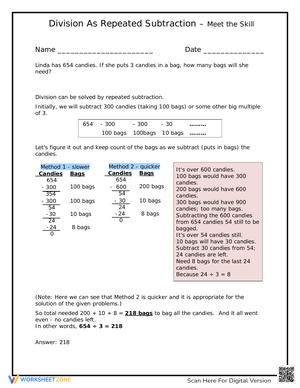
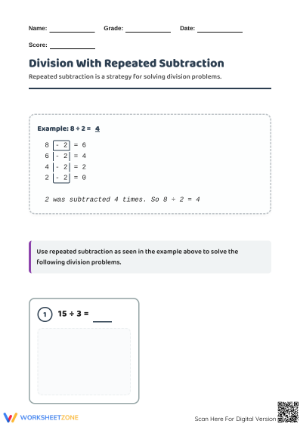
Repeated subtraction worksheets give students a starting value and a divisor and ask them to record each step: 20 − 5 = 15, 15 − 5 = 10, and so on, counting the steps at the end. This method is slower than the others, but it belongs in the set. For students who need to see division as a process rather than a fact to retrieve, it's the right entry point. Number line worksheets work the same logic spatially — students mark backward jumps of equal size from the dividend to zero, then count the jumps.
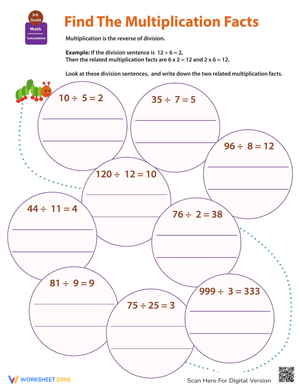
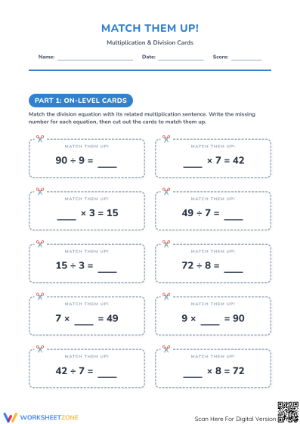
Fact family worksheets use a triangle format: three numbers sit at the vertices, and students fill in all four related equations around the outside. It's a low-stakes entry point for students who freeze when the division symbol appears on its own, because the multiplication side of the family gives them a way in without requiring full procedural fluency yet.
Errors Worth Catching Before They Calcify
The most persistent error across all four methods is quotient-group confusion — students produce the right number but write 3 ÷ 12 = 4 instead of 12 ÷ 3 = 4. They've got the correct value but wrong placement for every term in the equation. This isn't carelessness; it signals that students haven't yet internalized what the divisor represents versus what the dividend represents. The equal-groups worksheets address this directly by keeping the dividend visually prominent at the top and the divisor as the count of circles below — the spatial layout mirrors the equation structure.
On number line worksheets, students fairly often make jumps forward instead of backward, especially when they've just come from a unit where "more jumps" meant moving right. A brief class discussion before the first number line worksheet — asking which direction you'd move if you were taking equal groups away — saves a lot of crossed-out work and saves students from practicing the error repeatedly.
With fact family worksheets, the error to watch is students writing the same equation twice: they list 4 × 3 = 12 and 3 × 4 = 12 and stop there, missing both division sentences. They read the triangle as a multiplication prompt. Shading the two division vertices on a sample triangle before distributing the worksheets draws attention to the difference before pencils go down.
Building These Worksheets Into Your Lesson Plans
The set works well as a Monday introduction and a Friday consolidation within the same week. Introduce equal groups on Monday with counters on student desks, then send home the equal-groups worksheet that evening. By Wednesday, when you move to arrays, students already have one strategy documented and can compare it to the new one. The division strategies printable worksheets for 3rd grade are sequenced to support this kind of deliberate pacing — you don't have to teach all four methods in a single lesson to use the set effectively.
For small-group rotations, the fact family worksheet works well at the independent station and the number line worksheet belongs in the teacher-led group. Number line work generates questions — students want to know what to do when they can't land exactly on zero — and those questions are worth handling in a guided setting rather than letting them stall independent work time. The eight minutes before a lunch transition, when there isn't time to start something new, is a reliable slot for a single-strategy worksheet as a quick formative check. The results tell you exactly who needs a five-minute re-teach the following morning.
Adapting the Set for Different Learners
For students still building number sense below grade level, keep them on equal-groups and number line worksheets longer than the pacing guide suggests. Both methods ask students to represent each step visually, so you can see precisely where their thinking breaks down. A student who distributes items correctly through the first three circles and then stops is showing you something different from one who deals items randomly from the start — and that distinction shapes the next instructional conversation. The diagnostic clarity is worth the extra time.
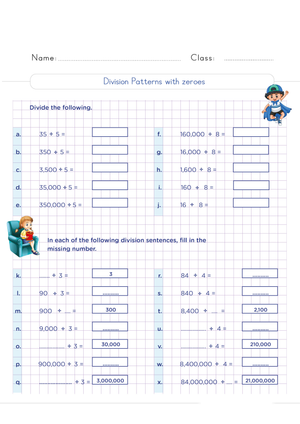
Students who arrive already fluent with basic facts often find equal-groups drawing tedious. Redirect them to the fact family worksheets with larger dividends, or ask them to write a word problem that matches a given array. The division strategies printable worksheets for 3rd grade extend naturally to higher number ranges — the same worksheet structure applies at 9 × 7 = 63 without any modification, so students working ahead of the standard stay in the same format while working with more demanding numbers.
For students with processing difficulties, the array worksheet is often the most accessible because the grid does the spatial organizing for them. The structure removes the decision about how to arrange the groups, which reduces cognitive load without removing the mathematical demand of finding the missing dimension.
Standard Alignment
These worksheets address 3.OA.A.2 — interpreting whole-number quotients as the number of objects in each share or the number of equal shares — and 3.OA.C.7, which targets fluency with multiplication and division within 100 using strategies and properties of operations. Standard 3.OA.A.2 typically lands in the first half of the school year, alongside equal-groups and array work that makes the concept visual before students are expected to produce answers from memory. The 3.OA.C.7 fluency work, including fact families, usually appears in the second half once students have spent time on the conceptual side.
Frequently Asked Questions
Can these worksheets be used before students have memorized their multiplication facts?
Yes. The equal-groups, array, and number line worksheets don't require fact memorization — they build toward it. Students who are still drawing and counting items in circles are doing valid, grade-appropriate mathematical work. The fact family worksheets are the exception: they move more efficiently when students can retrieve at least partial facts, so those are better placed in the middle or end of a division unit rather than at the start.
How are the worksheets sequenced within the set?
The intended sequence moves from concrete to abstract: equal groups first, then arrays, then repeated subtraction and number lines together, then fact families as a fluency-building bridge. Each worksheet targets one method, so teachers can move through the sequence at their own pace rather than feeling locked into a single-lesson delivery.
Do the word problems use realistic third-grade contexts?
Several of the division strategies printable worksheets for 3rd grade include word problems alongside procedural practice. The scenarios use classroom-sized quantities — groups of students, rows of chairs, snacks divided among friends — rather than abstract large numbers. This keeps problems within a range where students can sanity-check their answers against lived experience, which matters when the concept is still new and students haven't yet developed the number sense to recognize an obviously wrong quotient.
How do these worksheets function as formative assessment?
Because each worksheet isolates one strategy, a student's errors are easy to trace. A pile of repeated-subtraction worksheets where students stop one step too early tells you something specific about where those students' understanding breaks down — and it tells you that after two minutes of looking, not after a lengthy scoring process. That's the kind of quick read that shapes Tuesday's lesson on Monday evening.













 Interactive Worksheet Maker
 Quiz Maker
 Word Search Maker
 Crossword Puzzle Maker
 Word Scramble Generator
 Sentence Scramble Generator
 Handwriting Worksheet Generator
 Name Tracing Generator
 Fill In The Blank Generator