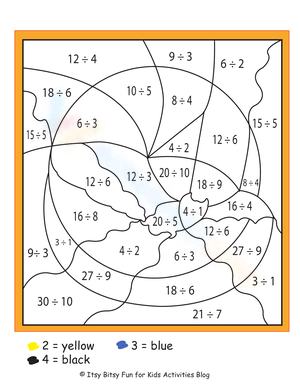
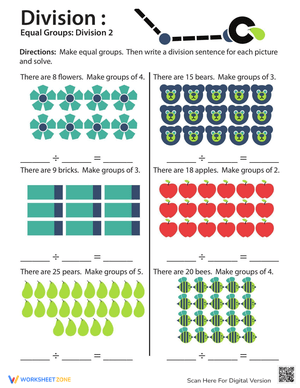
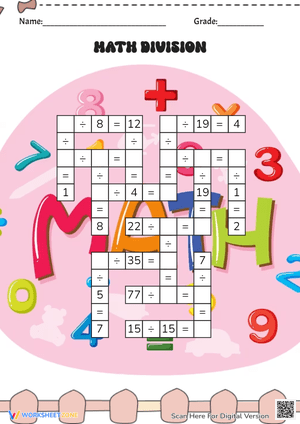
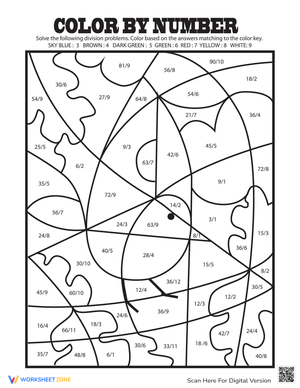
These 3rd grade division facts printable worksheets give teachers a clear instructional path from equal-groups models through fluent fact recall — a span that typically covers several weeks in a Grade 3 unit. The set covers divisors 1 through 10, moving from picture-based tasks to symbolic equations and then to mixed practice. Each worksheet addresses a specific skill so teachers can assign them deliberately rather than defaulting to whatever comes next in the sequence.
What's Inside the Set
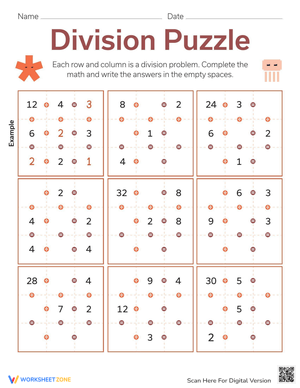
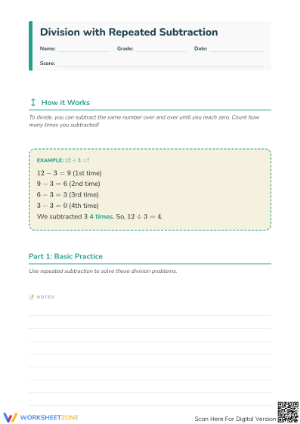
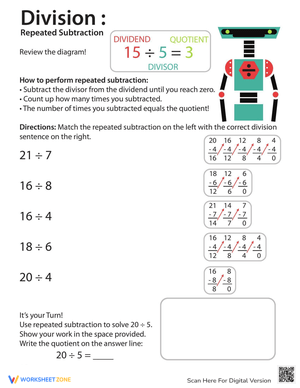
The 3rd grade division facts printable worksheets in this set span seven distinct task types, each placed in the learning sequence for a purpose rather than for variety alone.
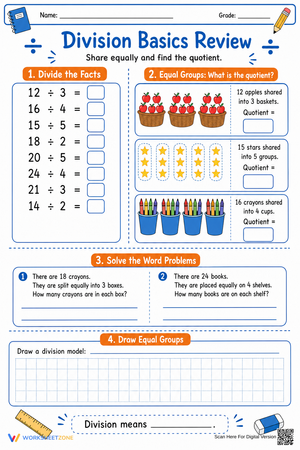
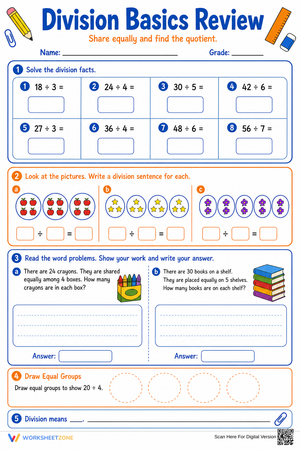
- Equal groups and sharing: Students distribute objects into sets and record how many are in each group, connecting a physical action to a written division sentence.
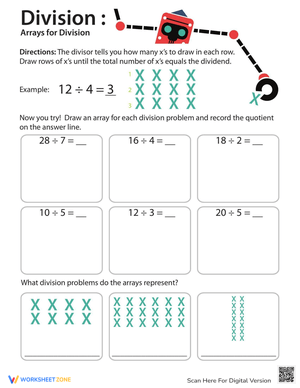
- Array tasks: Rectangular arrangements make the inverse relationship between multiplication and division visible before students work with numbers alone.
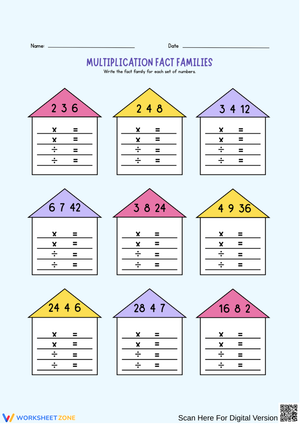
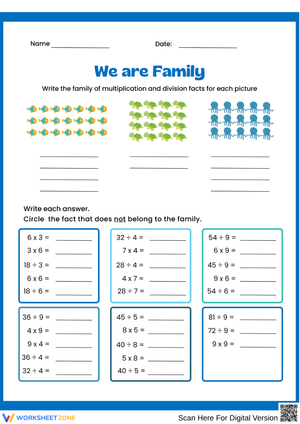
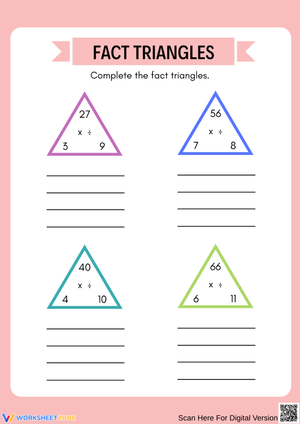
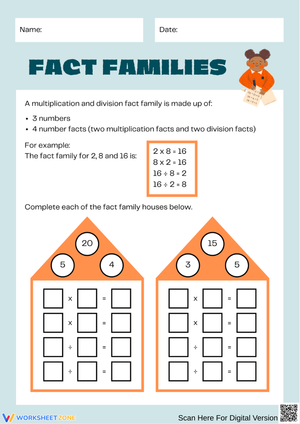
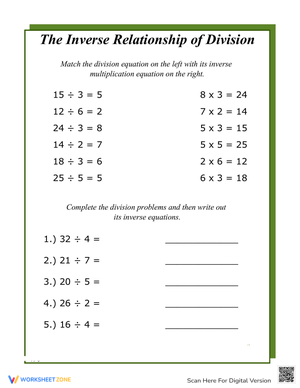
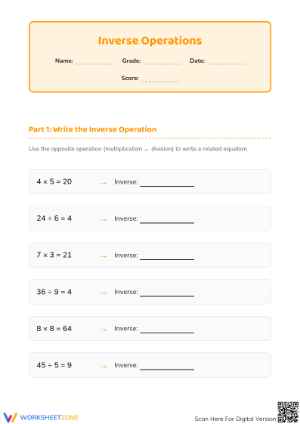
- Fact families: Students write one multiplication sentence and two related division sentences from a single set of three numbers — 4 × 6 = 24, 24 ÷ 6 = 4, and 24 ÷ 4 = 6 all from the same triangle of values.
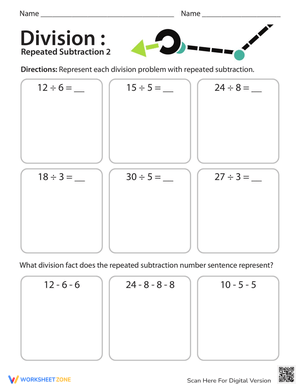
- Missing-number equations: Problems such as 24 ÷ __ = 4 require reasoning rather than retrieval, which surfaces gaps that bare-fact drills miss entirely.
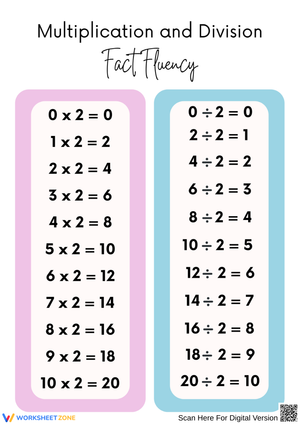
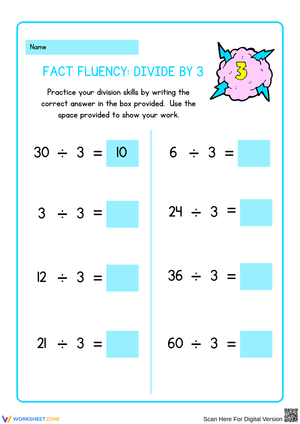
- Single-divisor practice: Short worksheets focused on one divisor at a time let teachers concentrate practice on the facts students are currently learning.
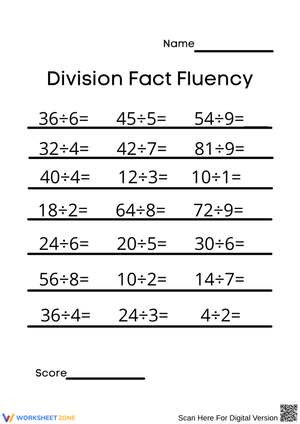
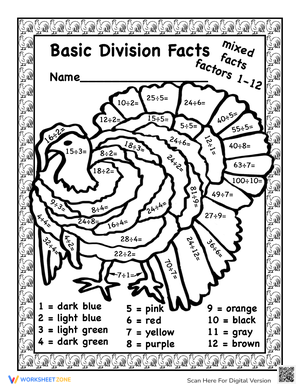
- Mixed review: Later worksheets combine multiple divisors so teachers can check whether fluency holds across the whole fact range.
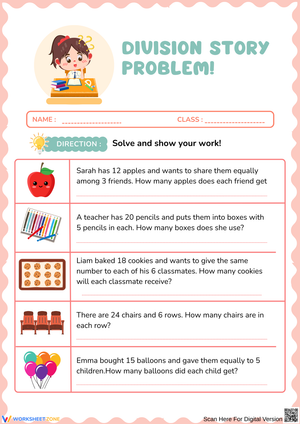
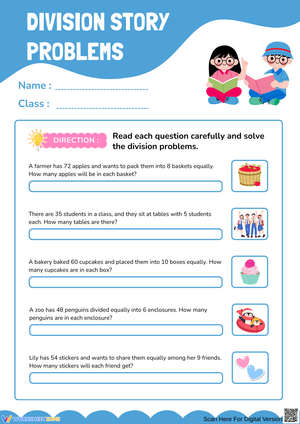
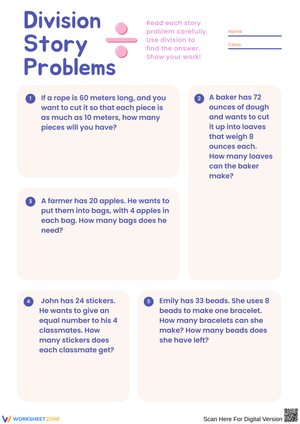
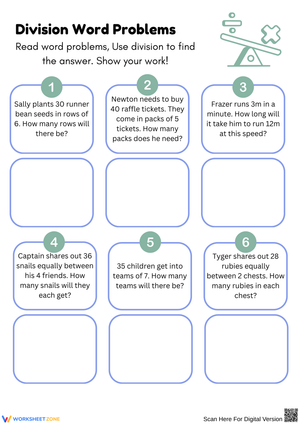
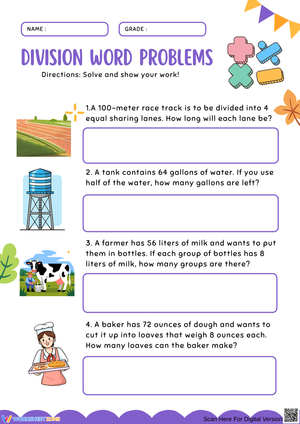
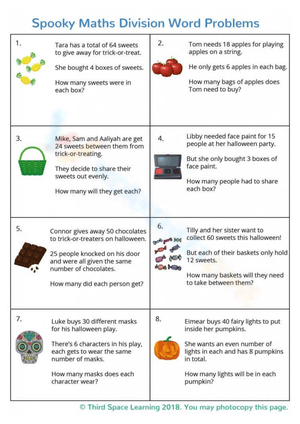
- Word problems: Brief one- and two-sentence contexts test whether students can apply division meaning rather than pattern-match to a format.
Student Errors Worth Watching For and Addressing Early
The most consistent error in early division is quotient-divisor confusion. A student who solves 12 ÷ 3 = 4 correctly with counters in front of them will frequently write 12 ÷ 3 = 3 on paper — they reach for the number they see rather than reason through the equal groups. This surfaces repeatedly on missing-number tasks: given 18 ÷ __ = 3, students write 18 instead of 6, filling the blank with the dividend because they are pattern-matching rather than thinking about what the question is actually asking.
The other error worth watching is the one-way fact relationship. Many students treat 24 ÷ 6 = 4 and 24 ÷ 4 = 6 as unrelated problems. They will get one right and the other wrong in the same sitting, even on the same fact family worksheet. The fix is not more repetition — it is requiring students to write both division sentences immediately after writing the multiplication sentence, not as separate exercises but as a single act. Fact family worksheets in this set follow that structure, which makes the relationship harder to overlook.
How to Build These Worksheets Into Your Weekly Math Block
The most effective approach is assigning each worksheet a single role in the lesson. A visual model worksheet works best at the lesson launch, paired with counters so students build the problem physically before recording it. That same day, a fact family worksheet fits naturally into centers, requiring no manipulatives and keeping students working independently. A short mixed-review worksheet at the end of the week serves as a fluency check: five minutes, eight problems, enough to see which divisors still need attention before the following Monday.
Monday morning is another reliable slot. A single-divisor worksheet — six to eight problems focused on, say, dividing by 4 — takes about five minutes and reactivates the previous week's work before the new lesson starts. That spaced-retrieval moment costs almost no instructional time but slows forgetting meaningfully. For intervention groups, pull a visual model worksheet and let students circle equal groups in pencil before writing equations. That extra motor step keeps the focus on meaning rather than answer-getting.
Standard Alignment
These worksheets align directly with CCSS 3.OA.A.2, which requires students to interpret whole-number quotients by reasoning about equal groups and sharing situations, and 3.OA.C.7, which calls for fluent recall of all products and quotients within 100. The progression from visual models through fact families and into mixed practice matches the instructional sequence these standards imply: build meaning first, then build speed. Teachers typically use the model-based worksheets during the conceptual phase of the division unit and shift to fluency worksheets in the final weeks, when recall accuracy becomes the instructional priority rather than understanding.
Adjusting the Worksheets for a Range of Learners
For students still working on the concept of equal groups, use model-based worksheets and allow them to draw circles around groups or place counters before recording an equation. Keeping the divisor constant — all problems dividing by 2, for instance — lowers the cognitive demand enough that the focus stays on what division means rather than on computation. These students should not move to missing-number tasks until they can correctly explain what the quotient represents in a sharing situation.
Students who have the concept but need fluency work benefit most from single-divisor practice worksheets used across several days. Repeated focused practice with a small fact set consolidates recall faster than jumping across divisors. For students already fluent with simpler divisors, mixed-review worksheets and word problems add productive challenge. Ask them to generate a full fact family starting only from a product — begin with 36 and write all four related sentences — which keeps them reasoning rather than just recalling.
The 3rd grade division facts printable worksheets in this set fall naturally into three instructional pathways: building the model through visual tasks, connecting multiplication to division through fact families, and developing fluency through mixed practice. Teachers can move students among pathways as understanding grows without changing the unit focus or preparing separate materials for each group.
Frequently Asked Questions
Which divisors should Grade 3 students learn first?
Start with divisors 2, 5, and 10, since students usually carry strong skip-counting patterns for those numbers from second grade. Divisors 3 and 4 come next, followed by 6 through 9. The single-divisor worksheets in this set are arranged to support that sequence, though teachers can reorder them to match their own pacing guide without losing the skill progression.
Can these worksheets work with students who are still shaky on multiplication?
Yes — the fact family worksheets prompt students to write the related multiplication sentence first, then derive both division sentences from it. That sequence turns a known multiplication fact into a retrieval cue rather than asking students to recall division facts independently. Students do not need multiplication fluency to use this set, but they do need some familiarity with equal-groups multiplication to access the fact family tasks meaningfully.
How do the word problem worksheets differ from the equation-only worksheets?
The word problem worksheets ask students to identify what is being divided and what the quotient actually represents — something bare equations do not test. A student can solve 18 ÷ 3 = 6 correctly without knowing whether 6 is the number of groups or the number in each group. Each word problem worksheet in this set includes both sharing situations and grouping situations, so teachers can see which interpretation gives their students trouble.
Are these worksheets suitable for homework?
Before sending any 3rd grade division facts printable worksheets home as homework, make sure students have practiced those divisors in class. Model-based worksheets travel home well because students can use household objects — coins, pasta, small blocks — as informal counters if they want to check their thinking. Fact family worksheets also work as homework since the structure is clear enough for families to follow without a math background. Save the mixed-review worksheets for in-class use until students have worked through all the divisors those sets include, since sending home unfamiliar facts tends to produce guessing rather than productive retrieval practice.













 Interactive Worksheet Maker
 Quiz Maker
 Word Search Maker
 Crossword Puzzle Maker
 Word Scramble Generator
 Sentence Scramble Generator
 Handwriting Worksheet Generator
 Name Tracing Generator
 Fill In The Blank Generator