


























0
Views
0
Downloads

Save
0 Likes
Share
Learn to Tell Time with Analog and Digital Clocks
0 Views
0 Downloads
Paste this activity's link or code into your existing LMS (Google Classroom, Canvas, Teams, Schoology, Moodle, etc.).
Students can open and work on the activity right away, with no student login required.
You'll still be able to track student progress and results from your teacher account.
Information
Description
What It Is:
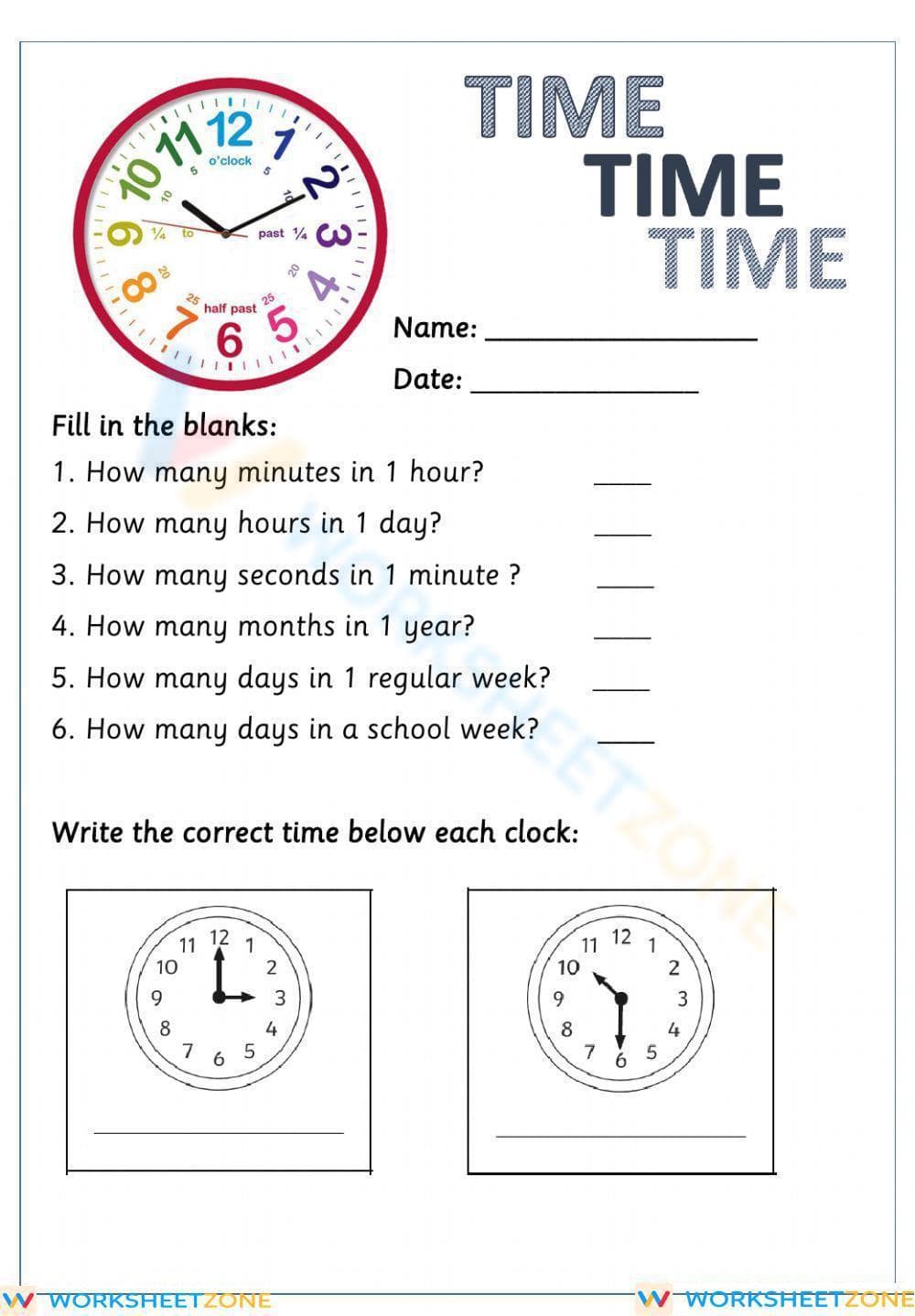
This is a worksheet focused on telling time and understanding basic time-related concepts. It includes fill-in-the-blank questions about minutes in an hour, hours in a day, seconds in a minute, months in a year, days in a week, and days in a school week. Additionally, it features two clock faces where students must write the correct time displayed. The worksheet also includes a colorful example clock with labeled minutes.
Grade Level Suitability:
This worksheet is suitable for 1st to 3rd grade students. The questions are basic time concepts appropriate for early elementary, and telling time from analog clocks is a common skill taught in these grades.
Why Use It:
This worksheet reinforces fundamental concepts of time measurement. It helps students learn the relationships between different units of time (minutes, hours, days, weeks, months, years) and practices their ability to read analog clocks. It provides a structured way to assess their understanding of time.
How to Use It:
First, have the student fill in the blanks with the correct answers to the time-related questions. Then, have them look at each clock face and write the corresponding time below it. The example clock at the top can be used as a reference.
Target Users:
The target users are elementary school students, specifically those in grades 1-3, who are learning about time and how to read analog clocks. It's also useful for students who need extra practice or review in these concepts.
This is a worksheet focused on telling time and understanding basic time-related concepts. It includes fill-in-the-blank questions about minutes in an hour, hours in a day, seconds in a minute, months in a year, days in a week, and days in a school week. Additionally, it features two clock faces where students must write the correct time displayed. The worksheet also includes a colorful example clock with labeled minutes.
Grade Level Suitability:
This worksheet is suitable for 1st to 3rd grade students. The questions are basic time concepts appropriate for early elementary, and telling time from analog clocks is a common skill taught in these grades.
Why Use It:
This worksheet reinforces fundamental concepts of time measurement. It helps students learn the relationships between different units of time (minutes, hours, days, weeks, months, years) and practices their ability to read analog clocks. It provides a structured way to assess their understanding of time.
How to Use It:
First, have the student fill in the blanks with the correct answers to the time-related questions. Then, have them look at each clock face and write the corresponding time below it. The example clock at the top can be used as a reference.
Target Users:
The target users are elementary school students, specifically those in grades 1-3, who are learning about time and how to read analog clocks. It's also useful for students who need extra practice or review in these concepts.


