


























Views
Downloads

Printable Telling Time to the Half Hour — Grade 2 Math
Paste this activity's link or code into your existing LMS (Google Classroom, Canvas, Teams, Schoology, Moodle, etc.).
Students can open and work on the activity right away, with no student login required.
You'll still be able to track student progress and results from your teacher account.
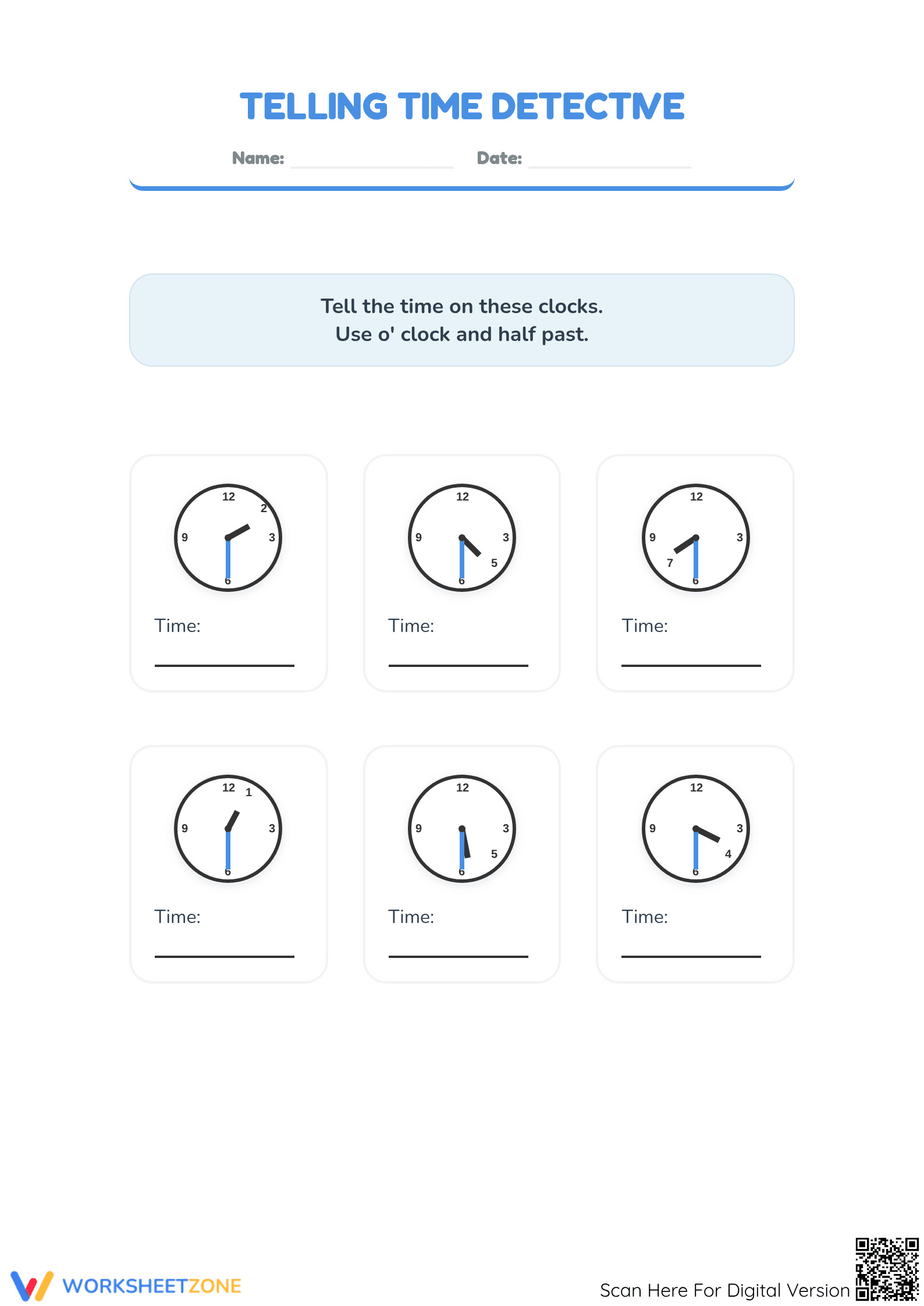
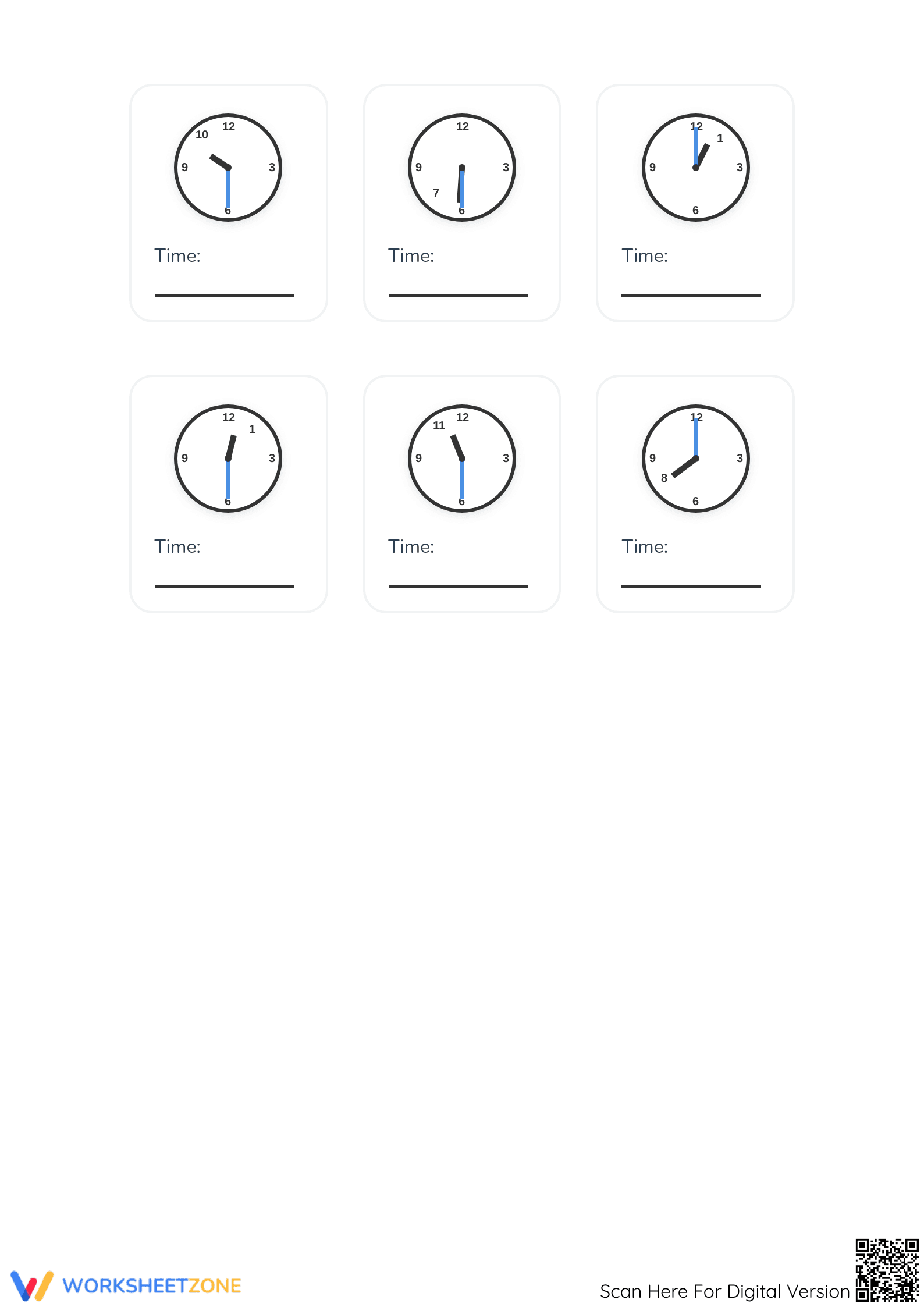
Help your students master the foundational skill of reading analog clocks with this "Telling Time Detective" activity. Students examine 12 distinct clock faces to identify times at the hour and half-hour intervals using traditional "o'clock" and "half past" terminology. This exercise bridges the gap between abstract time concepts and concrete visual recognition for elementary learners.
At a Glance
- Grade: 2 · Subject: Math
- Standard:
2.MD.C.7— Tell and write time from analog clocks to the nearest half-hour- Skill Focus: Hour and half-hour recognition
- Format: 2 pages · 12 problems · Answer key included · PDF
- Best For: Daily warm-up or quick skill check
- Time: 10–15 minutes
What's Inside
This comprehensive two-page PDF features 12 clear, large-format analog clock faces. Each clock is intentionally designed with the minute hand positioned exclusively at the 12 or 6 positions to reinforce "o'clock" and "half past" concepts. The layout includes spacious response lines labeled "Time:" for students to write their answers. A complete answer key is provided to ensure rapid grading and immediate student feedback.
Zero-Prep Workflow
Implementing this activity into your math block requires less than two minutes of teacher preparation. Simply print the two-page document and distribute it to your class; no additional manipulatives or setup are necessary. The clear instructions allow students to work independently, making this an ideal resource for substitute folders or emergency lesson plans. Reviewing the 12 answers as a group takes approximately five minutes.
Standards Alignment
The worksheet is primarily aligned with 2.MD.C.7, which requires students to tell and write time from analog and digital clocks. By focusing specifically on the hour and half-hour, it also supports the foundational requirements of Grade 1 measurement standards. Both standard codes can be copied directly into lesson plans, IEP goals, or district curriculum mapping tools to demonstrate clear alignment with state and national mathematics frameworks.
How to Use It
Use this worksheet as a formative assessment during your measurement and data unit. It is particularly effective after direct instruction on the function of the minute hand versus the hour hand. Alternatively, assign it as a "Morning Work" task to build fluency. Observe if students correctly position the hour hand between numbers when reading "half past" times, as this is a common point of confusion.
Who It's For
This resource is designed for Grade 2 students but serves as an excellent remediation tool for Grade 3 and 4 learners who need to strengthen their clock-reading fluency. The simple language and large visuals make it accessible for English Language Learners and students with IEP accommodations. It pairs naturally with physical Judy clocks or interactive whiteboard time-telling games.
Developing a robust understanding of analog time is a critical cognitive milestone in early elementary mathematics. According to research analyzed in the EdReports 2024 review of curriculum coherence, mastery of time-telling requires a synthesis of spatial reasoning and skip-counting skills. This worksheet facilitates that synthesis by isolating the hour and half-hour markers, allowing students to build confidence before moving toward five-minute increments. The 2.MD.C.7 standard emphasizes that students must move beyond mere identification to functional writing of time. By requiring students to use specific phrases like "half past," this resource reinforces the linguistic patterns associated with temporal awareness. This structured approach aligns with the "gradual release of responsibility" model advocated by Fisher & Frey (2014), providing a stable platform for independent practice. Educators can use the resulting data to identify specific misconceptions regarding hand placement, ensuring that every student achieves the fluency required for higher-level measurement tasks in subsequent grades.


