


























Views
Downloads



Essential Telling Time Quarter Hours Worksheet | Grade 2-4
Paste this activity's link or code into your existing LMS (Google Classroom, Canvas, Teams, Schoology, Moodle, etc.).
Students can open and work on the activity right away, with no student login required.
You'll still be able to track student progress and results from your teacher account.
Students develop fluency in reading analog clocks to the quarter-hour with this comprehensive five-page math resource. By identifying fifteen-minute intervals, learners bridge the gap between whole hours and precise timekeeping. This worksheet ensures children can confidently translate visual clock faces into digital formats, securing a vital life skill through structured, repetitive practice and multiple-choice verification.
At a Glance
- Grade: 2–4 · Subject: Math
- Standard:
2.MD.C.7— Tell and write time from analog and digital clocks to five minutes- Skill Focus: Quarter-hour time identification
- Format: 5 pages · 27 problems · Answer key included · PDF
- Best For: Independent math centers or homework
- Time: 20–30 minutes
What's Inside
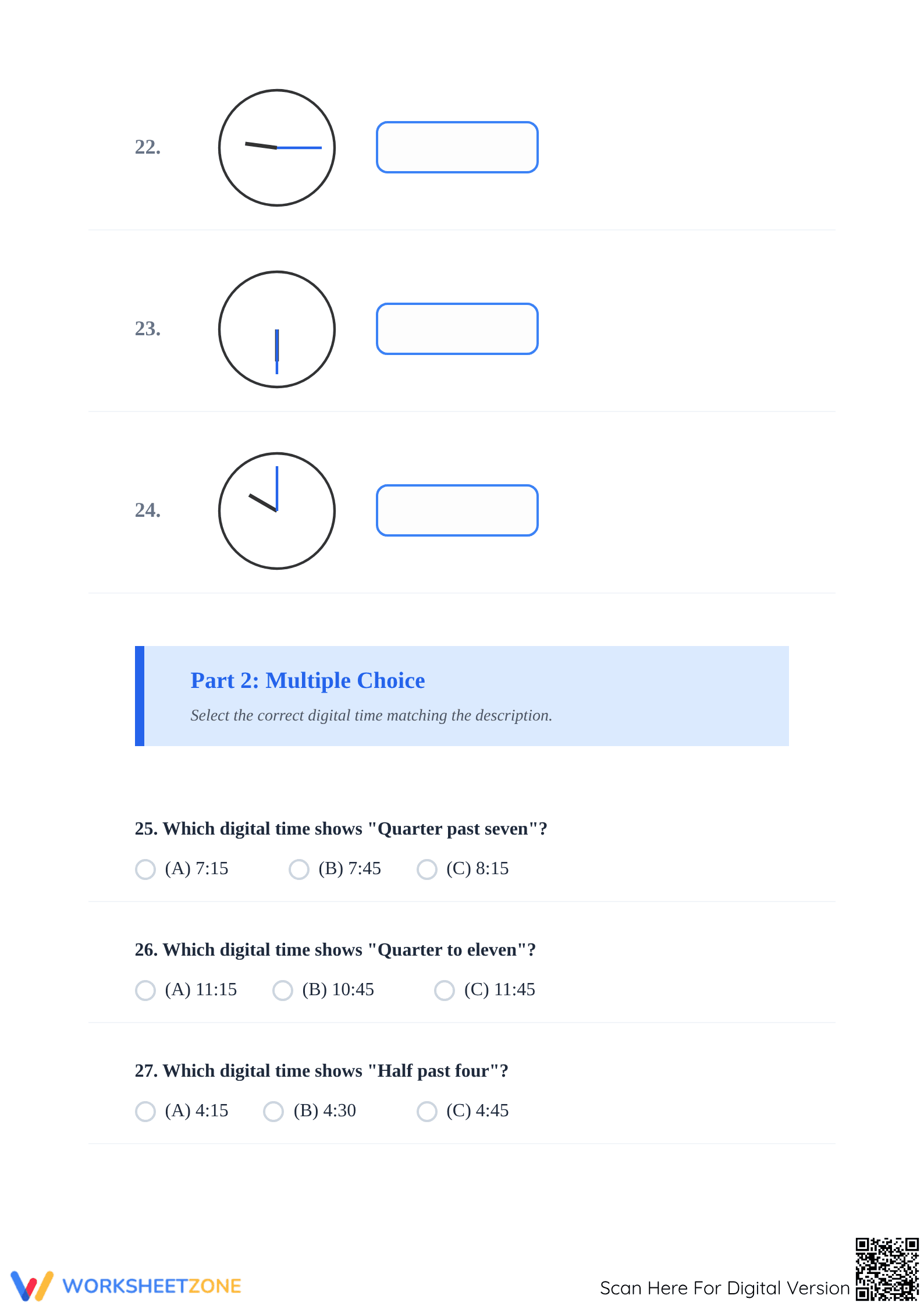
This 5-page PDF bundle contains 27 focused tasks designed to build mastery of quarter-hour increments. The first 24 problems present clear analog clock faces showing quarter-past, half-past, and quarter-to intervals, requiring students to write the corresponding digital time. The final page concludes with three multiple-choice questions that challenge students to match verbal descriptions, like "quarter to eleven," with digital numerical equivalents.
Zero-Prep Workflow
The zero-prep design allows teachers to implement this lesson in under two minutes. Simply print the five-page sequence and distribute it for an immediate independent practice session. Because the digital time boxes are clearly labeled and the multiple-choice section provides instant feedback, total review time is minimized. This layout makes it an ideal resource for emergency sub plans or quick formative assessments during math rotations.
Standards Alignment
This resource is primary aligned to 2.MD.C.7: "Tell and write time from analog and digital clocks to the nearest five minutes, using a.m. and p.m." It specifically targets the foundational quarter-hour benchmarks necessary for third and fourth-grade measurement standards. Both standard codes can be copied directly into lesson plans, IEP goals, or district curriculum mapping tools to ensure instructional compliance and tracking.
How to Use It
Use this worksheet during the "You Do" phase of a gradual release lesson on measurement and data. Teachers can observe students as they complete the first page to identify misconceptions regarding the "quarter-to" hour hand placement, which is a common stumbling block. The expected completion time is 20 to 30 minutes, making it a perfect transition activity between direct instruction and small-group rotations.
Who It's For
This practice set is designed for second-grade students introducing time, or third and fourth graders requiring remediation. It serves as a natural pairing for interactive clock manipulatives or a digital "Telling Time" passage. Differentiation is built into the repetitive structure, allowing struggling learners to find success with "half-past" before tackling the more complex "quarter-to" conceptual shifts.
Reading analog clocks remains a fundamental cognitive milestone that bridges spatial reasoning and numerical literacy. This Grade 2 Telling Time resource addresses the 2.MD.C.7 requirement for students to write time to the nearest five minutes. By focusing on quarter-hour intervals, the worksheet provides the scaffolding necessary for students to eventually master 1-minute precision. Research from Fisher & Frey (2014) emphasizes that scaffolded practice with clear visual cues—such as the analog faces provided here—improves long-term retention of measurement concepts. The inclusion of 27 varied tasks ensures that students move beyond simple memorization toward a functional understanding of temporal relationships. Analysts in the ScienceDirect TpT Analysis highlight that high-quality, zero-prep materials like this one reduce teacher burnout while maintaining high academic standards for student output. This PDF is a reliable tool for both general education classrooms and specialized instructional settings focusing on foundational math skills.


