




























Views
Downloads
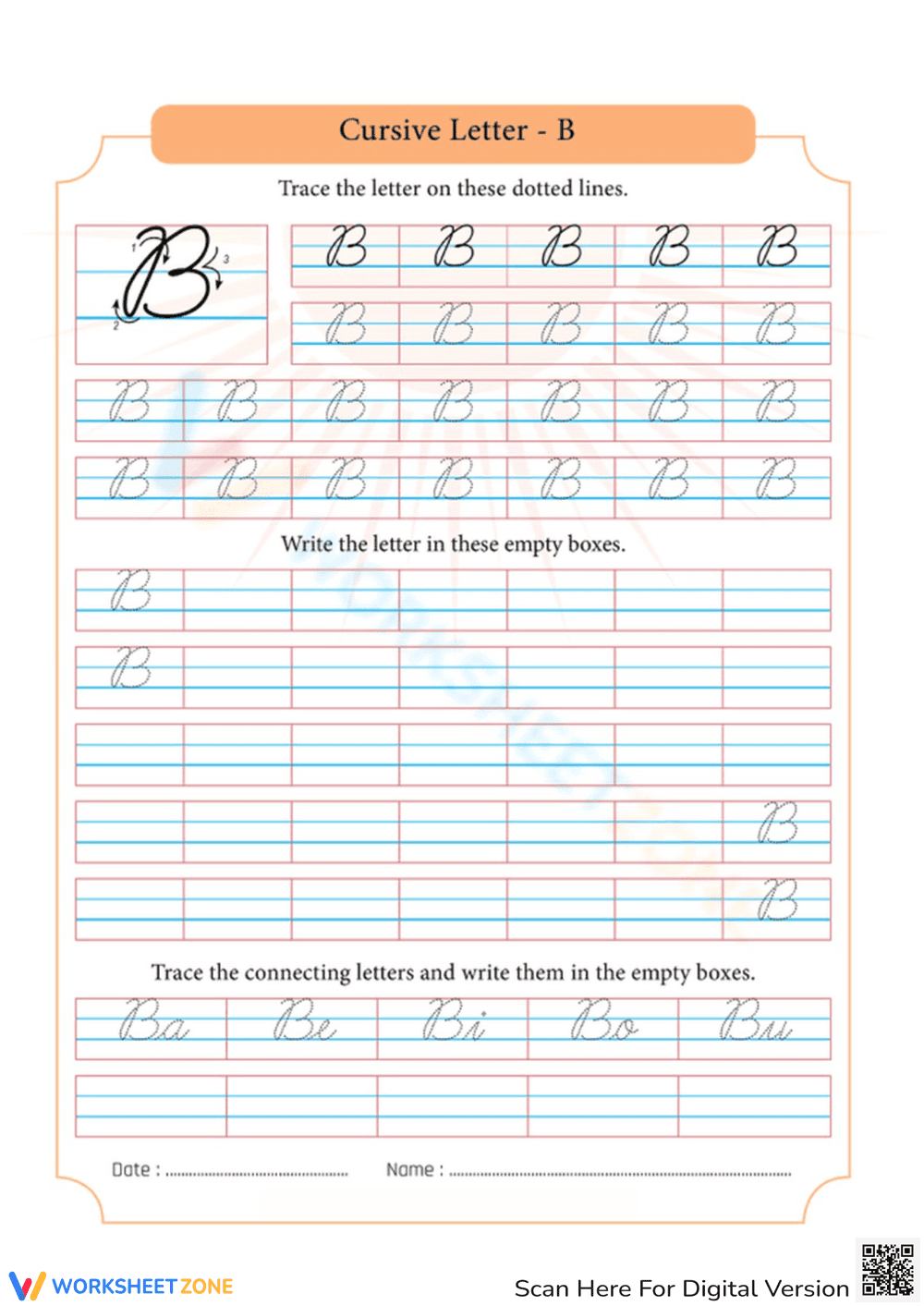

Grade 3 Cursive Letter B — Printable No-Prep Worksheet

Paste this activity's link or code into your existing LMS (Google Classroom, Canvas, Teams, Schoology, Moodle, etc.).
Students can open and work on the activity right away, with no student login required.
You'll still be able to track student progress and results from your teacher account.
This single-page handwriting worksheet provides focused practice for forming the cursive capital letter B. Students develop fine motor control and muscle memory through guided tracing and independent writing tasks. The structured layout ensures learners transition smoothly from isolated letter formation to connecting the uppercase B with vowels.
At a Glance
- Grade: 3 · Subject: ELA
- Standard:
CCSS.ELA-LITERACY.L.3.1— Write legibly using standard conventions and letter formations- Skill Focus: Cursive capital B formation
- Format: 1 page · 40 problems · No answer key needed · PDF
- Best For: Independent morning work
- Time: 10–15 minutes
The printable includes four practice sections to build handwriting fluency. It begins with a numbered directional guide showing the exact stroke sequence for the capital B. Students complete two rows of dotted-line tracing before moving to independent writing in empty grid boxes. The final section introduces letter connections, requiring students to trace and write syllables like Ba, Be, Bi, Bo, and Bu to practice continuous fluid motion.
This resource requires zero teacher preparation. Print (1 minute): Send the PDF to the copier for your class. Distribute (1 minute): Hand out the single-page sheets during morning arrival. Review (0 minutes): The visual stroke guides make the task self-explanatory for third graders, requiring no direct instruction. It serves perfectly as a reliable emergency sub plan or a quiet independent center activity while you work with small reading groups.
This handwriting practice aligns with CCSS.ELA-LITERACY.L.3.1, supporting students as they demonstrate command of the conventions of standard English when writing. While cursive is often a localized requirement, mastering fluid letter formation directly supports broader writing stamina and spelling automaticity. Both standard codes can be copied directly into lesson plans, IEP goals, or district curriculum mapping tools.
Deploy this worksheet during morning work to establish a calm, focused classroom environment right after the bell rings. Alternatively, use it as a dedicated handwriting station during literacy rotations. As students work, observe their pencil grip and stroke direction, ensuring they start the capital B from the top line rather than the bottom. Expect most third graders to complete the entire page within 10 to 15 minutes.
This resource is designed for second and third-grade students who are beginning their cursive instruction or need targeted remediation on specific letter formations. The heavy visual scaffolding makes it highly accessible for occupational therapy students working on fine motor goals. Pair this worksheet with a visual alphabet anchor chart displayed at the front of the room to reinforce standard letter proportions and slant.
Developing automaticity in handwriting is a critical foundational skill that directly impacts broader literacy outcomes across elementary grades. According to a comprehensive review by Fisher & Frey (2014), students who achieve fluency in letter formation can allocate significantly more cognitive resources to higher-order tasks like drafting complex sentences, organizing their thoughts, and focusing on content rather than mechanics. This worksheet targets that exact automaticity by providing structured, repetitive practice with the cursive capital B. By aligning with CCSS.ELA-LITERACY.L.3.1, the activity ensures students write legibly using standard conventions and letter formations. The deliberate progression from tracing directional arrows to executing independent letter connections builds the precise muscle memory required for efficient written communication. Consistent practice with these targeted handwriting exercises reduces cognitive load during extended writing assignments, ultimately supporting overall academic achievement and building student confidence in their written expression.


