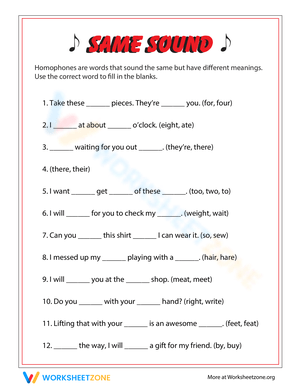
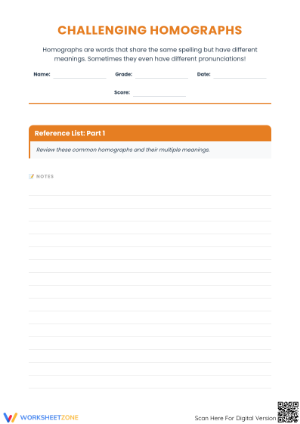
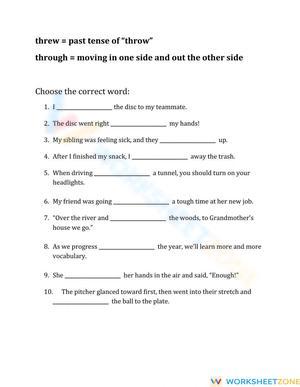
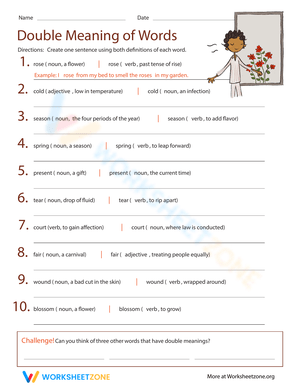
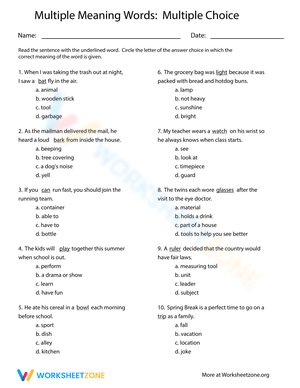
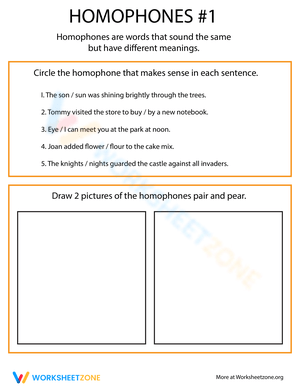
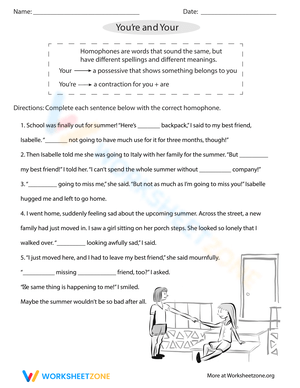
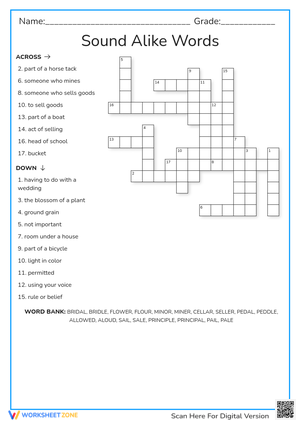
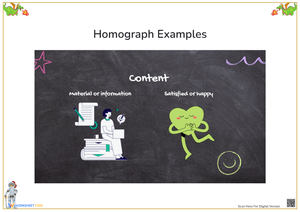
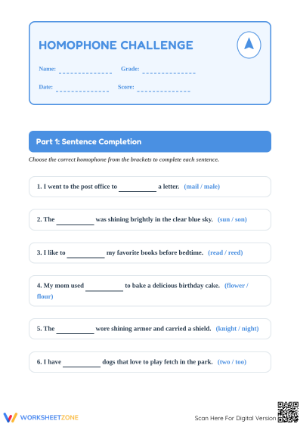
These 3rd grade homophones and homographs printable worksheets give teachers a targeted set of practice materials for one of the vocabulary concepts that trips students up most in the middle elementary grades — words that sound identical but spell differently, and words that look exactly the same on the page but carry unrelated meanings that only context can sort out.
The Specific Skills Each Worksheet Targets
Each worksheet works one distinction at a time rather than mixing homophone and homograph practice in the same activity. That separation matters. Students who can reliably sort "their," "there," and "they're" by meaning often freeze when asked to suddenly handle "bat" as a mammal versus a piece of equipment — the cognitive demands are different, and conflating them inside one worksheet produces confusion rather than clarity.
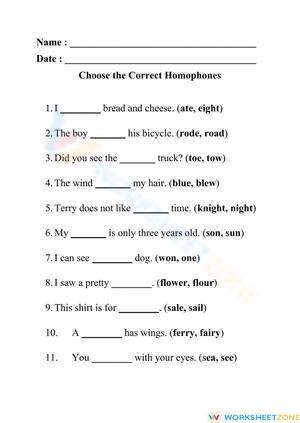
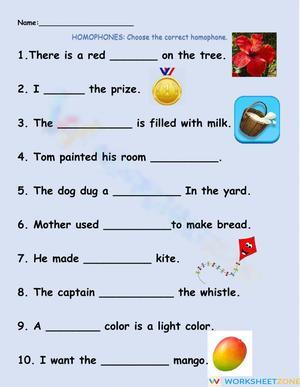
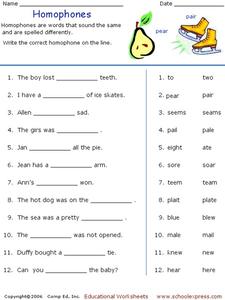
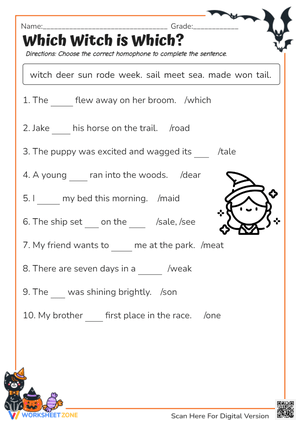
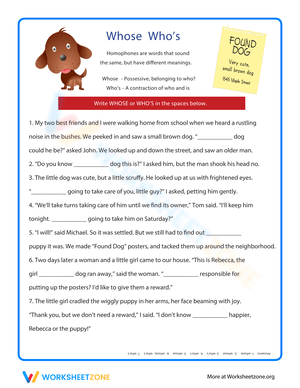
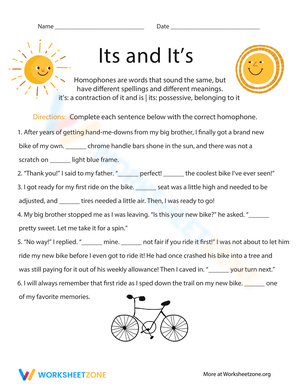
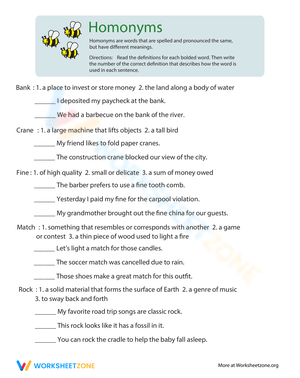
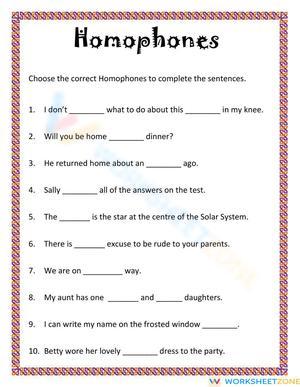
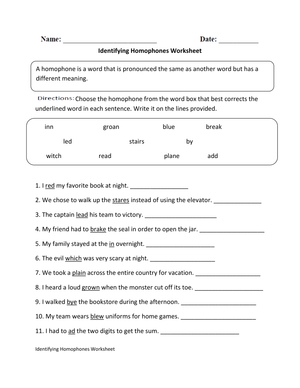
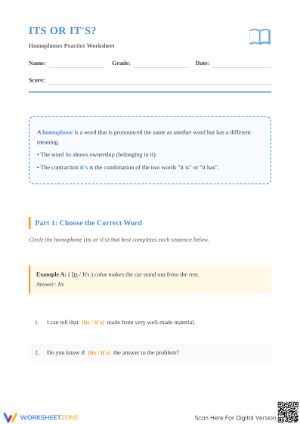
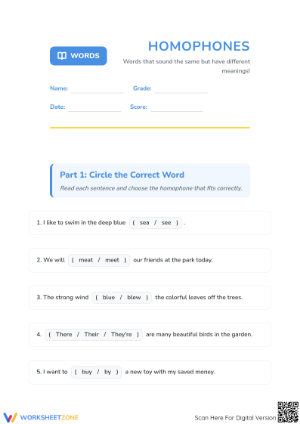
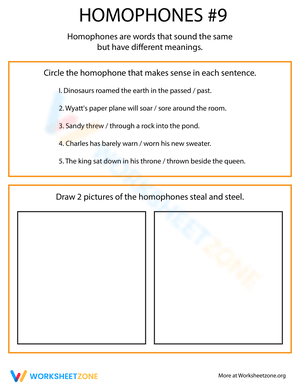
The homophones worksheets ask students to underline the correct word from a pair inside complete sentences, fill in blanks within short passages where a wrong choice changes the meaning entirely, and rewrite sentences that already contain an error. Several worksheets target three-way sets like "to/too/two" and "write/right/rite" because those require students to hold more options in mind simultaneously — a harder task than a simple binary choice.
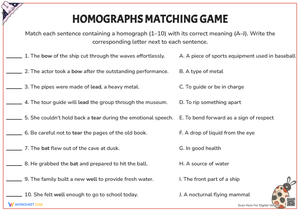
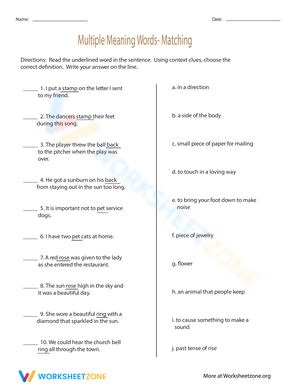
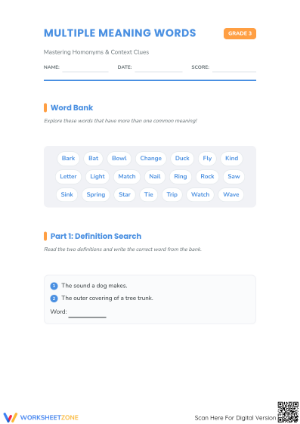
The homographs worksheets shift the approach. Students annotate sentences by marking which meaning of a word is active in context, write two original sentences using the same word to demonstrate two distinct meanings, and work through definition-matching before encountering the same words inside brief reading passages. Words like "spring," "wave," "object," and "lead" appear across multiple activities so students build familiarity through repeated exposure in different sentence contexts rather than meeting each word only once.
Student Errors Worth Knowing Before You Teach This Set
For homophones, the errors that appear most consistently in third-grade writing aren't always the expected ones. Students who have been corrected on "to/too/two" since first grade usually handle those pairs adequately. The persistent trouble spots are "passed/past" and "which/witch." "Passed/past" is especially stubborn: students write "I past the school on my way home" and the sentence looks correct to them — both spellings feel plausible, and neither one triggers the internal alarm that "they're" versus "their" does. That specific pair is worth a direct lesson before students pick up any worksheet in the set.
For homographs, the consistent issue is premature pronunciation. During oral reading, students assign a word its most familiar meaning before finishing the sentence. A student who reads "The wind wound around the tower" will often plow straight through without pausing — they decided how to say "wind" before they had enough context to choose correctly. The activities in these worksheets require students to write out which meaning applies before moving on, which interrupts that habit in a way that simply reading aloud does not.
Building These Worksheets Into Your Teaching Week
The most reliable entry point is the Monday warm-up, specifically the 8–10 minutes before morning meeting ends. One homophone worksheet presented as a quick whole-class activity — projected on the board, students writing answers on whiteboards — gives the teacher an immediate read on who already has the concept before any formal lesson begins. That kind of fast formative check is harder to get from a center activity alone, where you're circulating and can only see a few students at once.
For small-group instruction, the homographs worksheets pair well with guided reading. When a group is working through a text that contains a homograph they've already encountered on a worksheet — "bark," "saw," "spring" — stop and ask which meaning is active. The recognition is often visible on students' faces. Students who practiced annotating context clues on the worksheet transfer that habit into live reading more readily than students who only heard the concept explained.
These 3rd grade homophones and homographs printable worksheets also hold up as Friday consolidation materials during the last block of the week, when launching new instruction rarely makes sense but reinforcing the week's vocabulary work does. A cloze-format homophone worksheet where students fill in a short story is low-stakes but still produces usable information about where errors persist heading into the following week.
Standard Alignment
These worksheets address CCSS.ELA-LITERACY.L.3.4 — "Determine or clarify the meaning of unknown and multiple-meaning words and phrases based on grade 3 reading and content, choosing flexibly from a range of strategies." Within that standard, homographs sit directly under the multiple-meaning words expectation, while homophones connect to context-dependent word choice in writing. In practical classroom terms, L.3.4 shows up in both reading groups and writing conferences — it's one of the few Language strand standards that surfaces in daily instruction rather than only during a dedicated vocabulary block, which makes consistent, low-prep practice tools genuinely useful.
Adjusting the Set for a Range of Learners
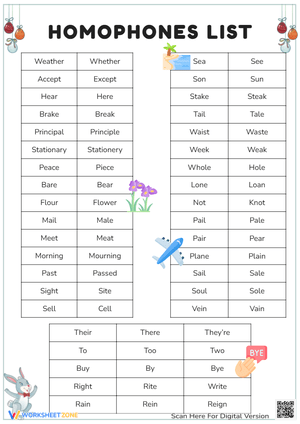
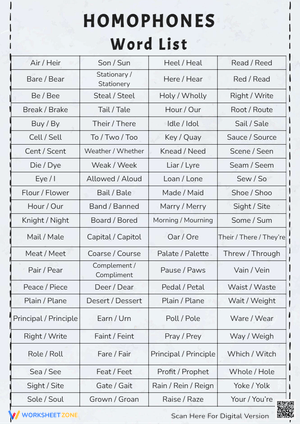
Students who need more support benefit from working with homophones before homographs, and from having a reference list nearby — not a completed answer key, but a list of the word pairs covered in whichever worksheet they're using. The goal is to reduce memory load so attention stays on meaning rather than retrieval. A student struggling to remember whether "heel" or "heal" refers to a body part isn't practicing context clues; they're practicing recall under stress, which is a different skill entirely.
Students who are ready for more challenge do well with the original-sentence tasks on the homographs worksheets. Asking them to write one sentence per meaning of "object" or "row" — then swap with a partner to see whether the partner can identify which meaning is intended — adds a layer of metacognitive work without requiring a separate enrichment packet. For heteronyms specifically (homographs that change pronunciation, like "tear" and "live"), students who are still shaky can hear sentence pairs read aloud before attempting the written activity, which keeps the pronunciation issue from blocking the meaning work.
Frequently Asked Questions
How do I explain the difference between a homophone and a homograph to a third grader without making it more confusing?
The word parts do most of the work: phone means sound (like telephone) and graph means writing (like autograph or photograph). Tell students a homophone has the same sound — close your eyes and you can't tell them apart. A homograph has the same writing — you see one word but it holds two completely different meanings. Most third graders lock onto that distinction quickly once they connect the roots to words they already know, and it gives them a self-correction strategy they can use independently.
Which word pairs are worth prioritizing at this grade level?
For homophones, the pairs that appear most often in grade-level reading and come up most in student writing errors are their/there/they're, your/you're, its/it's, to/too/two, passed/past, and hear/here. For homographs, the words students encounter most in third-grade chapter books are bat, bark, wave, spring, saw, and light. Starting with high-frequency words gives instruction the most immediate payoff because students meet the same words again within days in their independent reading.
Can these worksheets work as a pre-assessment before starting a unit?
These 3rd grade homophones and homographs printable worksheets work well as a pre-assessment precisely because they ask students to apply understanding rather than recognize a definition from a list. The fill-in and sentence-correction formats show clearly whether a student can already distinguish "passed" from "past" in context, or whether they're choosing homophones by habit rather than by meaning. Running one worksheet from each category before instruction begins takes about 10 minutes and gives the teacher a real baseline — including which specific pairs need direct attention and which students already have solid footing.
Do these worksheets include heteronyms — homographs that change pronunciation?
Several worksheets in the set include heteronyms such as lead (the metal vs. to guide), tear (to rip vs. a drop from the eye), and wind (air movement vs. to turn or coil). The activities present these inside sentence context and ask students to mark the correct pronunciation and meaning before writing. That detail is worth noting because it is exactly where 3rd grade homophones and homographs printable worksheets resources most often fall short — many cover only same-pronunciation homographs and skip heteronyms entirely, leaving a gap that students then hit in oral reading.












 Interactive Worksheet Maker
 Quiz Maker
 Word Search Maker
 Crossword Puzzle Maker
 Word Scramble Generator
 Sentence Scramble Generator
 Handwriting Worksheet Generator
 Name Tracing Generator
 Fill In The Blank Generator