


























0
Views
0
Downloads

0.0
0
Save
0 Likes
Share
Multiple Meanings: Which Definition?
0 Views
0 Downloads
Paste this activity's link or code into your existing LMS (Google Classroom, Canvas, Teams, Schoology, Moodle, etc.).
Students can open and work on the activity right away, with no student login required.
You'll still be able to track student progress and results from your teacher account.
Information
Description
What It Is:
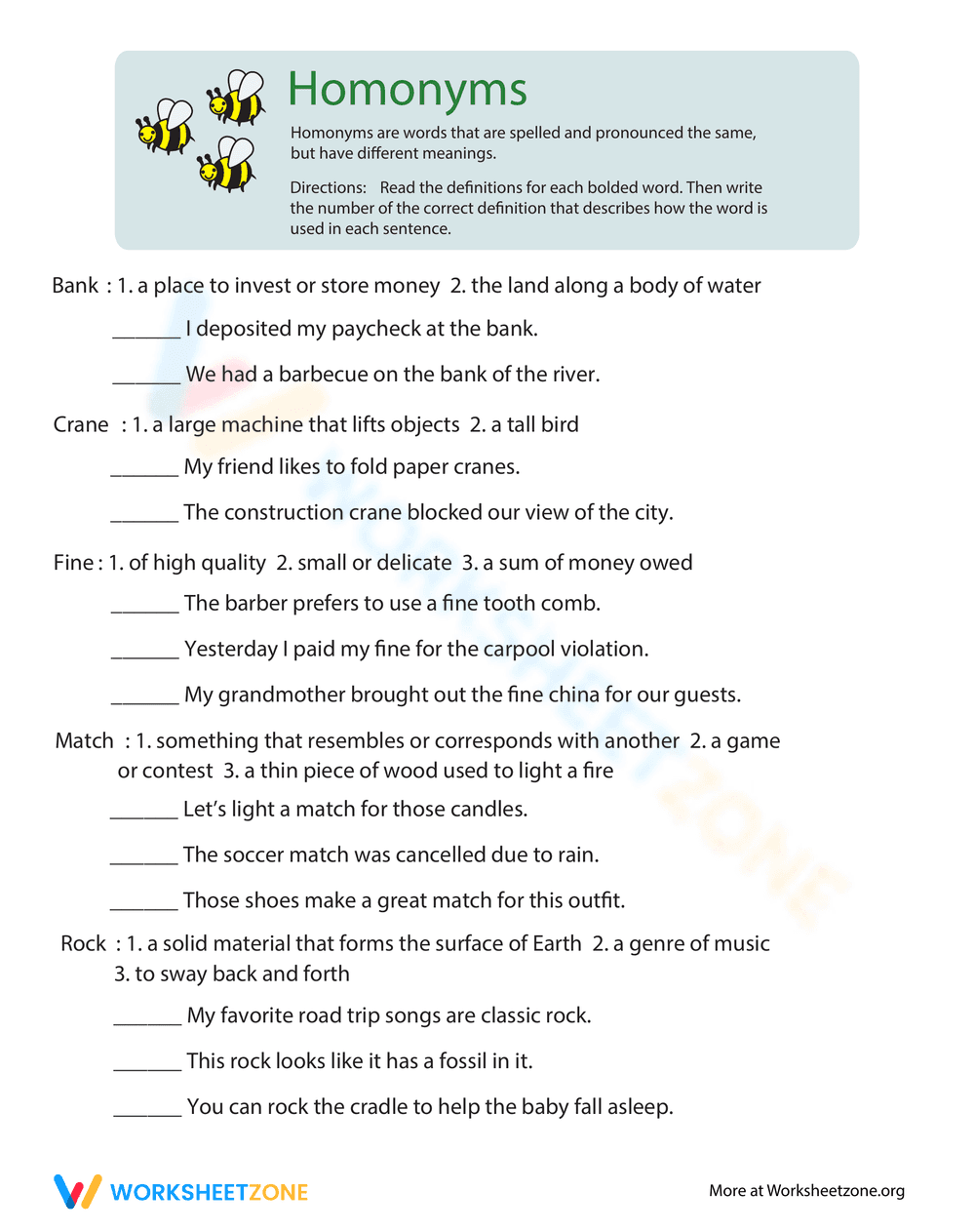
This is a language arts worksheet focused on homonyms. The worksheet provides definitions for different meanings of the same word (bank, crane, fine, match, rock). Students are instructed to read the definitions and then write the number of the correct definition next to each sentence where the homonym is used.
Grade Level Suitability:
This worksheet is suitable for grades 3-5. The vocabulary and sentence structure are appropriate for this age range, and the concept of homonyms is a common language arts topic in these grades. The task requires reading comprehension and critical thinking.
Why Use It:
This worksheet helps students understand the concept of homonyms and how the same word can have different meanings. It improves reading comprehension, vocabulary skills, and the ability to use context clues to determine the correct meaning of a word.
How to Use It:
Students should first read the definitions provided for each homonym. Then, they should read each sentence and determine which definition of the homonym is being used in that sentence. Finally, they should write the number of the correct definition in the blank space provided before each sentence.
Target Users:
This worksheet is ideal for elementary school students in grades 3-5 who are learning about homonyms. It can be used as a classroom activity, homework assignment, or as a supplemental resource for students who need extra practice with vocabulary and reading comprehension.
This is a language arts worksheet focused on homonyms. The worksheet provides definitions for different meanings of the same word (bank, crane, fine, match, rock). Students are instructed to read the definitions and then write the number of the correct definition next to each sentence where the homonym is used.
Grade Level Suitability:
This worksheet is suitable for grades 3-5. The vocabulary and sentence structure are appropriate for this age range, and the concept of homonyms is a common language arts topic in these grades. The task requires reading comprehension and critical thinking.
Why Use It:
This worksheet helps students understand the concept of homonyms and how the same word can have different meanings. It improves reading comprehension, vocabulary skills, and the ability to use context clues to determine the correct meaning of a word.
How to Use It:
Students should first read the definitions provided for each homonym. Then, they should read each sentence and determine which definition of the homonym is being used in that sentence. Finally, they should write the number of the correct definition in the blank space provided before each sentence.
Target Users:
This worksheet is ideal for elementary school students in grades 3-5 who are learning about homonyms. It can be used as a classroom activity, homework assignment, or as a supplemental resource for students who need extra practice with vocabulary and reading comprehension.


