


























Views
Downloads


Its vs It's Worksheet | Grade 2 ELA Printable
Paste this activity's link or code into your existing LMS (Google Classroom, Canvas, Teams, Schoology, Moodle, etc.).
Students can open and work on the activity right away, with no student login required.
You'll still be able to track student progress and results from your teacher account.
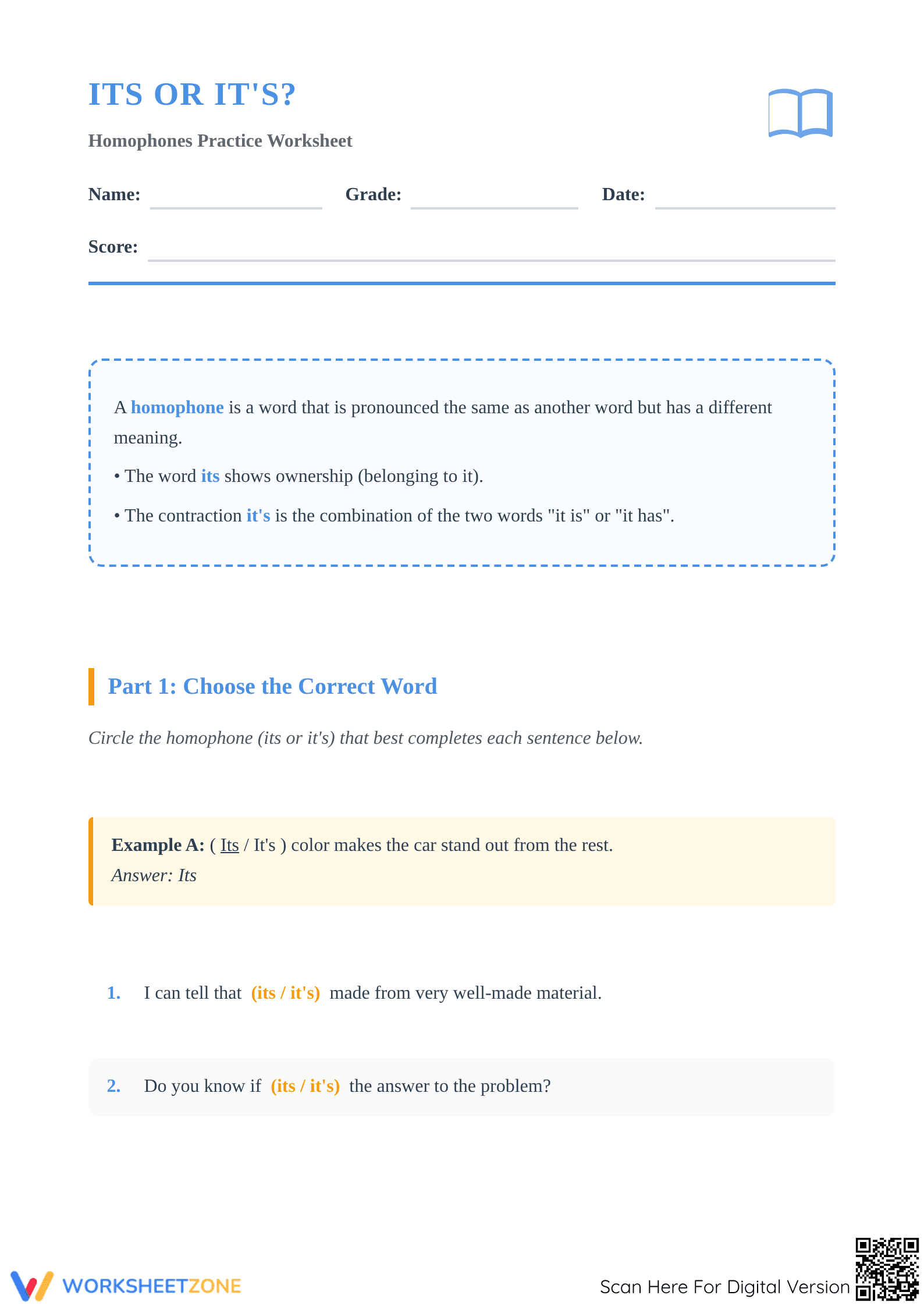
This focused grammar worksheet helps early elementary students master the difference between "its" and "it's" through targeted sentence-level practice. By applying context clues to determine possession versus contraction, learners build essential vocabulary skills and improve their overall writing mechanics with clear, structured repetition.
At a Glance
- Grade: 2 · Subject: ELA
- Standard:
CCSS.ELA-LITERACY.L.2.4.A— Use sentence context to determine word meaning.- Skill Focus: Homophones (Its vs. It's)
- Format: 3 pages · 18 problems · Answer key included · PDF
- Best For: Independent practice and grammar centers
- Time: 15–20 minutes
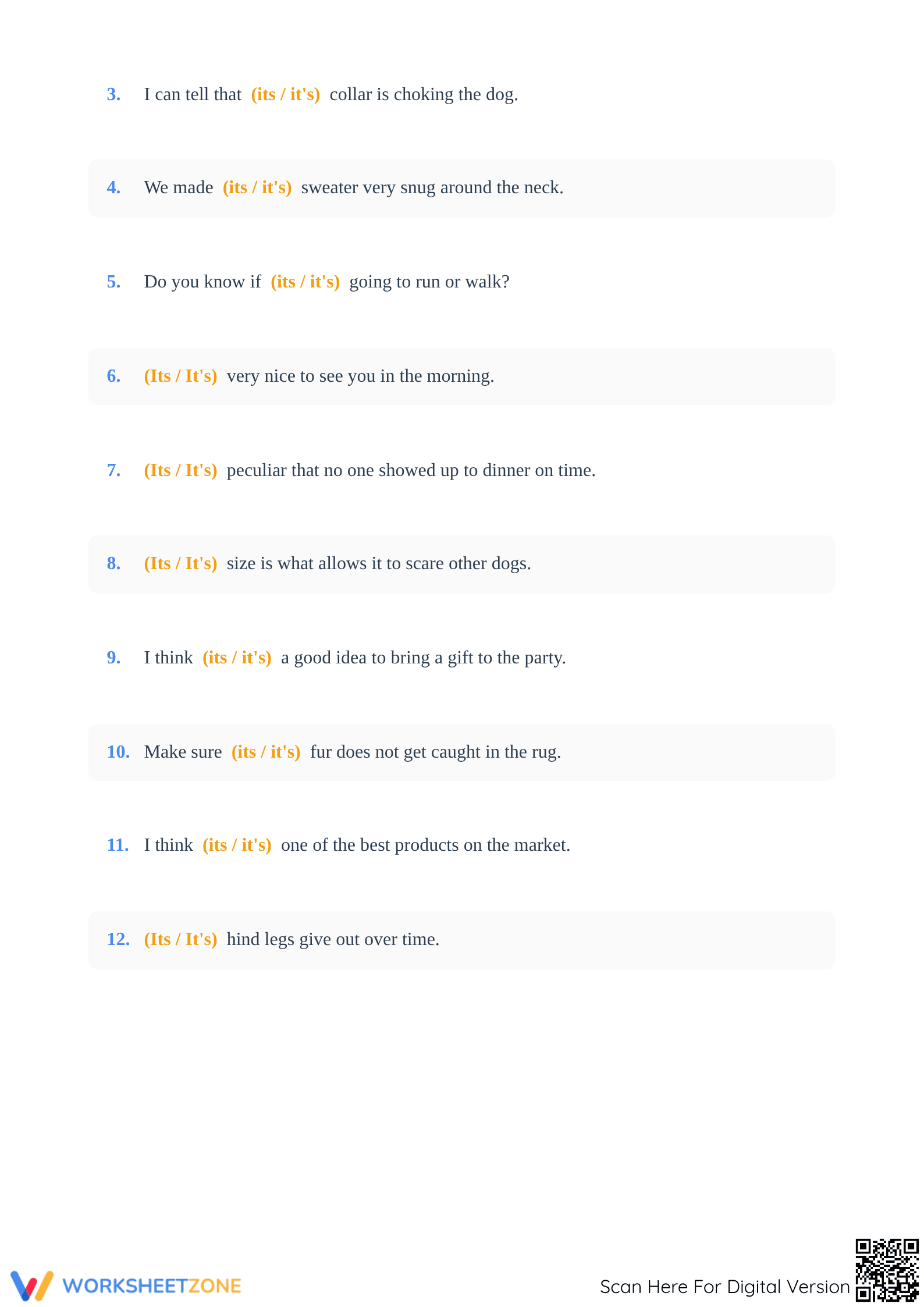
This resource features three pages of progressive grammar exercises alongside a complete answer key for quick grading. The layout begins with a clear instructional box defining the homophones, followed by multiple-choice sentence completions, fill-in-the-blank exercises, and a section for original sentence generation to ensure complete comprehension.
Skill Progression
- Guided practice: The first 12 problems provide a binary choice (its / it's) within highly contextualized sentences, supported by an initial worked example.
- Supported practice: The next 4 problems remove the multiple-choice scaffold, requiring students to recall the rule and fill in the blank independently.
- Independent practice: The final 2 tasks demand higher-order application, asking students to write their own original sentences using each word correctly.
This gradual-release structure follows the proven I Do, We Do, You Do model to build student confidence.
Standards Alignment
Aligned to CCSS.ELA-LITERACY.L.2.4.A, this resource requires students to use sentence-level context as a clue to the meaning of a word or phrase. It also supports foundational writing conventions by reinforcing the correct use of apostrophes in contractions. Both standard codes can be copied directly into lesson plans, IEP goals, or district curriculum mapping tools.
How to Use It
Deploy this worksheet during a dedicated grammar block after direct instruction on contractions and possessive pronouns. It works exceptionally well as a morning work assignment or a quiet independent center activity. As a formative assessment tip, review the final two original sentences to quickly gauge if a student has internalized the grammatical rule or is merely guessing on the multiple-choice section. Most students will complete the full progression in 15 to 20 minutes.
Who It's For
This material is designed for first through third-grade students developing foundational literacy and writing skills. For differentiation, teachers can assign only the first page to students needing heavy scaffolding, while early finishers can complete the entire three-page packet. Pair this activity with a visual anchor chart displaying common homophones to provide ongoing support.
Mastering frequently confused words requires explicit instruction and repeated contextual practice. According to Fisher & Frey (2014), instructional frameworks that utilize a gradual release of responsibility significantly improve student retention of complex grammatical rules. By transitioning learners from recognizing correct usage to producing original sentences, this resource ensures deep cognitive engagement. Addressing CCSS.ELA-LITERACY.L.2.4.A, the ability to use sentence context to determine word meaning is a critical predictor of later reading comprehension and writing fluency. When students actively differentiate between possessive pronouns and contractions, they reduce common mechanical errors that often persist into upper elementary grades. This structured approach not only builds immediate vocabulary proficiency but also establishes the foundational editing skills necessary for long-term academic success across all core content areas.


