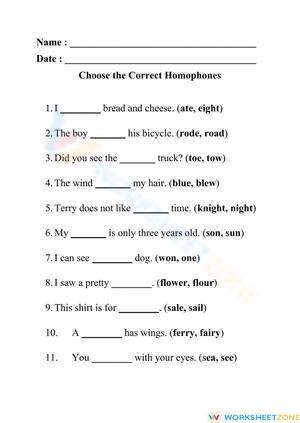
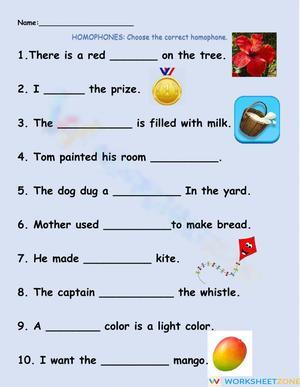
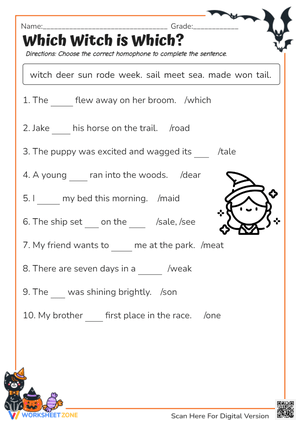
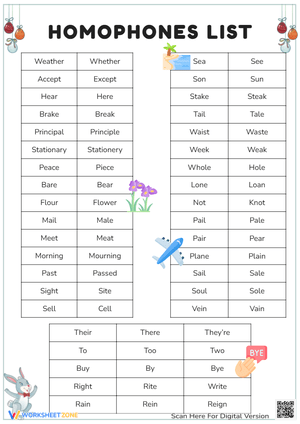
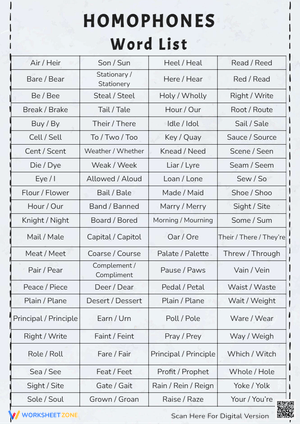
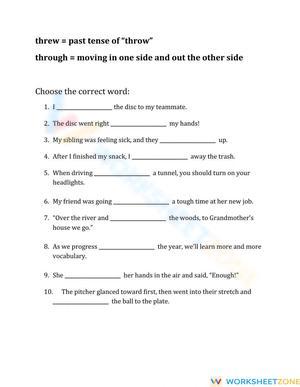
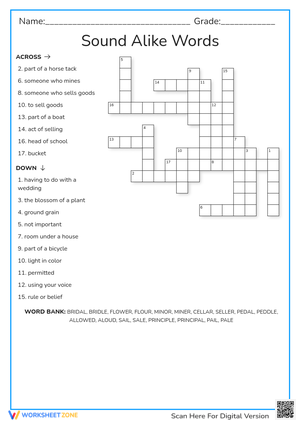
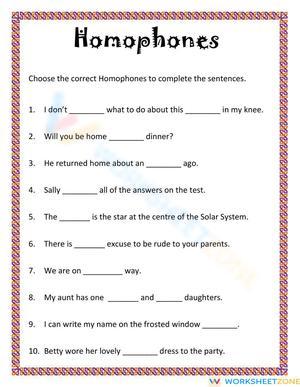
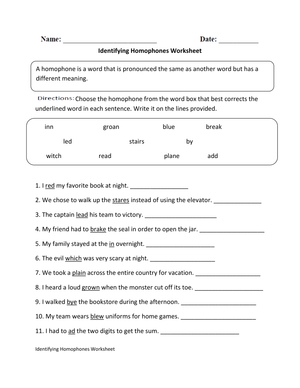
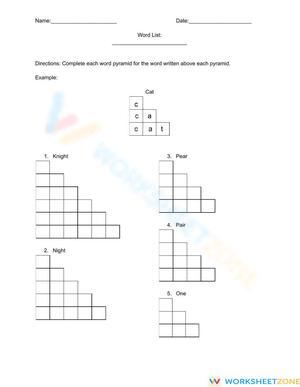
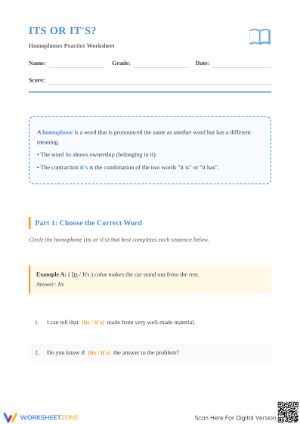
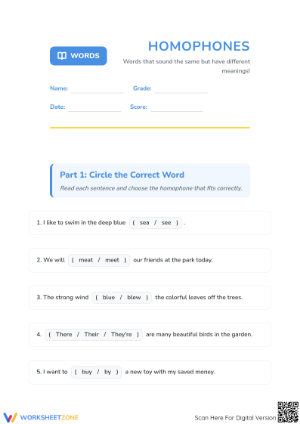
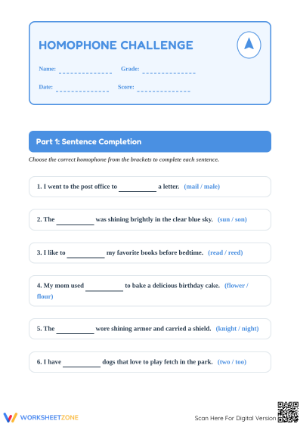
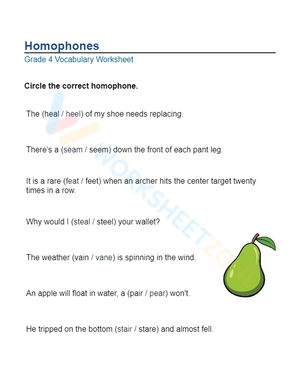
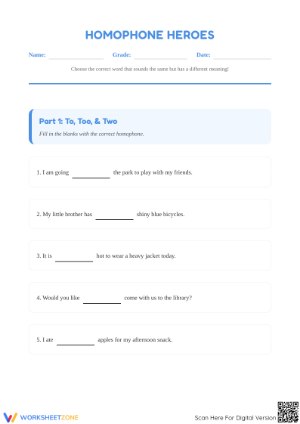
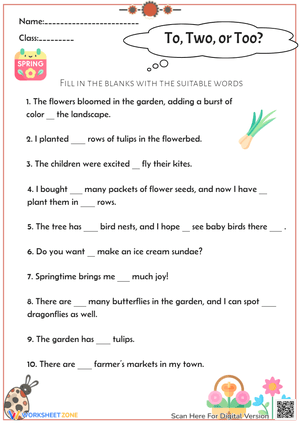
These homophones pdf worksheets for 3rd grade give teachers a focused set of resources for one of the trickiest spelling problems in elementary writing: students who can read "there," "their," and "they're" aloud without hesitation but still choose the wrong one every single time they pick up a pencil. The set covers the word pairs and trios that appear most in third-grade reading and writing—not an exhaustive catalogue of English phonology, but the words that actually derail student sentences. Each worksheet isolates a specific skill: context-based selection, editing for homophone errors, and meaning-to-spelling matching.
The Specific Skills Targeted
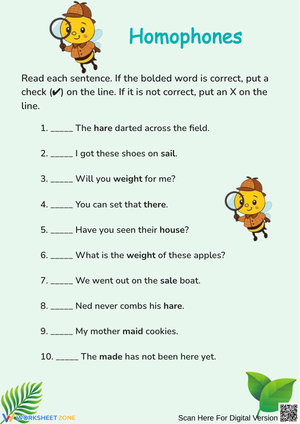
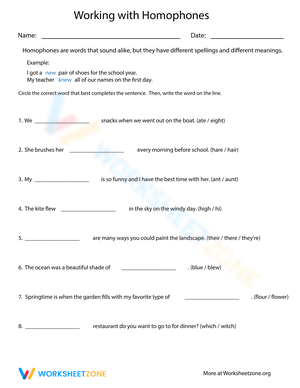
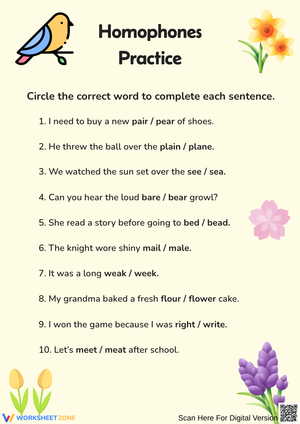
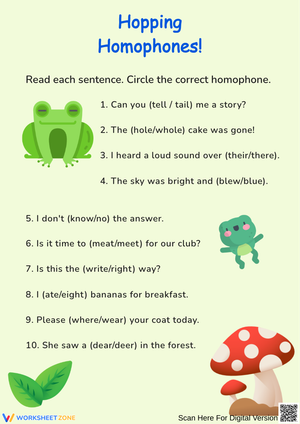
Each worksheet addresses one or two homophone pairs, keeping the cognitive load manageable rather than overwhelming students with a long list all at once. The set covers the highest-frequency pairs in third-grade reading and writing: right/write, hole/whole, piece/peace, bare/bear, flour/flower, and sail/sale. It also devotes dedicated practice to the trios that give even older students trouble—to/too/two and there/their/they're. Those two trios each get multiple worksheets because one round of exposure is never enough.
Activity formats rotate across the set. Fill-in-the-blank exercises ask students to read a complete sentence and choose the correct spelling from a small word bank—the sentence context does the work, not rote recall. Matching exercises connect each word to a short definition or visual cue, which helps students build a meaning anchor before they tackle spelling choices. The editing worksheets are the most demanding: students read a short paragraph seeded with deliberate homophone errors, mark each mistake, and write the correct spelling above it. That task mirrors the revision process students need to apply in their own writing, which makes the skill transfer more directly than drilling word lists ever does.
Frequent Student Errors Worth Watching For and Correcting
The most revealing error pattern in third-grade homophone work is not random—it is systematic. Students default to the spelling they encountered first or most often. "To" becomes the universal substitute: you almost never see "I want too go," but "I want to go two the store and back to" shows up constantly. Students who have drilled "there is" since first grade reach for "there" even when the possessive meaning is unmistakable. The editing worksheets surface exactly this pattern, because the errors planted in each practice paragraph mirror what actually accumulates in student writing folders by October.
The hole/whole pair produces a specific mistake worth watching for: students often get this pair right in isolation but then write "I ate the hole pizza" inside a narrative, because their attention is on the story, not on spelling conventions. That is not carelessness—it is what happens when composition demands most of the available working memory. Catching that error in a worksheet paragraph, where attention is fully on the text, builds the habit of pausing to check homophone choices before moving on. The transfer to independent writing is gradual, but it does happen.
Building These Worksheets Into Your Lesson Plans
The fill-in-the-blank and matching worksheets work best as a brief warm-up right before a writing block—five to eight minutes while students are settling in but have not yet started drafting. The timing matters: when students practice choosing between "peace" and "piece" in a worksheet sentence and then immediately sit down to write their own paragraph, the transfer is noticeably stronger than when practice and application happen on separate days. Spaced retrieval across a week still matters, but that immediate proximity between practice and production is worth protecting when you can.
These homophones pdf worksheets for 3rd grade also slot cleanly into a word work literacy center. Slide each worksheet into a dry-erase pocket, provide whiteboard markers, and the center becomes reusable across a full week without reprinting. The editing worksheets, though, are better used whole-class or in pairs rather than as independent center work. Reading the paragraph aloud together before marking errors helps students catch mistakes they would miss reading silently—hearing "I walked down the stare" makes the wrong spelling more obvious than seeing it. If your class does morning work, the matching and fill-in-the-blank formats are the right choice there: instructions are clear enough that students can begin before you finish attendance, and the tasks are contained enough not to create management problems during the first ten minutes of the day.
Adapting the Worksheets Across Ability Levels
Students who are still building basic word recognition can use the matching worksheets with a simple support structure: write the definition for each target word on a sticky note placed at the top of the worksheet. This removes the need to hold meaning in working memory while simultaneously making a spelling choice—doing both at once is too much for some third graders, and the sticky note solves it without altering the worksheet itself.
These homophones pdf worksheets for 3rd grade stretch naturally for students who move through the basics quickly. After finishing a fill-in-the-blank worksheet, ask those students to write two original sentences using each homophone in the pair—not just the one the worksheet exercised. For the trios, have them write a single sentence that uses all three correctly. That is genuinely difficult, and students who can do it have moved well past surface memorization into flexible, context-driven spelling.
English language learners often struggle with homophones for a different reason than native speakers: both words in a pair may be new in spoken and written form, so the same-sound connection that helps native speakers is not yet available. For these students, the visual matching worksheets—those that pair each word with a picture or short definition—build meaning first. Once a student knows that "bear" means the animal and "bare" means without covering, the fill-in-the-blank exercises become about applying meaning they already hold, which is a much more manageable task than learning spelling and meaning simultaneously.
Standard Alignment
These worksheets align to CCSS.ELA-LITERACY.L.3.4, which asks third graders to determine or clarify the meaning of unknown and multiple-meaning words and phrases using context clues as a primary strategy. Every fill-in-the-blank exercise is direct instruction in that standard: students must use sentence context to determine which meaning—and therefore which spelling—fits. The editing worksheets address CCSS.ELA-LITERACY.L.3.2.E as well, the language conventions standard that specifically names correct use of frequently confused words. In classroom terms, this standard typically becomes most pressing in the second semester of third grade, when students are writing longer informational and narrative pieces and homophone errors start appearing in drafts with enough regularity to affect readability.
Frequently Asked Questions
Are these worksheets appropriate for advanced second-grade students?
The word pairs are calibrated to third-grade frequency lists, but a second-grader who reads fluently will handle the matching and fill-in-the-blank formats without much difficulty. The editing worksheets assume familiarity with paragraph structure, so those work better as a second-semester activity for advanced second graders rather than earlier in the year, when paragraph reading is still new.
Are the worksheets sequenced, or can teachers use them in any order?
Each worksheet stands alone—there is no required sequence. Most teachers start with the high-frequency trios (there/their/they're and to/too/two) because errors with those words show up in student writing faster and more visibly than errors with lower-frequency pairs like flour/flower. But the order is fully flexible and should follow what your current writing unit actually demands.
Do the worksheets come with answer keys?
Yes. Each worksheet includes an answer key formatted to match the student version, which makes partner checking or quick self-correction straightforward. The answer keys for the editing worksheets mark each error location and provide the correct spelling, so teachers can also use them during whole-class debrief without hunting through the paragraph in real time.
How do these resources fit into spelling intervention for students receiving additional support?
These homophones pdf worksheets for 3rd grade work well alongside intervention, but the emphasis should stay on meaning rather than memorization. Have the student verbalize why they chose a particular spelling—"I picked 'whole' because it means all of something, and the sentence is about the whole class"—rather than just marking the answer and moving on. That verbalization step builds the habit of connecting spelling choice to meaning, which is exactly the skill these students need to carry into independent writing.












 Interactive Worksheet Maker
 Quiz Maker
 Word Search Maker
 Crossword Puzzle Maker
 Word Scramble Generator
 Sentence Scramble Generator
 Handwriting Worksheet Generator
 Name Tracing Generator
 Fill In The Blank Generator