


























Views
Downloads

Homophones Crossword | Printable Grade 3 ELA
Paste this activity's link or code into your existing LMS (Google Classroom, Canvas, Teams, Schoology, Moodle, etc.).
Students can open and work on the activity right away, with no student login required.
You'll still be able to track student progress and results from your teacher account.
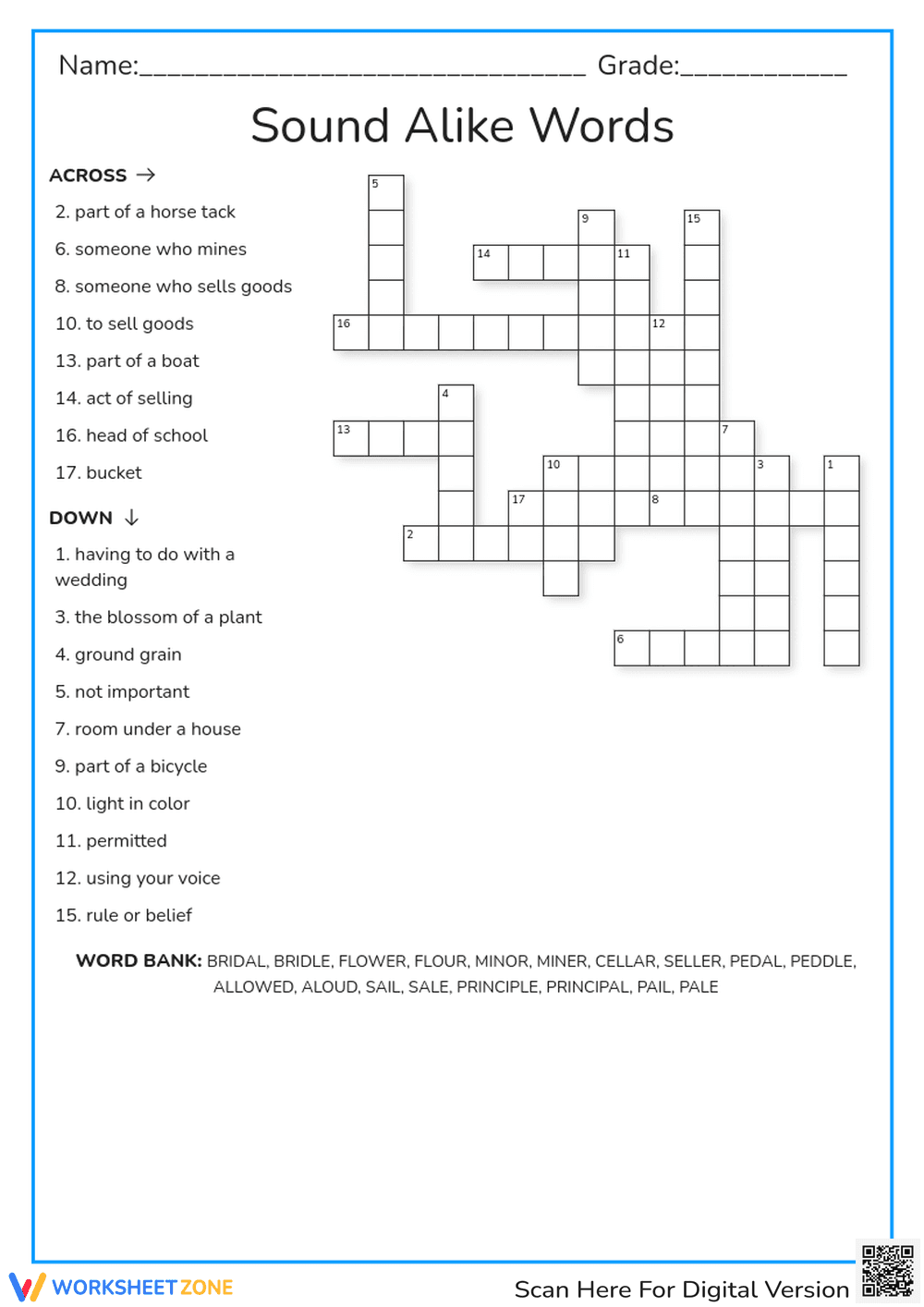
This Grade 3 ELA crossword puzzle provides targeted practice with homophones, helping students distinguish between words that sound alike but have different meanings and spellings. By matching context clues to the correct vocabulary word, learners strengthen their reading comprehension and spelling accuracy in an engaging, puzzle-based format.
At a Glance
- Grade: 3 · Subject: ELA
- Standard:
CCSS.ELA-LITERACY.L.3.4— Determine the meaning of unknown and multiple-meaning words.- Skill Focus: Homophones and Vocabulary
- Format: 1 page · 18 problems · Answer key included · PDF
- Best For: Independent practice and review
- Time: 15–20 minutes
This single-page resource features an 18-clue crossword puzzle focused entirely on frequently confused sound-alike words. Students read definitions for both across and down directions, then select the correct spelling from a comprehensive word bank at the bottom. The bank includes challenging pairs such as principal/principle and minor/miner, providing built-in scaffolding to support accurate spelling. A complete answer key is included.
Zero-Prep Workflow
- Print (1 minute): Download the PDF and print a class set. The black-and-white design is ink-friendly and requires no special formatting.
- Distribute (1 minute): Hand out the puzzle during morning work, literacy centers, or as an early finisher activity. The clear instructions mean students can begin immediately.
- Review (2 minutes): Use the provided answer key to quickly check student work or project it on the board for self-correction. Total teacher preparation time is under two minutes, making this an ideal emergency sub plan.
Standards Alignment
This activity aligns with CCSS.ELA-LITERACY.L.3.4, requiring students to determine the meaning of multiple-meaning words based on grade 3 content. It supports spelling conventions by forcing students to choose the correct spelling based on definition. Both standard codes can be copied directly into lesson plans, IEP goals, or district curriculum mapping tools.
How to Use It
Deploy this crossword puzzle as an independent literacy center activity after direct instruction on homophones. It serves as an excellent formative assessment; observe which word pairs students struggle to place correctly to identify specific vocabulary gaps. Alternatively, use it as a quiet morning work assignment to settle the classroom while reinforcing essential language skills. The puzzle format keeps engagement high, and most third graders will complete the task within a 15 to 20-minute window.
Who It's For
This worksheet is designed for third-grade students developing their vocabulary and spelling proficiency. The inclusion of a word bank provides necessary differentiation for learners who might struggle with spelling recall but can successfully match definitions to words. It pairs perfectly with a mini-lesson or anchor chart illustrating common homophone pairs, offering immediate, structured application of the concept.
Mastering homophones is a critical component of early literacy development. According to Fisher & Frey (2014), explicit vocabulary instruction combined with engaging, context-rich practice significantly improves reading comprehension and writing clarity. This worksheet targets CCSS.ELA-LITERACY.L.3.4 by asking students to determine the meaning of unknown and multiple-meaning words through definition matching. When students actively differentiate between words like "flour" and "flower" based on context clues, they build the orthographic mapping skills necessary for fluent reading and accurate spelling. Crossword puzzles specifically encourage this cognitive heavy lifting while maintaining high student motivation. By integrating a word bank, the activity reduces cognitive overload, allowing learners to focus purely on meaning and spelling correspondence rather than rote recall. This targeted approach ensures that foundational language conventions are solidified.


