




























Views
Plays


Singular and Possessive Nouns Worksheet | Grade 3-5 Aligned

Paste this activity's link or code into your existing LMS (Google Classroom, Canvas, Teams, Schoology, Moodle, etc.).
Students can open and work on the activity right away, with no student login required.
You'll still be able to track student progress and results from your teacher account.
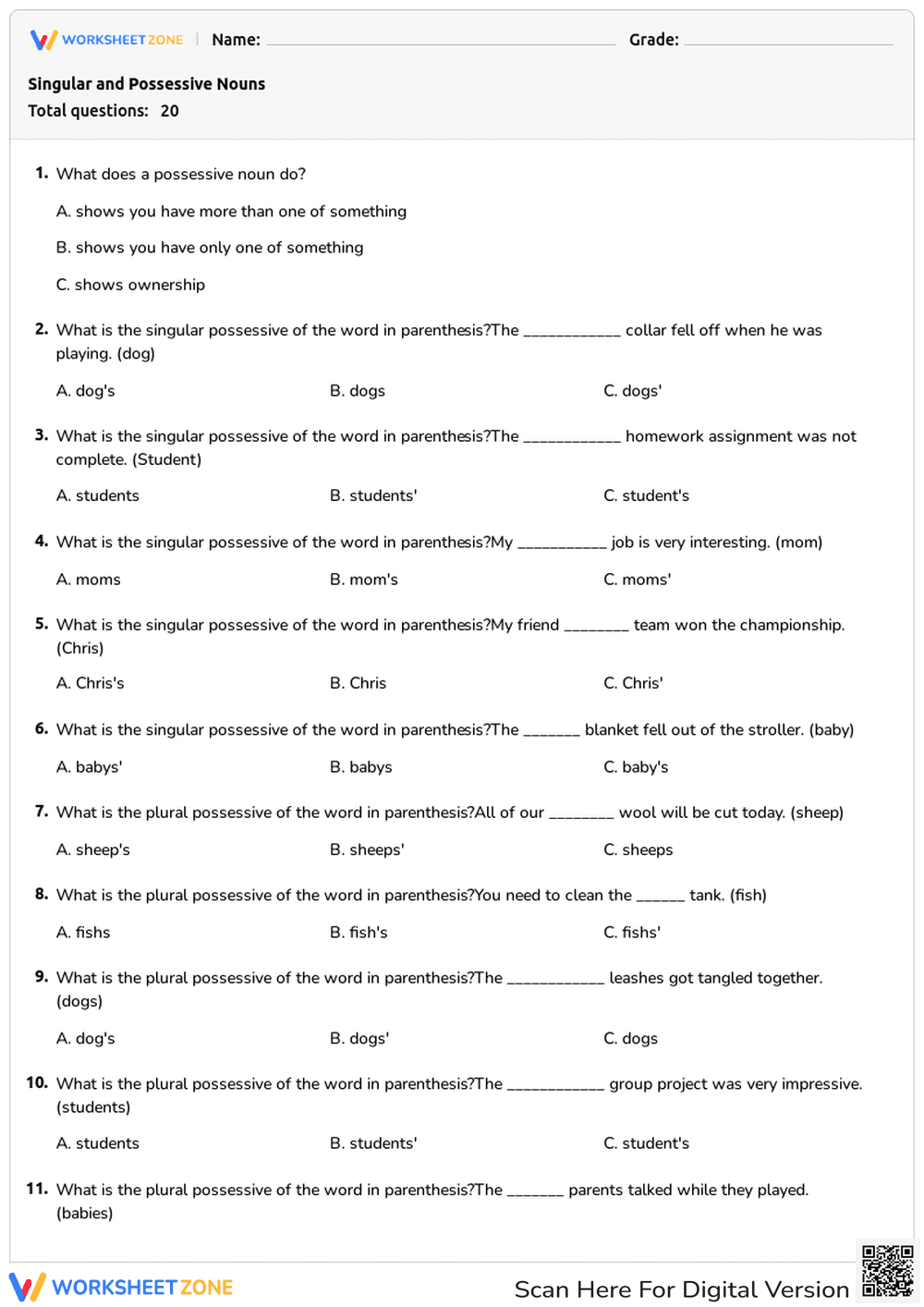
This singular and possessive nouns worksheet provides comprehensive practice for upper elementary students to master apostrophe placement. By identifying ownership in various sentence contexts, learners develop a concrete understanding of grammar rules. This resource ensures students can distinguish between simple plurals and possessive forms, leading to improved writing clarity and technical accuracy in daily assignments.
At a Glance
- Grade: 3-5 · Subject: ELA Grammar
- Standard:
CCSS.ELA-LITERACY.L.3.2.D— Form and use possessives correctly in sentences- Skill Focus: Singular and plural possessive nouns
- Format: 2 pages · 20 problems · Answer key included · PDF
- Best For: Formative assessment and grammar review
- Time: 15–20 minutes
This two-page PDF contains 20 multiple-choice questions designed to test a student's grasp of possessive mechanics. The first page focuses on definitions and singular possessive formation, while the second page challenges students to identify plural possessives and distinguish between singular and plural forms in context. A clear layout and consistent question format make it easy for students to focus on the linguistic rules without distraction.
Skill Progression
- Guided practice: The worksheet begins with conceptual questions defining what a possessive noun does, establishing a foundation for the 20 tasks.
- Supported practice: Questions 2 through 12 provide parenthetical prompts, asking students to transform specific nouns into their correct possessive forms using multiple-choice options.
- Independent practice: The final section requires students to analyze complete sentences and categorize underlined words as either singular or plural possessives without direct prompts.
This gradual-release model moves students from basic identification to higher-level analysis of grammatical structures.
Standards Alignment
The primary focus is `CCSS.ELA-LITERACY.L.3.2.D`, which requires students to "Form and use possessives." Additionally, it supports L.4.2 and L.5.2 standards regarding the use of punctuation to indicate possession. Both standard codes can be copied directly into lesson plans, IEP goals, or district curriculum mapping tools.
How to Use It
Use this worksheet as a summative quiz after a unit on nouns or as a bell-ringer activity to gauge prior knowledge. For a formative assessment, observe students during questions 13-15 to see if they can articulate the rules for apostrophe placement before applying them. Most students will complete the 20 questions within a 15-to-20-minute window.
Who It's For
This resource is ideal for third, fourth, and fifth-grade students, as well as English Language Learners (ELL) who struggle with the nuances of English punctuation. It pairs naturally with an anchor chart showing the "Apostrophe + S" vs. "S + Apostrophe" rules for visual reinforcement during direct instruction.
According to the RAND AIRS 2024 report on literacy instruction, targeted grammar practice that isolates specific punctuation rules significantly improves student writing mechanics in the upper elementary grades. This worksheet aligns with the Fisher & Frey (2014) gradual release of responsibility framework by transitioning students from defining possessive nouns to independently identifying them within complex sentence structures. By focusing on the CCSS.ELA-LITERACY.L.3.2.D standard, the 20-question set provides the necessary repetition required for students to internalize the difference between singular and plural ownership. Research from EdReports 2024 suggests that high-quality instructional materials must provide clear, scaffolded opportunities for students to apply language standards in context. This resource meets those criteria by offering structured multiple-choice options that highlight common errors, such as confusing pluralization with possession. Educators can use these results to inform small-group interventions or to document progress toward specific IEP goals related to written expression and language conventions.


