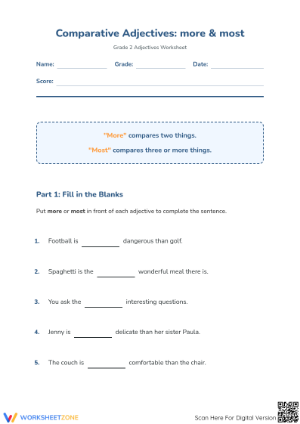
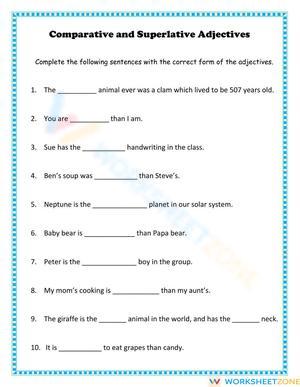
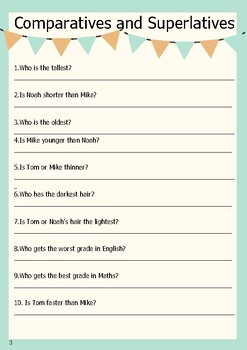
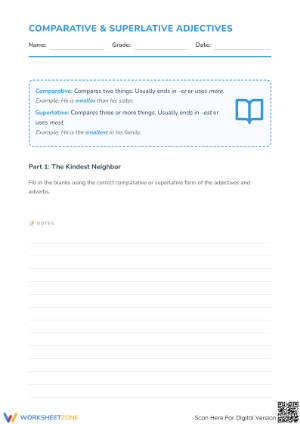
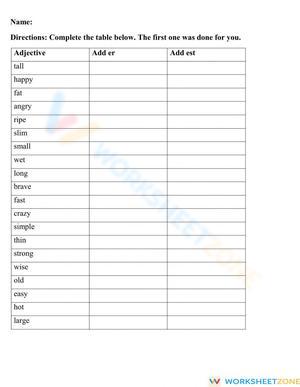
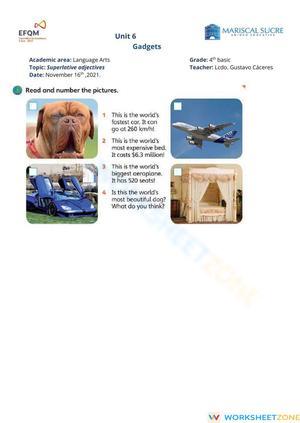
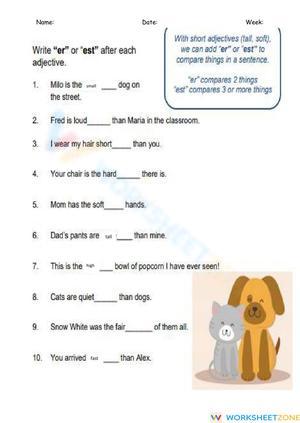
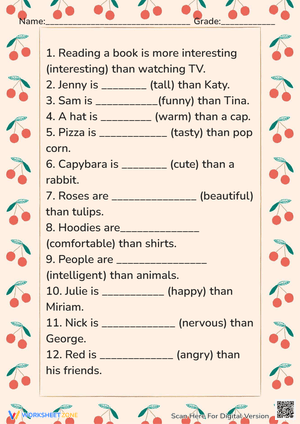
These comparative and superlative adjectives worksheets for 3rd grade give teachers a set of ready-to-print exercises that target one of the most rule-dense grammar concepts in the Language strand — and one of the easiest to half-learn. Students who grasp the basic idea of taller and tallest often stall the moment spelling changes enter the picture, which is precisely where focused, well-sequenced worksheet practice earns its place in a grammar block.
The Specific Rules Each Worksheet Targets
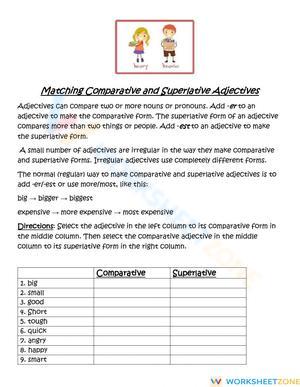
Six distinct patterns make up the full comparative and superlative system that third graders are expected to control. The set isolates one or two patterns per worksheet so students can build on a single rule before the forms start combining.
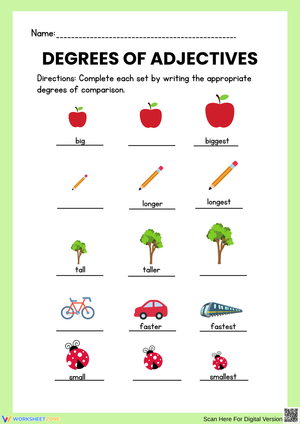
- One-syllable adjectives with no spelling change: Add -er or -est directly. (fast → faster → fastest)
- CVC adjectives: Double the final consonant before the suffix. (big → bigger → biggest)
- Adjectives ending in silent e: Drop the e before adding the suffix. (large → larger → largest)
- Adjectives ending in -y: Change y to i before adding the suffix. (happy → happier → happiest)
- Multisyllabic adjectives: Use more or most instead of a suffix. (careful → more careful → most careful)
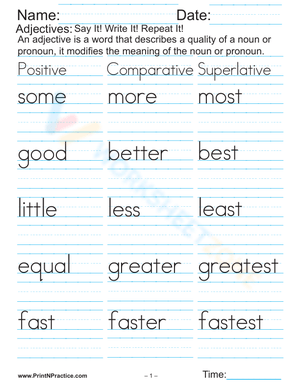
- Irregular forms: Memorize these. Good/better/best and bad/worse/worst are the two sets third graders need to own before the unit closes.
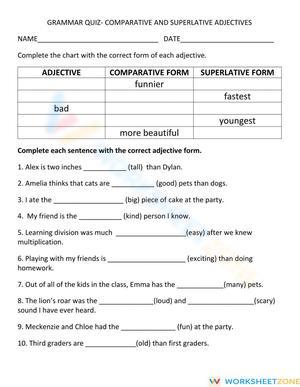
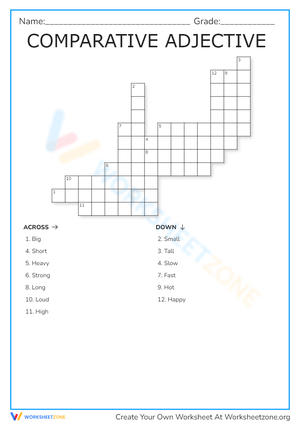
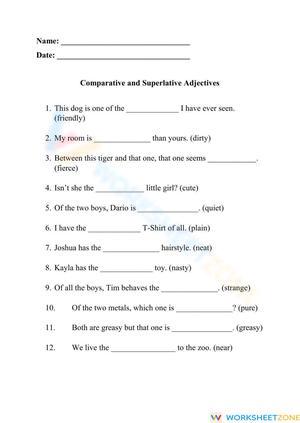
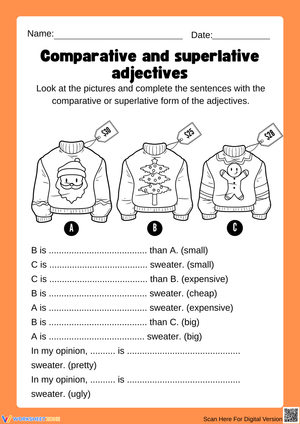
Activity formats across the worksheets include fill-in-the-blank sentence frames, circle-the-correct-form multiple choice, sentence writing from a target base word, adjective sorting by form type, and error-correction tasks where students find and rewrite a flawed sentence. Error correction belongs toward the end of a sequence — it presses students to name the rule, not just apply it mechanically.
Student Errors Worth Catching Early
The most persistent mistake at this grade level is double-marking: students write most happiest or more faster, stacking a degree word and a suffix on the same adjective. This happens because students have heard constructions like "she is the most kindest person" in casual speech, and their ear does not flag it as wrong. When you see this pattern in student work, the comparison concept has clicked — the problem is that the form rule has not. Error-correction worksheets that show double-marked sentences and ask students to rewrite them are the fastest way to close that gap without re-teaching the whole concept.
A second cluster of errors involves the CVC doubling rule. Students who correctly write bigger on a worksheet where big is the given base word will often write hoter — skipping the double t — when they encounter a new word in a sentence and have to produce the form independently. The shift from prompted practice to unprompted retrieval is where the pattern breaks down, which is why the set includes both cued and open-ended tasks rather than relying on one format throughout.
How to Build These Worksheets Into Your Lesson Plans
The most effective sequencing moves from simpler forms toward spelling changes, then to multisyllabic words and irregulars. Day one works with clean one-syllable adjectives — no spelling changes, just adding a suffix — so students confirm their mental model without getting derailed by the mechanics of doubling or dropping a letter. Day two introduces the CVC and silent-e rules together, since students often notice the pattern themselves when they see a few examples side by side. Day three handles -y endings and the more/most rule. Day four consolidates irregular forms with a full-unit review. The error-correction worksheet fits best at this final stage, once students have enough pattern knowledge to recognize a deliberate mistake and explain why it is wrong.
For quick daily review, a fill-in-the-blank worksheet with three sentences works well as the first five minutes of a grammar block — it settles the room, and the answers give immediate formative data before the lesson starts. The sorting worksheet functions reliably in a center rotation when a teacher group is running guided reading and independent management matters.
Standard Alignment
These worksheets address CCSS.ELA-LITERACY.L.3.1(g), which requires students to form and use comparative and superlative adjectives and adverbs correctly, and to choose between adjective and adverb forms depending on what is being modified. In classroom terms, this standard surfaces during writing conferences when a student describes two characters, in shared reading discussions when the class compares settings, and in the grammar mini-lessons that most L.3 pacing guides place in the first and second quarters. The comparative and superlative adjectives worksheets for 3rd grade match that placement — they work most effectively as a focused unit in Q1 or Q2, before students are expected to apply these forms with full independence in their own writing.
Differentiating the Worksheets Across Ability Levels
Students who are still building spelling fluency benefit from keeping a printed rule card at their desk during worksheet practice — a simple two-column reference that lists the four spelling-change patterns and the two irregular sets. This reference does not remove the thinking; it reduces the demand on working memory so students can focus on the form rather than on recalling five rules at once. Students who have secured the basic patterns are ready for the error-correction and sentence-writing tasks, which require generating forms from scratch rather than selecting from given options.
For students who find the concept genuinely easy, extend any sentence-writing worksheet by asking them to write a short paragraph comparing three characters from a book they are currently reading, using at least four target forms. The comparative and superlative adjectives worksheets for 3rd grade provide the structured practice base; that extension pushes the same skill into authentic writing where the rules have to transfer on their own. For students who need more time with a specific pattern, slow the sequence and spend two full days on CVC doubling alone before introducing the next rule — rushed coverage of the doubling step produces errors that linger well past the unit.
Frequently Asked Questions
Do these worksheets cover both adjective and adverb forms?
The worksheets focus on adjective forms, which is where L.3.1(g) instruction typically begins. Comparative adverbs — more quickly, most carefully — appear in the higher-complexity tasks like sentence writing and error correction rather than as isolated targets in every exercise. Once students are solid on adjective forms, the adverb extension follows quickly because the underlying rule structure is the same.
How do I decide which worksheet to assign first?
Start with a fill-in-the-blank worksheet that uses only clean one-syllable base words with no spelling changes. If students complete it confidently, move to a spelling-change worksheet the next day. If errors cluster around one pattern — say, students consistently miss the CVC doubling — use the worksheet that isolates that rule before continuing through the sequence. The pattern of errors, not the calendar, drives the pacing.
Students do fine on the worksheets but still make errors in their writing. What helps?
Prompted worksheet practice builds recognition; it does not automatically transfer to production. Pair the worksheets with a short daily sentence-writing routine — one sentence per day comparing two things the student observes or reads about — so students practice retrieving and forming these adjectives without a base word sitting in front of them. The comparative and superlative adjectives worksheets for 3rd grade work best when they run alongside that kind of low-stakes daily writing, not as a self-contained grammar event that closes when the unit ends.
Are the worksheets appropriate for students who are still developing as spellers?
Yes, with the reference card described above. The spelling-change rules for comparative and superlative forms overlap with the CVC and silent-e patterns students encounter in word study, so the worksheets can reinforce two skills at once for developing spellers. Watch for students who apply the suffix correctly but misspell the base word — that signals a word-study gap, not a grammar gap, and it tells you something different about where the student needs support.












 Interactive Worksheet Maker
 Quiz Maker
 Word Search Maker
 Crossword Puzzle Maker
 Word Scramble Generator
 Sentence Scramble Generator
 Handwriting Worksheet Generator
 Name Tracing Generator
 Fill In The Blank Generator