


























Views
Downloads

Jugs and Mugs: Essential Capacity Worksheet | Grade 2
Paste this activity's link or code into your existing LMS (Google Classroom, Canvas, Teams, Schoology, Moodle, etc.).
Students can open and work on the activity right away, with no student login required.
You'll still be able to track student progress and results from your teacher account.
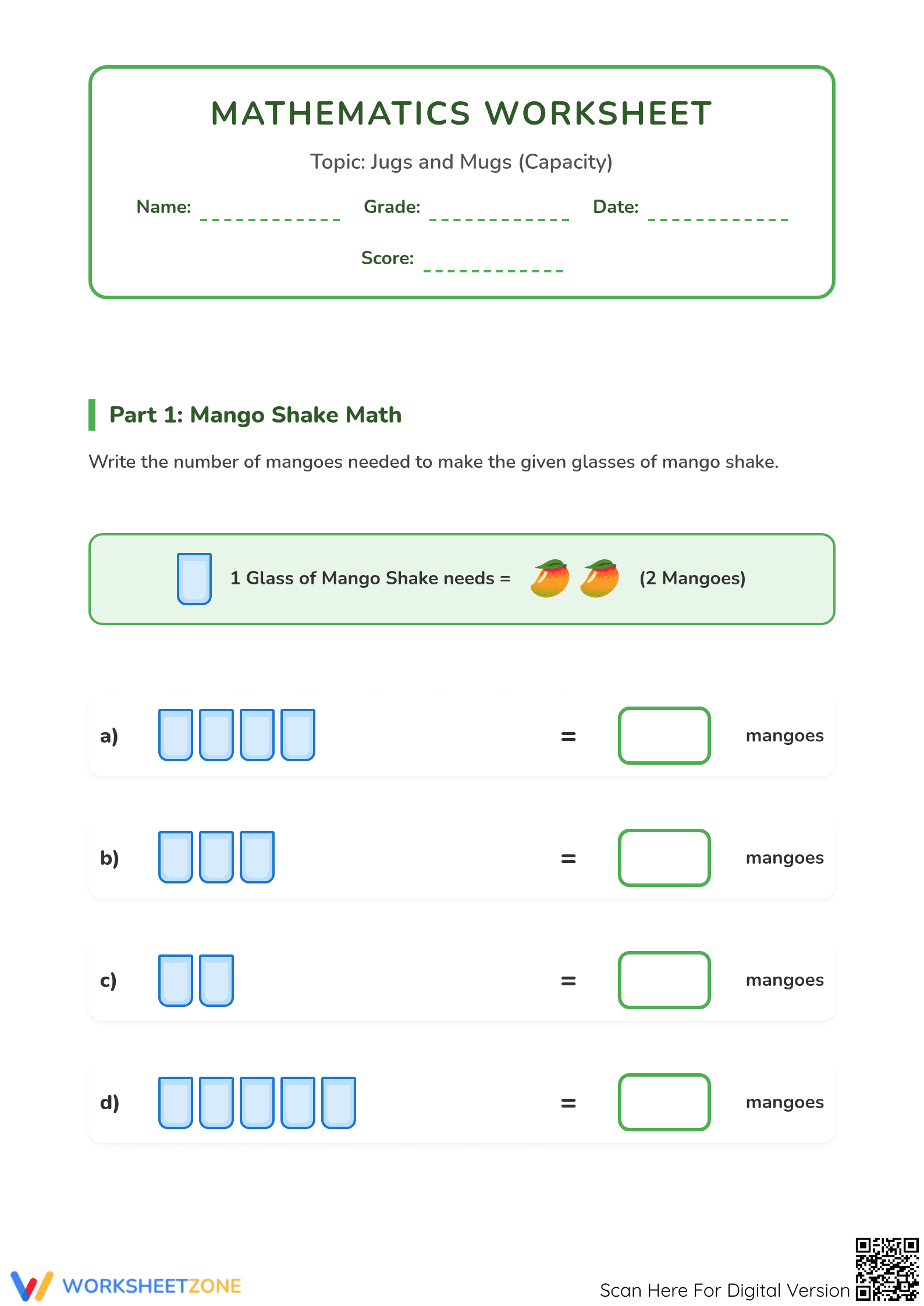
This Grade 2 volume and capacity worksheet helps students master the fundamentals of liquid measurement through visual comparison and non-standard unit calculation. Students will determine how many items are needed to fill specific containers and rank various vessels by their holding capacity. This resource ensures learners develop a strong conceptual grasp of volume before moving to formal metric units.
At a Glance
- Grade: 2 · Subject: Math
- Standard:
CCSS.MATH.CONTENT.2.MD.A.1— Measure and estimate liquid volumes using various containers and non-standard units- Skill Focus: Capacity comparison and unit iteration
- Format: 3 pages · 11 problems · Answer key included · PDF
- Best For: Introductory measurement lessons and formative assessment
- Time: 15–20 minutes
What's Inside
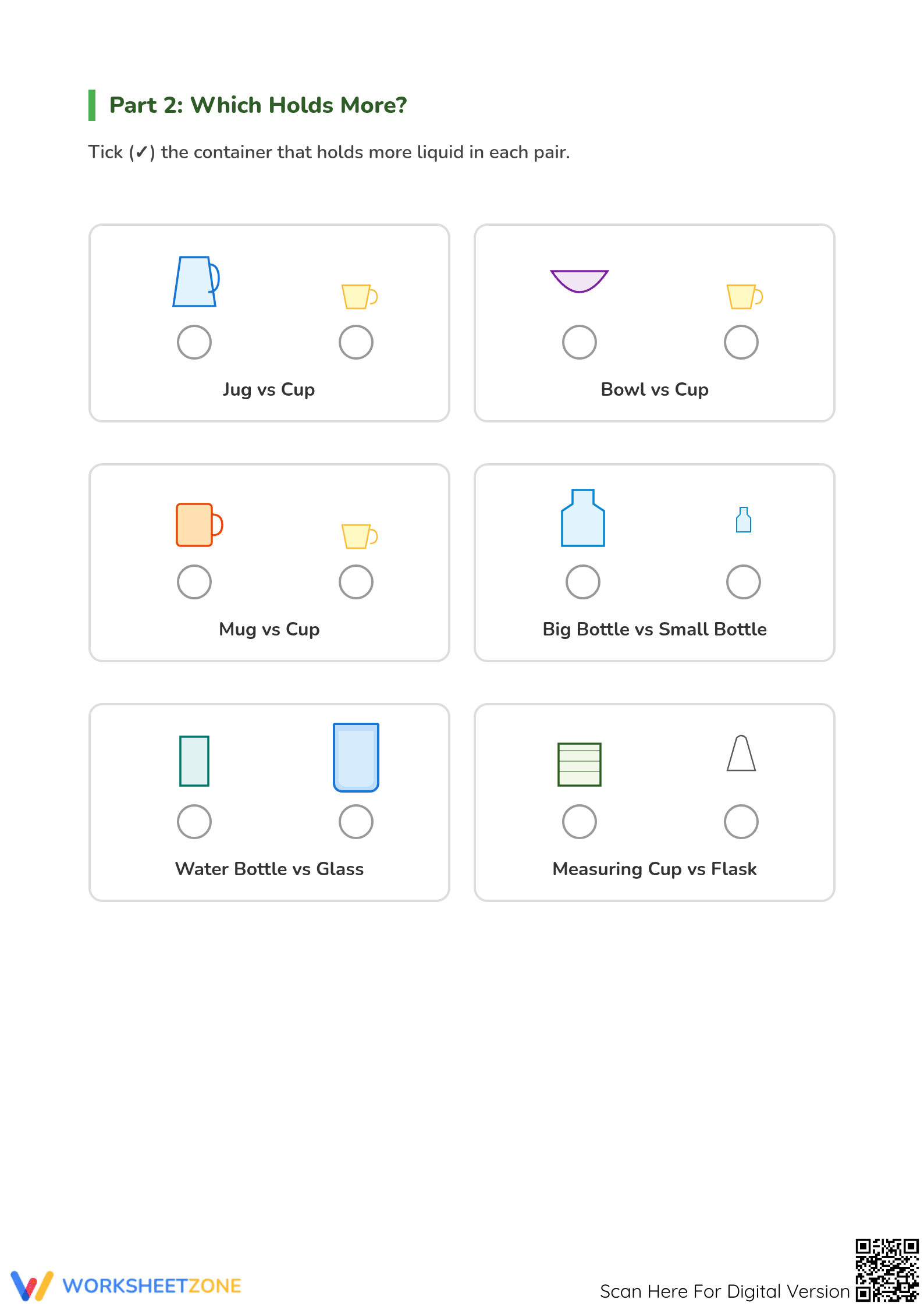
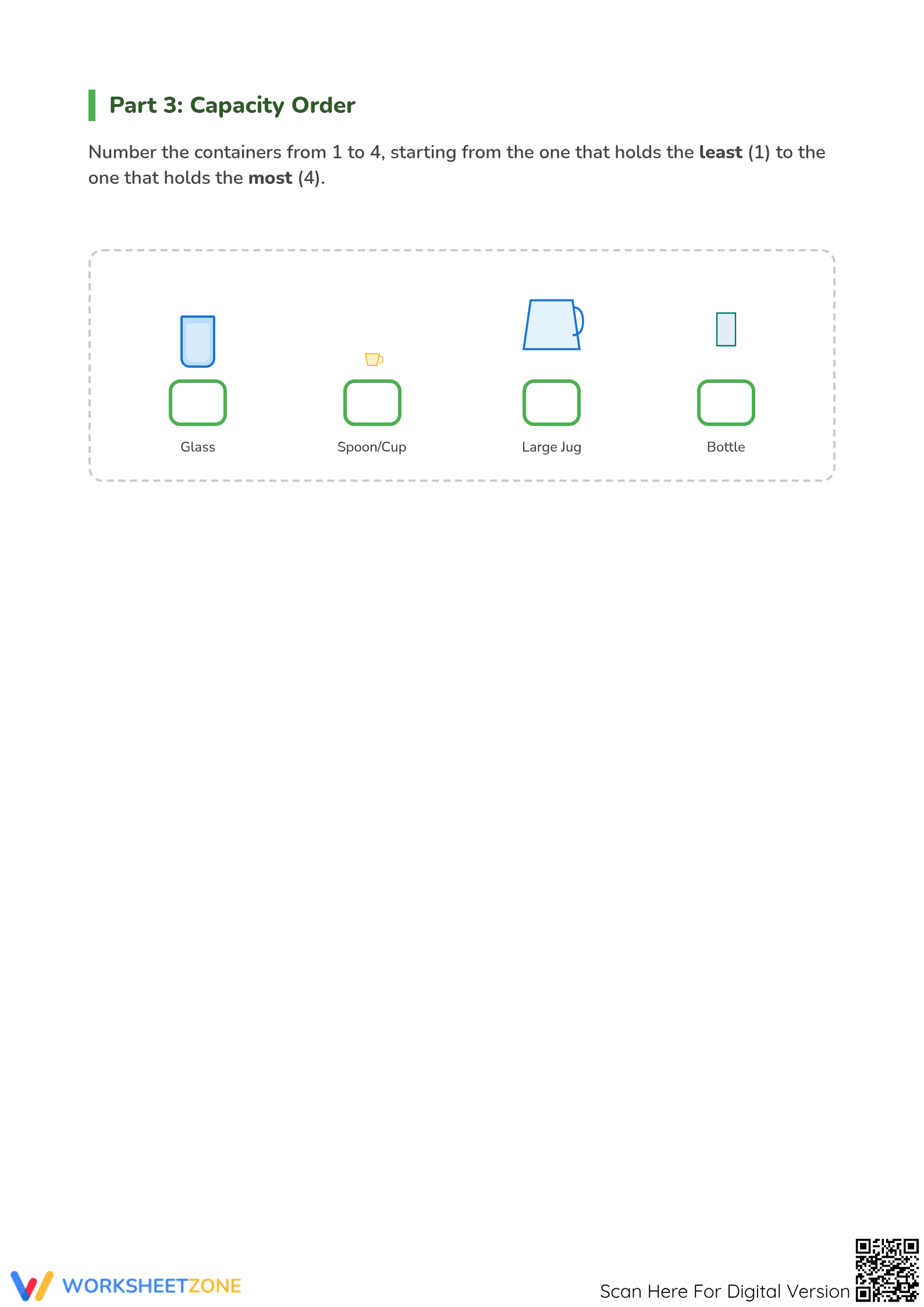
This comprehensive 3-page PDF includes three distinct sections designed to build measurement fluency. Part 1 features "Mango Shake Math," where students use repeated addition or early multiplication to calculate ingredient totals for multiple glasses. Part 2 provides six comparison pairs, asking students to identify the larger container. Part 3 requires ordering four different vessels from least to greatest capacity. A full answer key is provided for rapid grading.
Zero-Prep Workflow
- Print: Select the three pages and print; no color ink required (30 seconds).
- Distribute: Hand out during your measurement block or as morning work (1 minute).
- Review: Use the answer key for immediate feedback or self-correction (5 minutes).
This streamlined process requires minimal teacher preparation time, making it ideal for emergency sub plans or busy days.
Standards Alignment
The primary focus of this resource is CCSS.MATH.CONTENT.2.MD.A.1, which involves selecting and using appropriate tools to measure the length or volume of objects. While this worksheet uses non-standard units like mangoes and glasses, it builds the prerequisite skills for standard measurement. It also supports CCSS.MATH.CONTENT.1.MD.A.1 by requiring students to order objects by a measurable attribute. Both standard codes can be copied directly into lesson plans, IEP goals, or district curriculum mapping tools.
How to Use It
Assign this worksheet during the "independent practice" phase of a lesson on capacity. It works effectively after a whole-group demonstration using real water and containers. For a formative assessment, observe students during Part 3 to see if they can distinguish between height and volume, as many young learners confuse the two. Expect most students to complete the 11 tasks within 15 to 20 minutes.
Who It's For
This resource is designed for general education second-grade students, though it serves as an excellent challenge for advanced first graders. The heavy use of visual icons makes it accessible for English Language Learners (ELLs) and students with IEPs who require reduced text density. Pair this with a physical "water station" center or a measurement anchor chart for maximum instructional impact.
According to EdReports, high-quality math instruction must bridge the gap between concrete manipulation and abstract reasoning. This Jugs and Mugs worksheet facilitates this transition using familiar objects to represent volume. By calculating the mangoes needed for multiple glasses, the resource reinforces unit iteration, a precursor to formal multiplication. The visual comparison tasks align with NAEP framework milestones, emphasizing the ability to identify volume attributes before introducing complex formulas. Mastery of CCSS.MATH.CONTENT.2.MD.A.1 through these 11 tasks ensures learners develop a robust internal scale for capacity. This foundational understanding links to higher performance in later geometry modules, providing a scaffold for spatial reasoning.


