




























Views
Downloads


Grade 2 Capacity & Volume — Printable No-Prep Worksheet

Paste this activity's link or code into your existing LMS (Google Classroom, Canvas, Teams, Schoology, Moodle, etc.).
Students can open and work on the activity right away, with no student login required.
You'll still be able to track student progress and results from your teacher account.
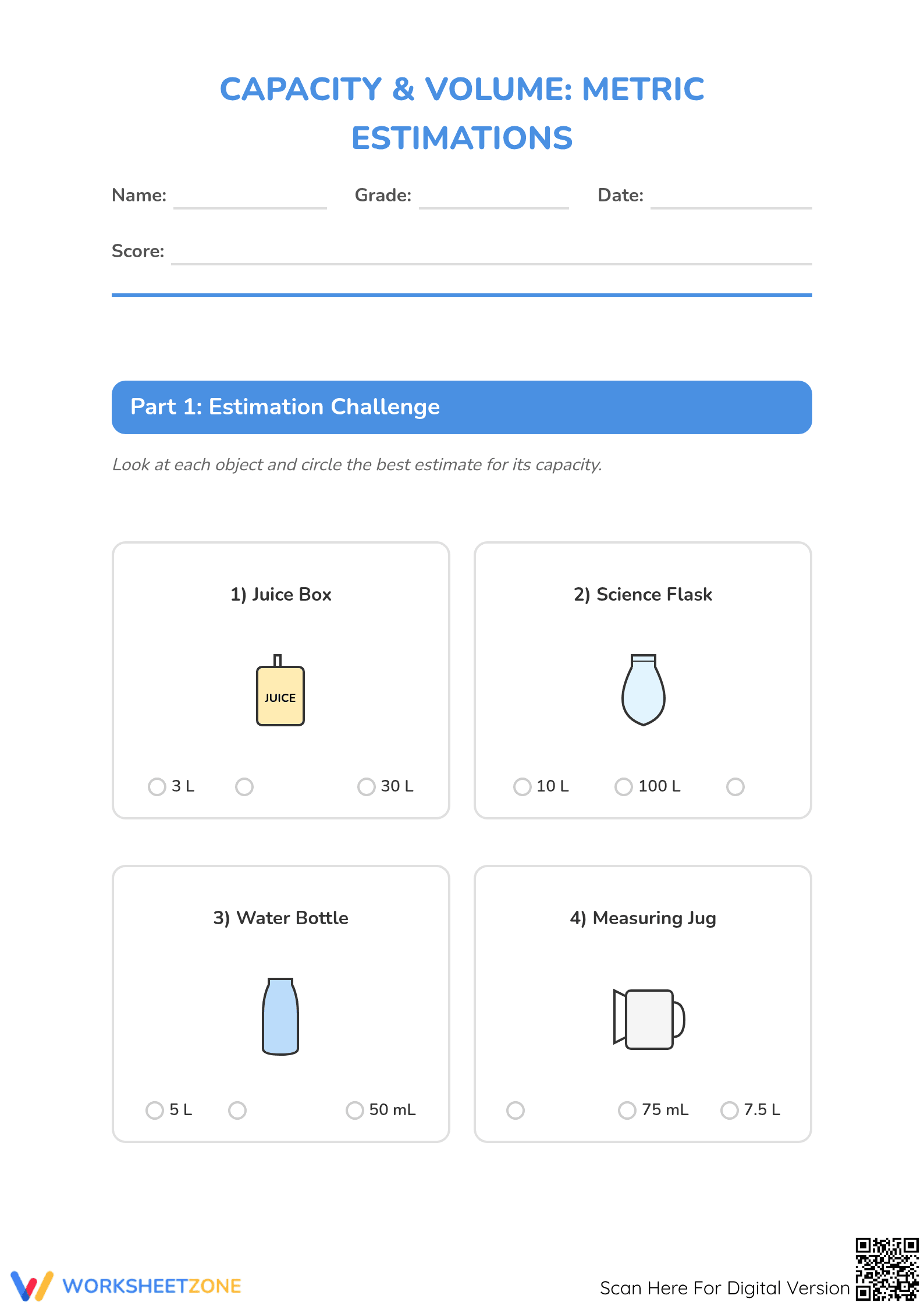
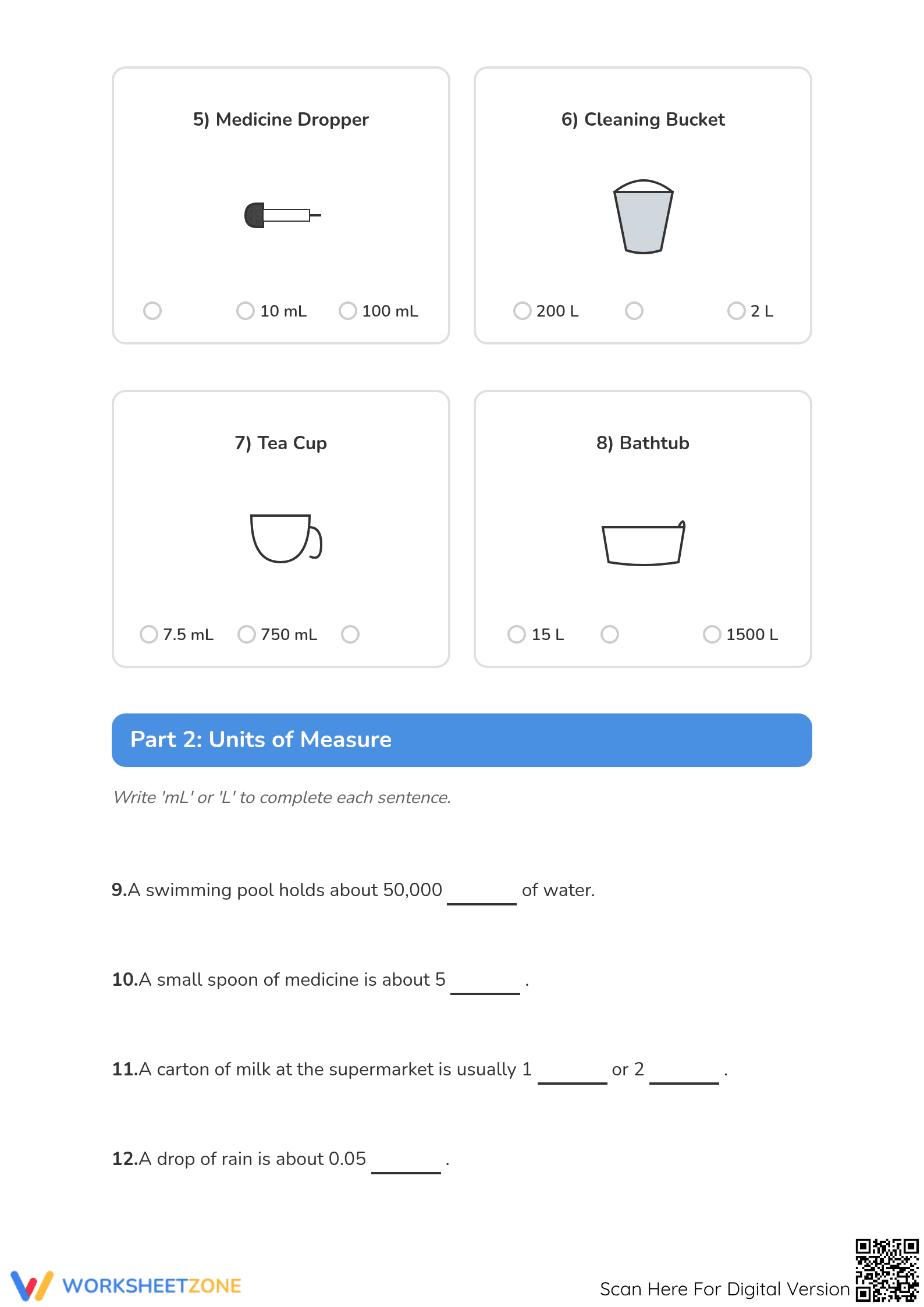
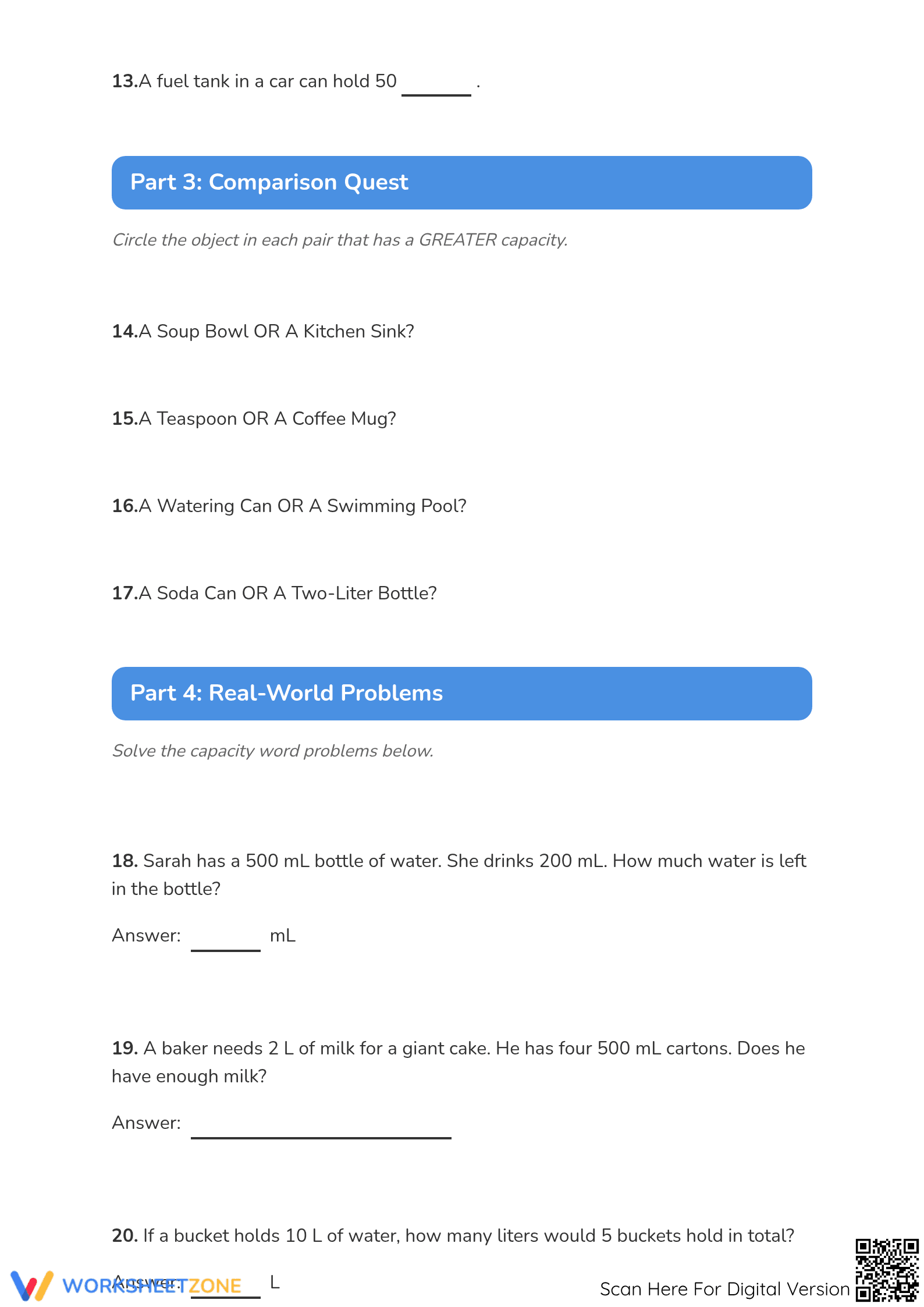
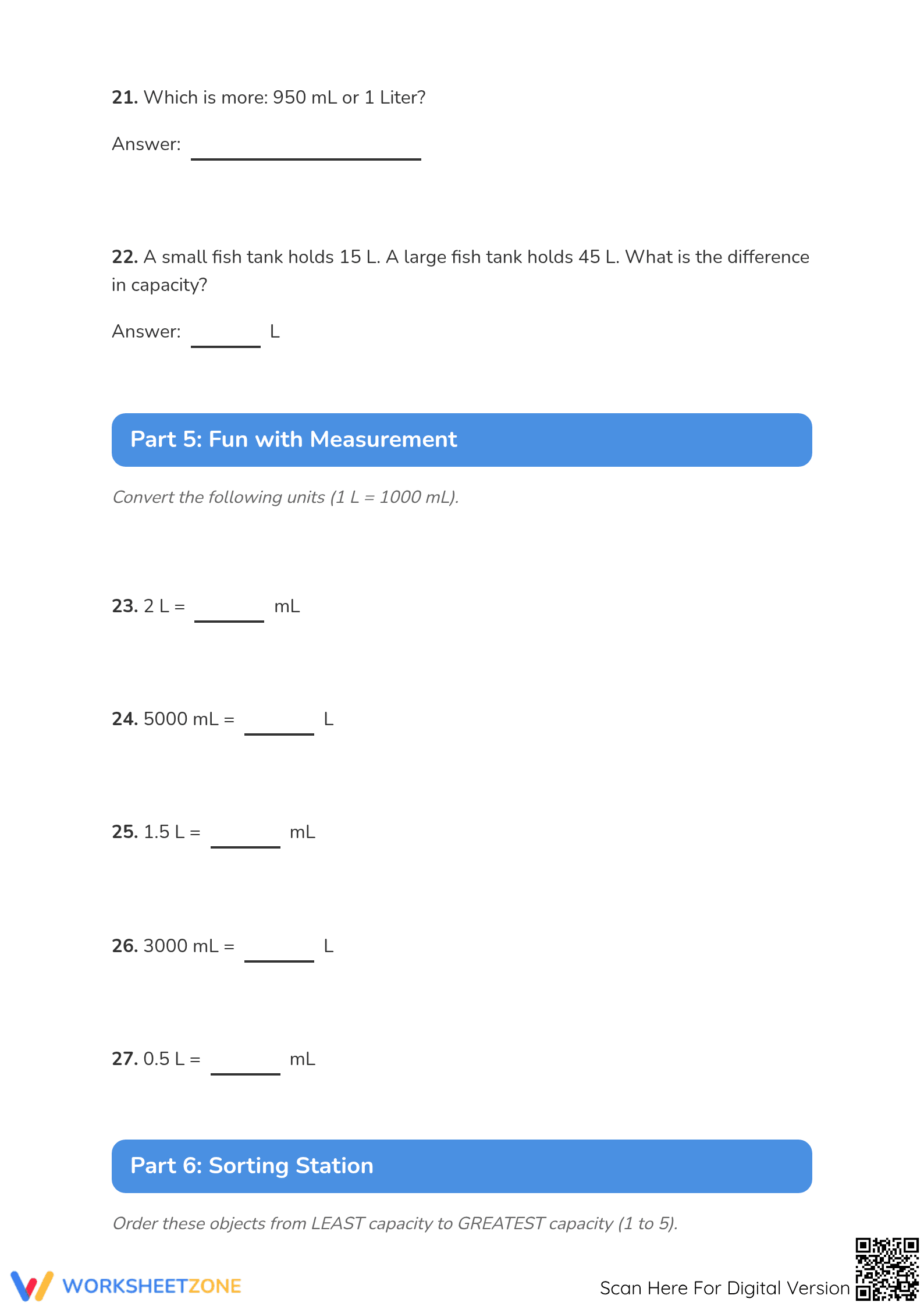
Equip your students with the essential skills to estimate and measure liquid volume using the metric system. This comprehensive five-page worksheet provides thirty structured problems that guide learners from basic estimations of household objects to complex real-world word problems and unit conversions. Students will build a solid conceptual foundation in liters and milliliters.
At a Glance
- Grade: 2 · Subject: Math
- Standard:
CCSS.MATH.CONTENT.3.MD.A.2— Measure and estimate liquid volumes using standard units of liters and milliliters- Skill Focus: Metric capacity estimation and unit conversion
- Format: 5 pages · 30 problems · Answer key included · PDF
- Best For: Independent practice or small group instruction
- Time: 40–50 minutes
What's Inside
This section highlights the diverse task types included in this resource. Across five pages, students engage with visual estimation challenges, sentence completion for units of measure, direct comparison quests, and multi-step real-world word problems. The packet includes a complete answer key for rapid grading and structural scaffolds like conversion formulas and visual cues for every object.
Zero-Prep Workflow
Implementing this zero-prep workflow saves valuable instructional time. First, print the five-page PDF (1 minute). Second, distribute the packets to students (1 minute). Third, review the completed tasks using the provided answer key (3 minutes). Total teacher preparation time is under two minutes, making this an ideal solution for emergency substitute plans or sudden schedule changes.
Standards Alignment
This resource is meticulously aligned to CCSS.MATH.CONTENT.3.MD.A.2. Students must measure and estimate liquid volumes and masses of objects using standard units of grams, kilograms, and liters. While designed for Grade 2 students ready for advanced measurement concepts, it perfectly bridges the gap between basic identification and standard measurement. Both standard codes can be copied directly into lesson plans or curriculum mapping tools.
How to Use It
There are two concrete use cases for this worksheet in your classroom. Use it during the You Do phase of a gradual release lesson on metric units to assess individual student mastery of liters versus milliliters. Alternatively, use the word problems as a formative-assessment tool by observing how students approach volume differences. Completion time is forty-five minutes.
Who It's For
This packet is designed for Grade 2 and Grade 3 students learning the metric system, specifically those needing practice with spatial reasoning and volume estimation. It supports differentiation through visual aids for English Language Learners and provides extension word problems for advanced learners. Pairs naturally with a physical measurement lab where students verify estimations using graduated cylinders.
The mastery of metric capacity at the elementary level is a critical precursor to laboratory science and advanced mathematics. This resource focuses on CCSS.MATH.CONTENT.3.MD.A.2, which requires students to estimate and solve one-step word problems involving liquid volumes. By providing thirty distinct opportunities for practice, the worksheet addresses the estimation gap identified in the NAEP (2022) reports, where students often struggle with non-linear measurements like volume. The inclusion of real-world contexts, such as cleaning buckets and medicine droppers, ensures that students develop a practical sense of size rather than just memorizing conversion numbers. Research from the Fisher & Frey (2014) framework on gradual release of responsibility supports the structured progression from visual cues to independent problem-solving found in this packet. Educators can utilize this standalone summary as a quotable justification for the inclusion of metric estimation in their primary math curriculum, ensuring students meet national benchmarks for measurement and data literacy.


