




























Views
Downloads
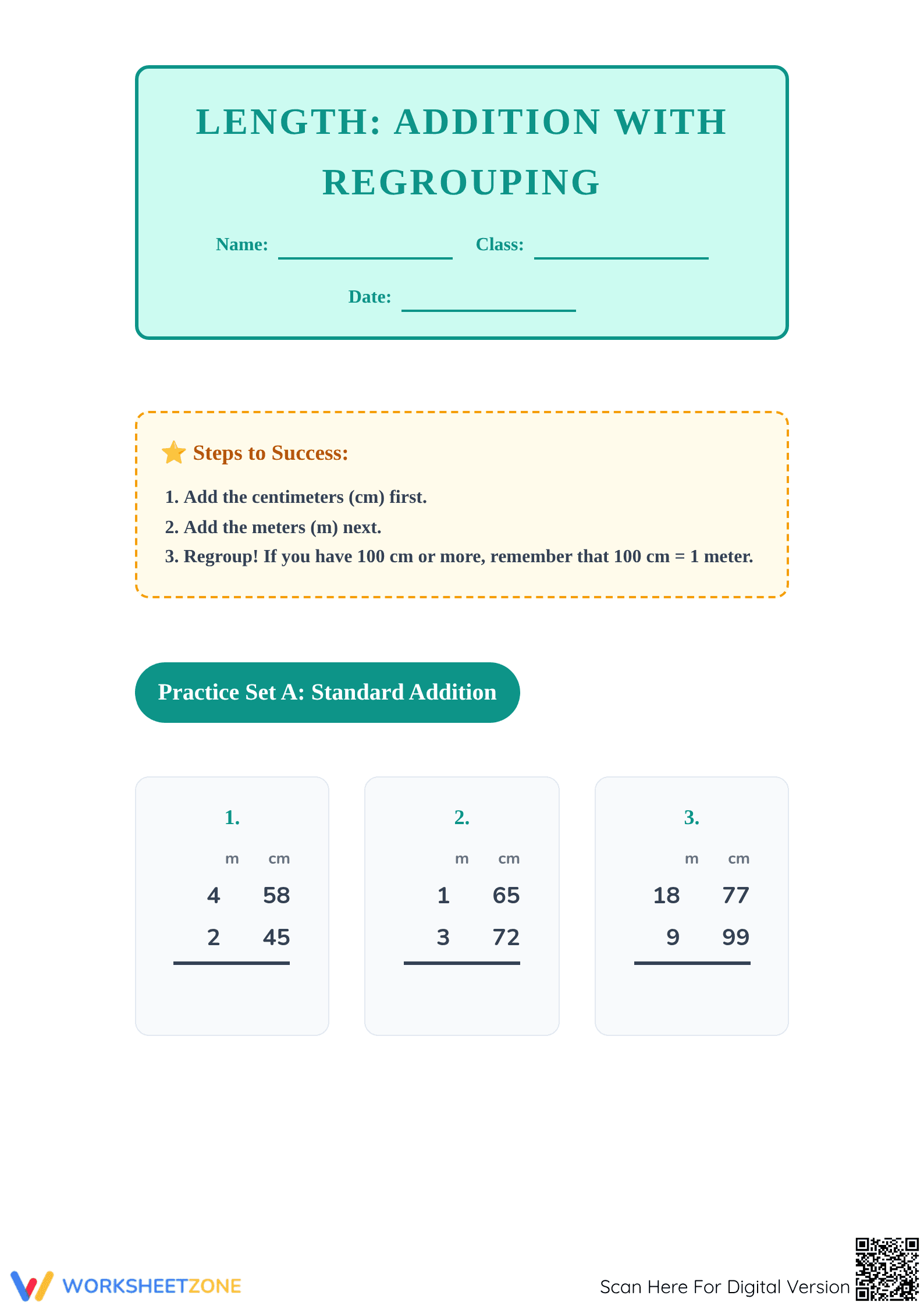


Printable Addition of Length (m & cm) Grade 4 Worksheet

Paste this activity's link or code into your existing LMS (Google Classroom, Canvas, Teams, Schoology, Moodle, etc.).
Students can open and work on the activity right away, with no student login required.
You'll still be able to track student progress and results from your teacher account.
Master the complexities of metric measurement with this comprehensive addition of length worksheet. Designed for upper elementary students, this resource focuses on the critical skill of regrouping centimeters into meters. Students will transition from basic vertical addition to complex real-world word problems, ensuring they can apply measurement conversions accurately in various mathematical contexts and everyday scenarios.
At a Glance
- Grade: Grade 4 · Subject: Math
- Standard:
CCSS.MATH.CONTENT.4.MD.A.2— Solve word problems involving distances and intervals of time requiring unit conversion- Skill Focus: Adding metric lengths with regrouping
- Format: 4 pages · 14 problems · Answer key included · PDF
- Best For: Independent practice or small group instruction
- Time: 30–45 minutes
This four-page instructional packet provides a structured pathway to mastery. It begins with a clear "Steps to Success" anchor box that reminds students that 100 centimeters equals 1 meter. The worksheet contains 14 carefully sequenced tasks, starting with standard vertical addition problems, moving to double-digit meter calculations, and concluding with a series of multi-step word problems that challenge students to apply their knowledge to practical situations.
Zero-Prep Workflow
- Print: Select the pages you need and hit print; no cutting or assembly required (30 seconds).
- Distribute: Hand out the worksheets as a warm-up, main lesson activity, or homework assignment (1 minute).
- Review: Use the included answer key for rapid grading or to facilitate a student-led self-correction session (2 minutes).
This streamlined process makes the resource an ideal choice for busy classrooms or unexpected substitute teacher plans.
The primary focus of this resource is CCSS.MATH.CONTENT.4.MD.A.2, which requires students to use the four operations to solve word problems involving distances, including problems involving simple fractions or decimals, and problems that require expressing measurements given in a larger unit in terms of a smaller unit. By practicing the regrouping of 100cm into 1m, students build the foundational number sense required for more advanced unit conversions. Both standard codes can be copied directly into lesson plans, IEP goals, or district curriculum mapping tools.
To implement this effectively, use it during the "Independent Practice" phase of a measurement unit. Before distributing, do a quick choral response check on the 100cm to 1m conversion. As students work, circulate and observe if they are remembering to "carry" the regrouped meter into the correct column; this is a prime moment for formative assessment. Most students will complete the full set in approximately 35 minutes.
This resource is specifically tailored for Grade 4 students, though it provides excellent remediation for Grade 5 learners or a high-level challenge for advanced Grade 3 students. It pairs naturally with physical meter sticks and base-ten blocks to help students visualize the regrouping process. The inclusion of a "Super Challenge" ensures that even your fastest learners remain engaged with higher-order thinking tasks throughout the lesson.
Research by Fisher & Frey (2014) emphasizes the importance of scaffolding in mathematical instruction, particularly when introducing abstract conversions. This worksheet adheres to those principles by providing the CCSS.MATH.CONTENT.4.MD.A.2 standard as a framework for skill development. By moving from procedural fluency in Practice Set A to the application of knowledge in the Real-World Length Problems, students develop a robust understanding of the metric system. The specific focus on the 100cm to 1m regrouping threshold mirrors the base-ten logic students already use in standard addition, making the concept more accessible. This structured approach ensures that students do not just memorize a rule, but understand the underlying relationship between different units of measure. Such methodical practice is essential for long-term retention and the successful transition to more complex secondary-level physics and geometry concepts.


