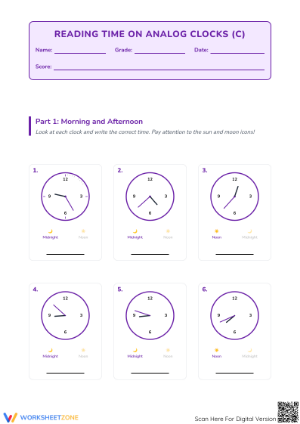
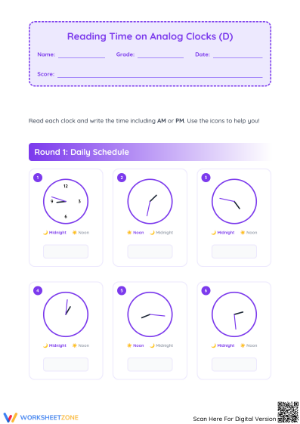
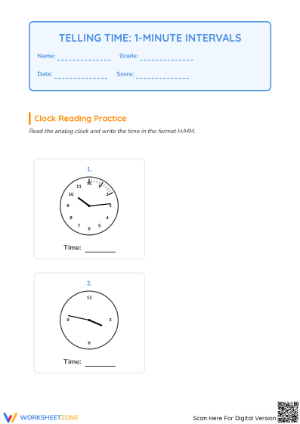
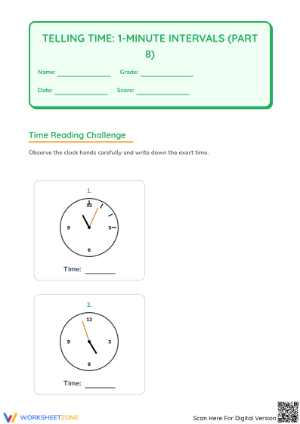
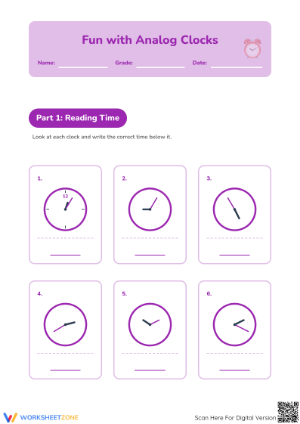
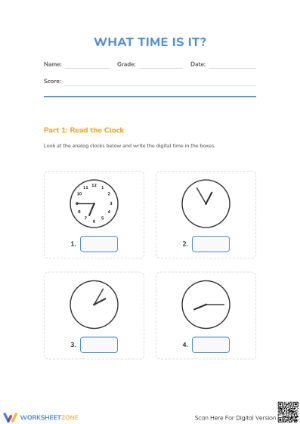
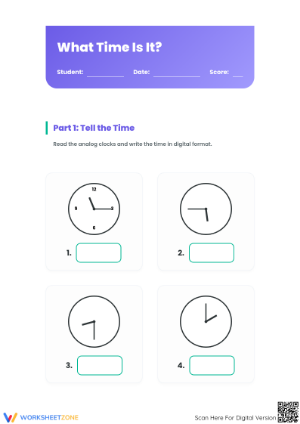
These 2nd grade time to the minute printable worksheets give teachers something that generic time-telling units rarely deliver: analog clock faces with clearly rendered individual tick marks, paired with problem types that specifically target the moment where most students stall — the switch from skip-counting by fives to counting on by ones. That mid-problem strategy shift is the real instructional challenge at this level, and these resources focus on it directly.
What Each Worksheet Targets
The 2nd grade time to the minute printable worksheets cover three distinct task types across the set:
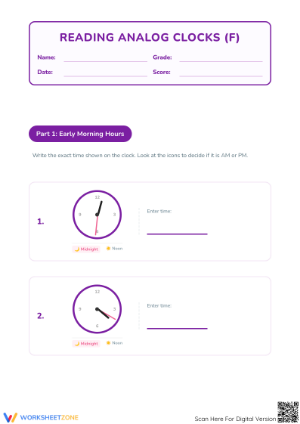
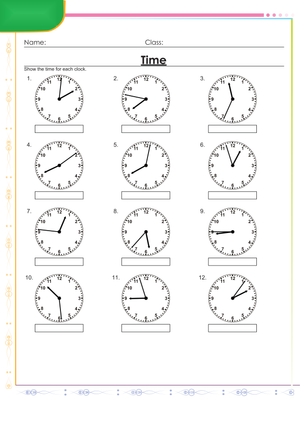
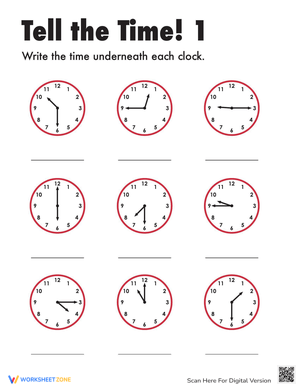
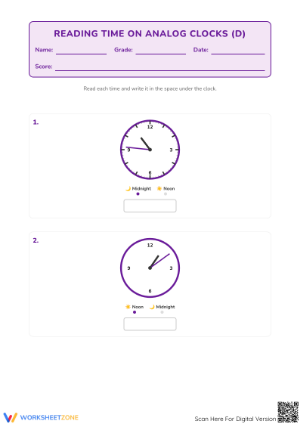
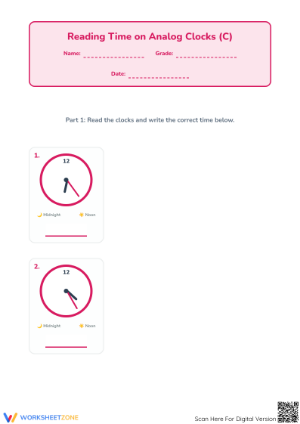
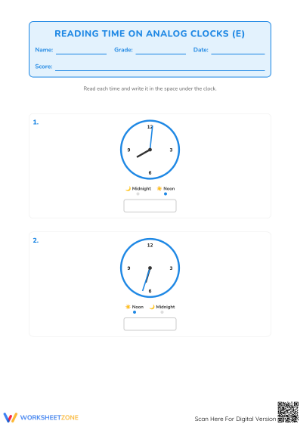
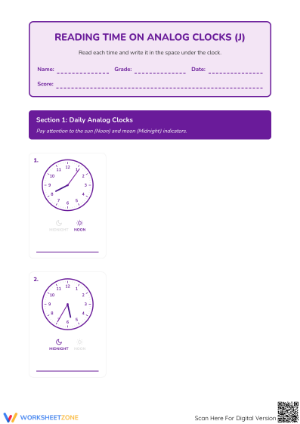
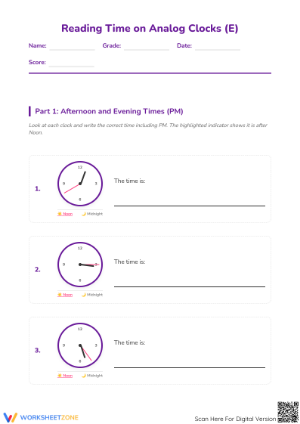
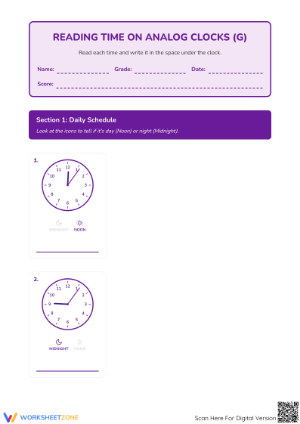
- Reading: Students examine a completed analog clock face and write the matching digital time.
- Drawing: Students receive a digital time and place both hands on a blank clock face.
- Matching: Students connect a set of analog clock images to a group of digital timestamps.
Each type tests a different facet of the same underlying skill — a student can sometimes read a clock correctly without being able to reconstruct it, and that asymmetry is worth knowing about. Drawing the hands is the most diagnostically useful task in the set. When a student writes 8:47 and draws the hour hand pointing directly at the 8, that error is immediately visible and tells you exactly what still needs to be addressed.
The Two-Step Counting Demand
Reading an exact minute requires two different counting strategies within the same problem. Students skip-count by fives from twelve to the last large number the minute hand has cleared, then switch to counting individual tick marks by ones for the remainder. At 6:23, a student counts to 20 at the 4, then adds three more ticks — twenty-one, twenty-two, twenty-three. The switch between counting modes mid-problem is harder than it sounds, especially when skip-counting by fives is still relatively new for second graders.
Several worksheets address this by presenting clocks with only the minute hand visible. Temporarily removing the hour hand isolates the harder skill so students build fluency with exact-minute identification before tracking two hands at once. Students who can name the exact minute on a single-hand clock quickly and without hesitation handle the full two-hand version with noticeably less frustration. The principle is straightforward: reduce how much needs to be tracked simultaneously until the underlying skill becomes automatic, then reintroduce the full complexity.
Common Errors Worth Anticipating Before They Calcify
The most durable mistake is misreading the hour hand when it sits close to the next number. At 2:54, the hour hand is just short of the 3, and a significant portion of students record the time as 3:54. The rule — the hour hand belongs to the number it has already passed — makes sense when stated, but students reliably revert under independent work conditions. The room concept helps: the space between the 2 and the 3 is the 2's room, and the hand is still inside it regardless of how close it is to crossing over.
A second error surfaces on drawing tasks when students are given a time like 11:55. They place the hour hand on the 12 because the time feels nearly twelve. The minute hand sitting near the 11 seems to pull the hour hand forward in their thinking. Both of these errors — misreading a near-advanced hour hand and misplacing one when drawing — appear consistently in actual student work and become visible quickly through the drawing tasks included in this set.
How to Work These Worksheets Into Your Lesson Planning
Short, regular exposures outperform longer occasional reviews for this skill. Five reading or drawing problems at the start of math block, three days a week, builds the kind of automatic recognition that spaced retrieval produces over time. One extended worksheet on Friday is less effective than the same number of problems spread across the week in smaller doses.
The matching worksheets work well in the transition minutes before dismissal or between subjects — focused, easy to manage, and requiring no setup. For math centers, laminate the drawing worksheets and supply dry-erase markers. Students reset the worksheet themselves, which extends the life of each printed set considerably and keeps centers running without constant teacher involvement.
For small-group instruction, the 2nd grade time to the minute printable worksheets pair well with a physical geared clock. A student reads a time from the worksheet, sets the geared clock to match, and a partner confirms. Students who write the correct answer on paper but cannot reliably set the geared clock are still working through the concept — that physical check surfaces the gap in a way written work alone does not.
Standard Alignment
CCSS 2.MD.C.7 requires telling and writing time from analog and digital clocks to the nearest five minutes, using a.m. and p.m. Reading to the exact minute is formally addressed by CCSS 3.MD.A.1 — a third-grade standard. These worksheets sit at that boundary deliberately. Used in late second grade, they extend practice for students who have already demonstrated solid fluency at the five-minute level. Used at the opening of third grade, they establish the precise skill that elapsed-time problems in 3.MD.A.1 depend on. Students who have not solidified exact-minute reading consistently make errors identifying start and end times, which cascades into wrong elapsed-time answers later in the year.
Adjusting the Set for Different Learners
For students still building fluency at the five-minute level, a reference strip listing 5, 10, 15 . . . 55 taped to the desk during practice removes the memorization load and keeps the focus on the counting-on-by-ones step. Once a student moves through the strip quickly and without hesitation, take it away and check whether those anchor points have genuinely been internalized.
Students who have already mastered exact-minute reading benefit from elapsed-time extensions added to drawing worksheets: "This clock shows when Kenji started his homework. He worked for 23 minutes. Write the time he finished." That extension requires no additional materials, stays within the same worksheet, and previews the third-grade work that exact-minute reading directly supports.
Frequently Asked Questions
My students read five-minute times correctly but fall apart at odd minutes. What is happening?
They are treating the skip-counting step as the complete answer. The minute hand is near a number, they count to it, and they stop — the idea that the hand can land between those five-minute anchor points has not fully settled. The 2nd grade time to the minute printable worksheets that show clocks where the minute hand always falls on the second, third, or fourth tick past a number — never on the number itself — address this directly by forcing the counting-on step every single time, with no problems that allow students to skip it.
How do I explain why the hour hand is not pointing directly at a number when the time is, say, 4:00 exactly?
At 4:00 it does point directly at the 4 — the confusion usually comes later, when students have seen that and then cannot explain why the hand would ever land between numbers. The most efficient fix is a geared clock demonstration: advance the minute hand slowly through a full rotation while students watch the hour hand creep from one number toward the next. Done without rushing, that single demonstration resolves the confusion faster than repeated written practice alone because students see the movement rather than being told about it.
Are these resources appropriate for all second graders, or mainly for students working ahead of grade level?
Realistically, exact-minute reading is a reach skill for many second graders, which is why the Common Core places it formally at third grade rather than second. These worksheets are well-suited for second graders who are solid at five-minute intervals and ready to extend that work, and for third graders building the foundational skill before elapsed-time instruction begins. Introducing them as the primary time-telling resource for an entire second-grade class early in the year would move faster than most students are prepared for.













 Interactive Worksheet Maker
 Quiz Maker
 Word Search Maker
 Crossword Puzzle Maker
 Word Scramble Generator
 Sentence Scramble Generator
 Handwriting Worksheet Generator
 Name Tracing Generator
 Fill In The Blank Generator