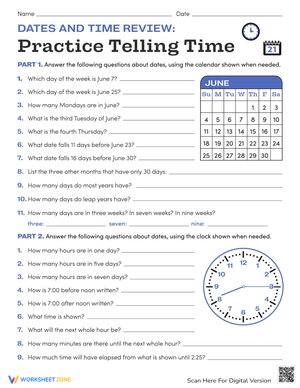
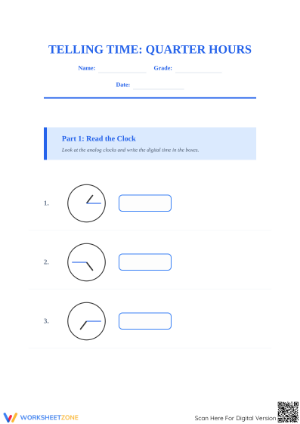
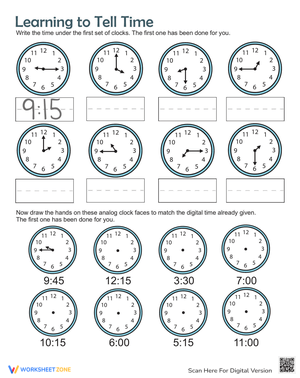
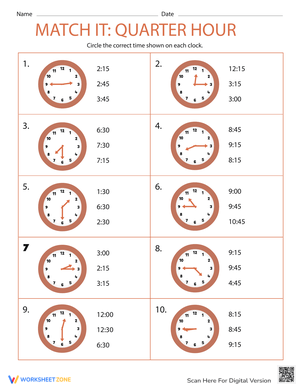
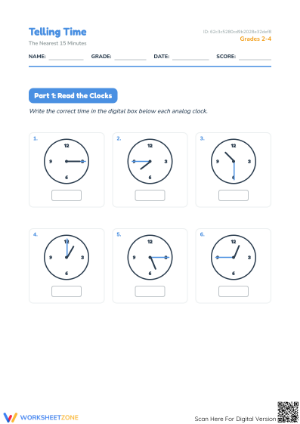
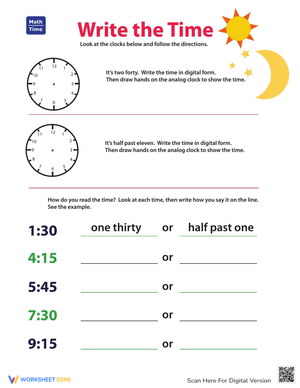
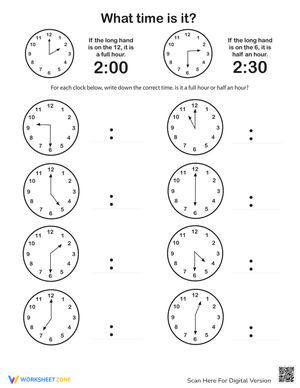
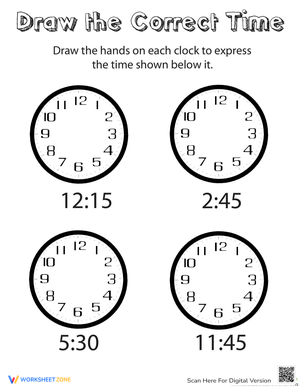
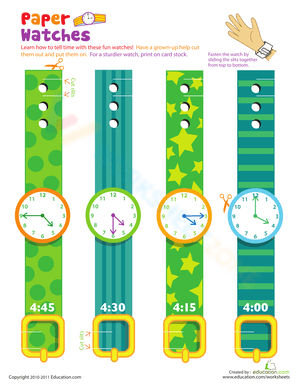
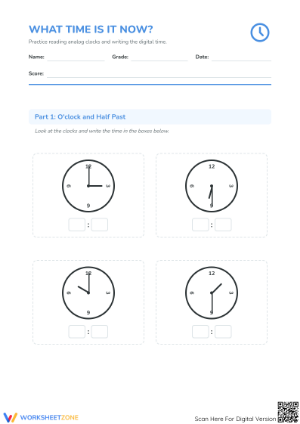
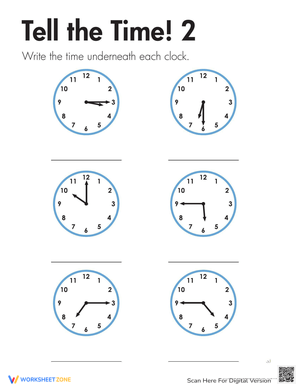
These time to the quarter hour printable worksheets for 2nd grade give teachers a focused practice set for one of the trickiest analog clock transitions in early elementary — the shift from whole and half hours into the quarter-hour intervals students will use every day for the rest of their lives. Each worksheet targets a distinct skill: reading quarter-past and quarter-to times on analog faces, converting those readings to digital notation, placing clock hands accurately from a written time, and applying quarter-hour vocabulary in simple word problems. The set moves from recognition to production, which is where most clock instruction falls short.
What's Inside the Set
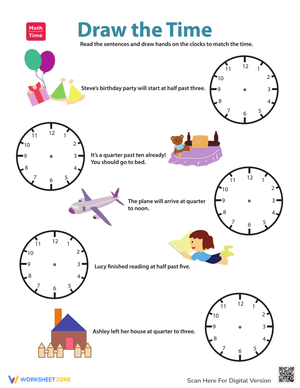
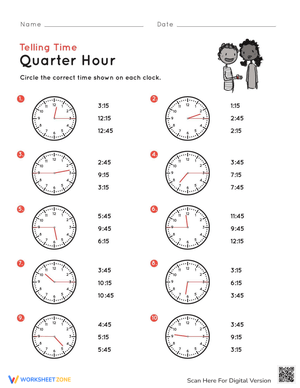
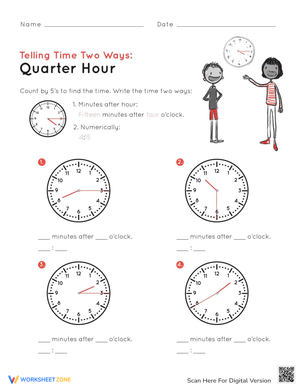
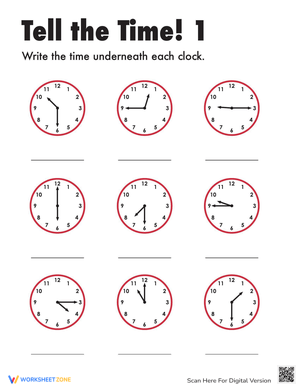
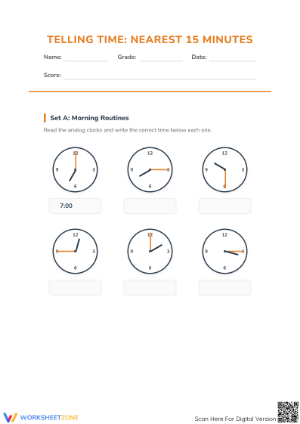
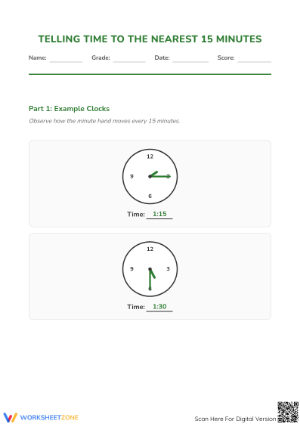
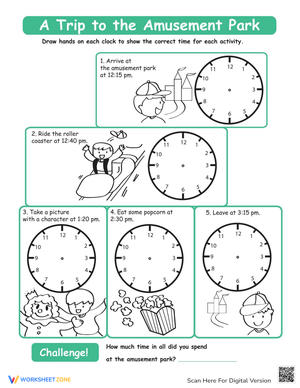
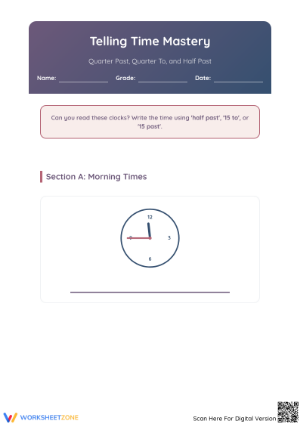
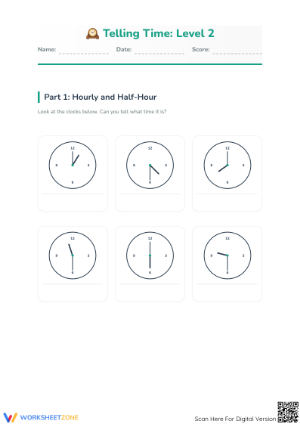
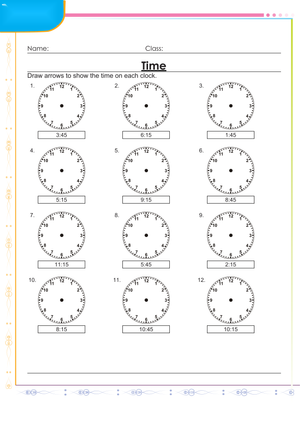
The worksheets cover the four anchor points of the clock face — on the hour, quarter past, half past, and quarter to — through several different activity formats. Matching exercises pair analog clock images with digital times, asking students to identify what the clock reads and find its equivalent. Drawing-hands worksheets flip that task: a digital time is given, and students must place the hands on a blank clock face. That second format reveals things matching activities hide — specifically, whether a student truly understands proportional placement of the hour hand or is only recognizing the minute hand position.
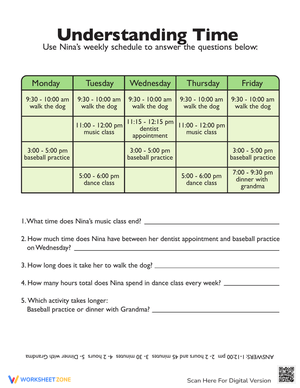
Cut-and-paste sorting activities group clock images by quarter-hour category, letting students work across a full set of times and spot the pattern rather than responding to one clock at a time. Word problem worksheets present simple daily-schedule scenarios — music class starts at quarter past two, lunch ends at half past twelve — and ask students to either draw the time or write it in digital format. The vocabulary terms quarter past, half past, and quarter to appear consistently across these worksheets so students encounter the phrasing in multiple contexts, not just as isolated definitions.
Mistakes Students Keep Making That These Worksheets Help You Catch
The hour hand is responsible for most of the errors second graders make on quarter-hour tasks. When the minute hand sits on the nine — signaling a quarter-to time — the hour hand is crowded close to the next number on the dial. A student reading 2:45 will often report 3:45 because the hour hand looks like it is pointing at the three. This is not carelessness; it is a predictable developmental error. Young readers have just learned to look at the number the hand points toward, and at 2:45 that logic produces the wrong answer. Direct instruction has to make explicit that the hour hand is always between two numbers during any quarter-to time, and that it belongs to the smaller of those two numbers until it physically reaches the next one. A useful classroom anchor: tell students the hour hand lives in the "room" of the smaller number until it crosses the threshold into the next. If the hand is between the two and the three, it is still in the two's room — full stop.
A second error pattern shows up in the vocabulary. Quarter past and quarter to both carry the word "quarter," and students use them interchangeably before the directional logic settles in. Students who correctly read 3:15 on a clock face will still write "quarter to four" rather than "quarter past three." Pairing the vocabulary terms with their clock-face positions consistently — and asking students to label clocks rather than circle answers — exposes this confusion faster than any multiple-choice format does.
Standard Alignment
CCSS 2.MD.C.7 requires second graders to tell and write time from analog and digital clocks to the nearest five minutes, including the use of a.m. and p.m. Quarter-hour fluency sits one level below that standard in terms of granularity, but it functions as the essential foundation before students can count by fives around the clock face. The quarter-hour positions — the 3, 6, and 9 on the minute-hand scale — are where students learn to stop, confirm what they know, and count forward from a fixed point. Teachers who rush past the quarter-hour phase typically see the confusion resurface when students try to read times like 4:20 or 7:35, because they have no reliable anchor points to work from. The time to the quarter hour printable worksheets for 2nd grade build the anchor-point fluency that makes the full five-minute standard reachable later in the year.
Smart Ways to Work These Worksheets Into Your Week
The most effective use of this set is distributed across weeks, not concentrated into a single clock unit. Running through all the quarter-hour worksheets during one math unit and moving on produces short-term performance and long-term forgetting. Spaced retrieval — returning to a skill days or weeks after initial instruction — is what converts exposure into durable knowledge. A practical approach: introduce the concept with direct instruction and a demonstration clock, use two or three worksheets during the unit for initial practice, then return to one additional worksheet every two to three weeks as a brief warm-up for the rest of the semester.
Drawing-hands worksheets work well during the first five to eight minutes of math class, before the main lesson begins. Matching and sorting worksheets fit easily into math centers where students work independently. The word problem worksheets are best used after students have solid reading fluency with the analog face — assigning them too early adds language-processing load on top of an already demanding visual task, and students stall on the reading rather than the math. Time to the quarter hour printable worksheets for 2nd grade that focus on drawing hands are also strong choices for individual formative assessment: a teacher can scan a class set in a few minutes and immediately see which students are placing the hour hand incorrectly during quarter-to times.
Differentiating the Set Across Ability Levels
Students who are not yet secure with whole-hour and half-hour readings need a narrower entry point before working through the full quarter-hour set. Limit initial practice to clocks showing exactly on the hour and half past. Once those two positions are automatic, introduce quarter-past, and then quarter-to last — the directional vocabulary on quarter-to is the steepest cognitive climb, and students handle it better when the other three anchor points are already stable. Matching worksheets with just those two formats, paired with consistent color-coding on the clock hands, give these students a structured entry without overwhelming them.
For students who read quarter-hour times accurately but work slowly, drawing-hands worksheets push fluency further than additional matching practice does. Remove color-coded hands as a self-check crutch and time a short set of clock-drawing problems to build automaticity. Students who are fully fluent and ready for extension benefit from mixed worksheets that include five-minute intervals alongside quarter-hour times — this anticipates the full 2.MD.C.7 standard and shows them how the quarter-hour anchors they have mastered connect to the broader clock face.
Frequently Asked Questions
How do I introduce the word "quarter" to students who haven't studied fractions yet?
Skip the numerical explanation entirely at first. Draw a large circle on the board, divide it into four equal sections like a pizza, and tell students that each section is called a quarter. Show that when the minute hand travels through one section, one quarter of the clock has passed. Color-coding the four sections makes the spatial concept concrete without touching fraction notation. Most second graders can hold the idea of "one of four equal pieces" well before they can formalize it as one-fourth — and that spatial understanding is all they need to make sense of the vocabulary in clock reading.
What's the most effective way to teach the difference between "quarter past" and "quarter to"?
Use a demonstration clock and emphasize motion rather than position. Show the minute hand moving from the twelve — it passes the three (quarter past), continues to the six (half past), then reaches the nine. At the nine, point out that the hand is climbing back up toward the twelve, getting close to the next hour but not there yet. That is "quarter to" the next hour. The directional framing — past means already gone, to means not yet arrived — gives students language that makes the distinction logical rather than arbitrary. Working through time to the quarter hour printable worksheets for 2nd grade that place quarter-past and quarter-to clocks side by side gives students the direct comparison that cements the difference in a way that isolated examples cannot.
How do I help students who consistently mix up the hour and minute hands?
Two strategies work reliably in combination. First, use consistent color on your demonstration clock — red for the short hour hand, blue for the long minute hand — and ask students to use matching colored pencils when they draw hands on their worksheets. Second, use the length of the words as a memory anchor: "hour" is a short word, just like the hour hand; "minute" is a long word, just like the minute hand. Students who still mix up the hands after several weeks of practice typically need time with a physical demonstration clock — turning the hands themselves, not just observing — before worksheet-based practice can reinforce what they have learned.













 Interactive Worksheet Maker
 Quiz Maker
 Word Search Maker
 Crossword Puzzle Maker
 Word Scramble Generator
 Sentence Scramble Generator
 Handwriting Worksheet Generator
 Name Tracing Generator
 Fill In The Blank Generator