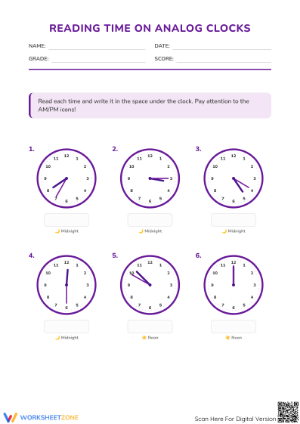
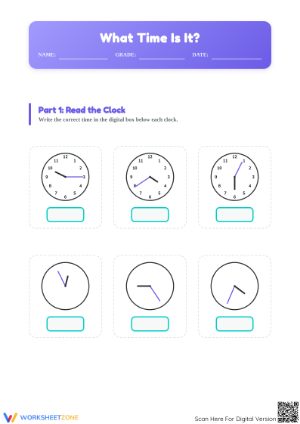
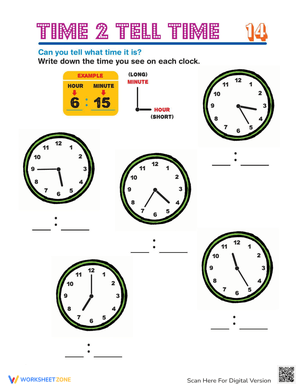
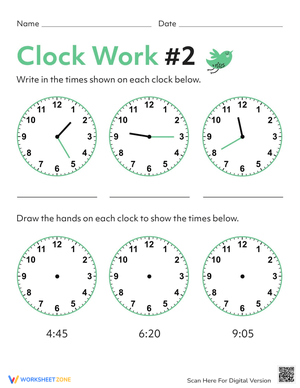
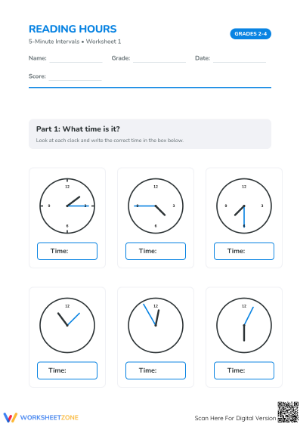
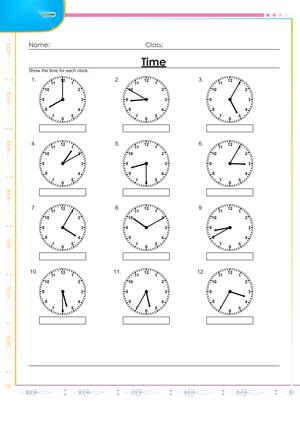
These 2nd grade time to the nearest five minutes worksheets put analog clock reading, digital clock writing, hand-drawing exercises, and a.m./p.m. identification into one downloadable set teachers can use the same day it arrives. The skill looks straightforward from the outside — it's just reading a clock — but second graders are managing three separate demands at once: skip counting by fives, tracking which hand does what, and interpreting the proportional position of the hour hand when it sits between two numbers.
What's Inside the Set
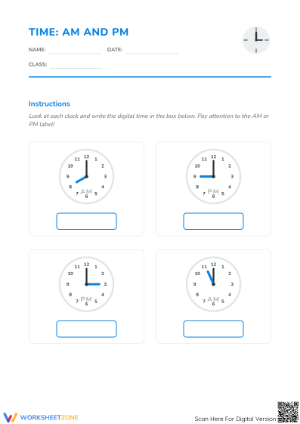
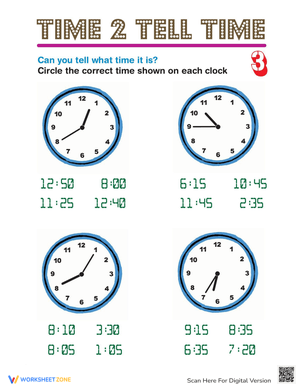
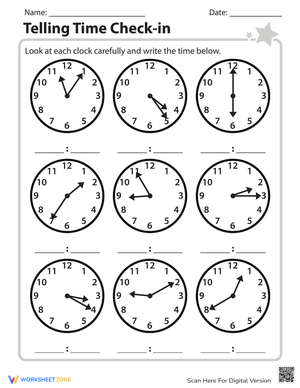
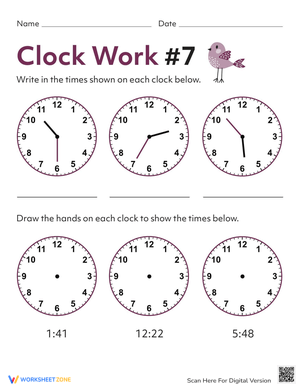
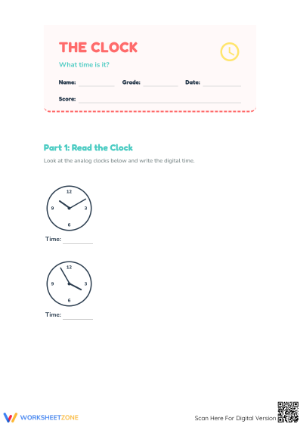
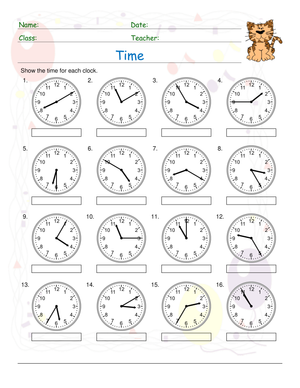
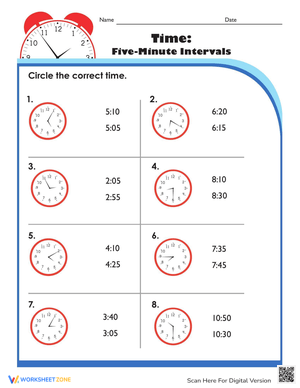
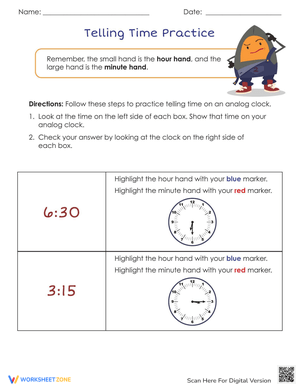
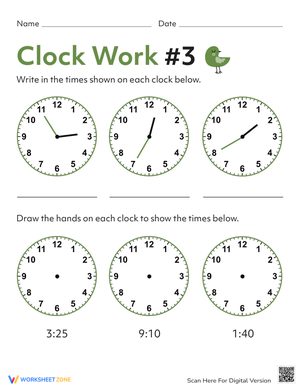
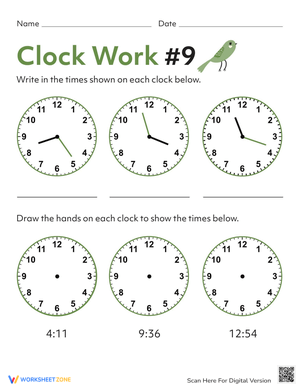
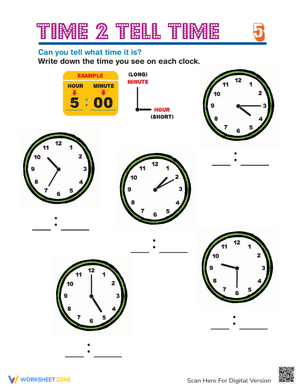
Each worksheet targets a distinct task rather than mixing every clock skill onto the same exercise. Some worksheets present completed analog clock faces and ask students to write the matching digital time. Others show a digital time and require students to draw both hands onto a blank clock face — a task that forces students to reason about hand length and placement, not just numeral position. Additional worksheets pair a clock face with a short contextual description and ask students to identify whether the time shown falls in the a.m. or p.m., addressing the second half of the grade-level standard directly.
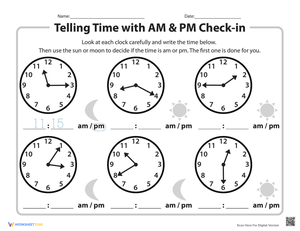
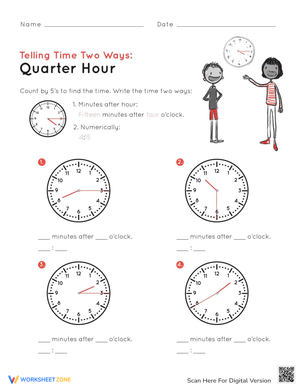
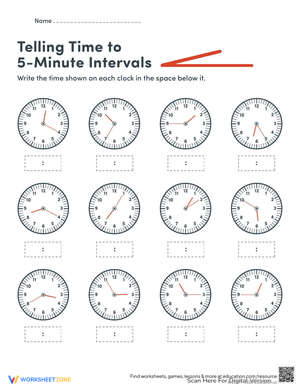
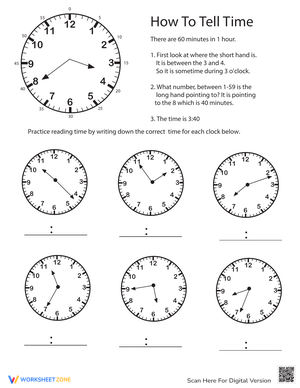
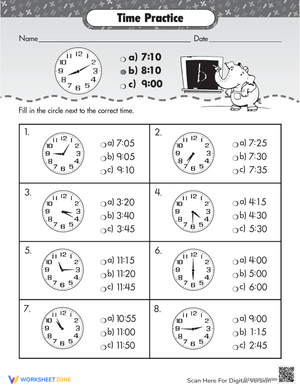
- Reading analog clock faces and recording the time in digital format
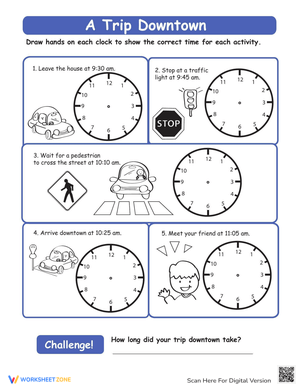
- Drawing hour and minute hands on blank clock faces from a given time
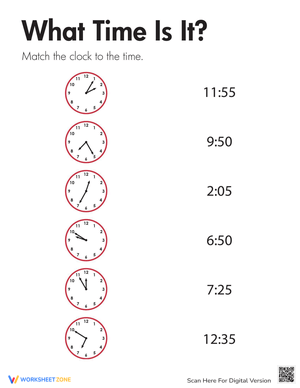
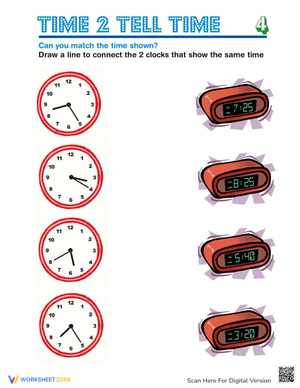
- Matching analog displays to their digital equivalents
- Labeling times as a.m. or p.m. using context clues
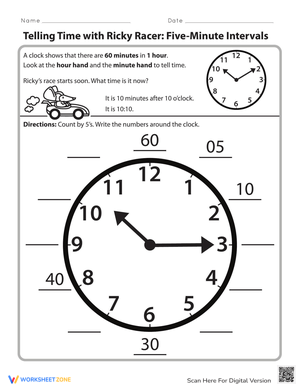
- Labeling minute values around a clock face to connect numerals 1–12 with their five-minute equivalents
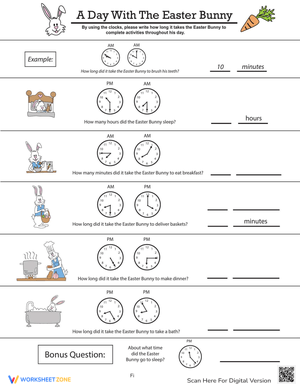
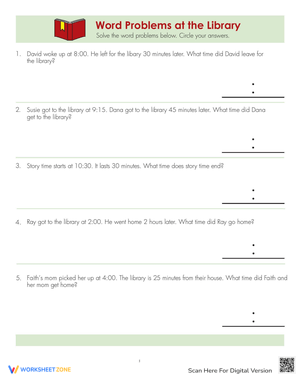
- Short word problems that ask students to identify when a daily event begins or ends
Student Errors Worth Anticipating Before the Lesson
The most stubborn mistake appears when the minute hand is in the final quarter of its rotation — roughly from the 9 to the 11. At 6:50, the hour hand sits close enough to the 7 that students scanning its position quickly will record the time as 7:50. This isn't careless; it reflects a real misunderstanding that the hour hand moves continuously rather than jumping at the stroke of the hour. Worksheets that include times like 3:55, 8:50, and 11:45 push this issue into the open where it can be corrected through direct instruction rather than discovered weeks later on an assessment.
A second pattern shows up reliably in student work: children who skip count accurately to 25 or 30 often lose the sequence past 35. The minute positions near the 8, 9, 10, and 11 get less practice in standard skip-counting activities, so the far side of the clock is less automatic. The hand-drawing exercises make this visible immediately — if a student draws the minute hand pointing at the 10 when asked to show 6:35, the miscount is right there on the worksheet rather than hidden inside a circled multiple-choice answer.
Standard Alignment
CCSS.MATH.CONTENT.2.MD.C.7 requires students to tell and write time from analog and digital clocks to the nearest five minutes, using a.m. and p.m. correctly. In classroom terms, this standard sits at the intersection of measurement and number sense — students cannot meet it without skip counting by fives up to 60, which is why time instruction often functions as a fluency checkpoint. The standard appears in the Measurement and Data domain, but the prerequisite work lives in Operations and Algebraic Thinking, specifically the skip-counting expectations introduced in 2.OA. When a student stalls on clock reading, the root cause is frequently a fluency gap there rather than a conceptual problem with time itself.
Fitting These Worksheets Into Your Weekly Math Block
The most efficient use of the 2nd grade time to the nearest five minutes worksheets is as a four-day morning warm-up sequence early in the unit, paired with a physical demonstration clock at the front of the room. Students look at the time you've set, write it on the worksheet, then compare answers — the exchange takes about eight minutes and generates visible, immediate feedback without cutting into core instruction time.
During small-group rotations, the hand-drawing worksheets work especially well at the teacher-led station. Watching where students hesitate — whether they're uncertain about which hand is longer, where the 35-minute mark falls, or how to handle times close to the hour — lets you catch and correct the misunderstanding before it becomes automatic. Save the matching and word-problem worksheets for independent practice or math centers after direct instruction has established the basics.
Adjusting the Set for Different Ability Levels
For students still building skip-counting fluency, add a reference strip along the top of the worksheet showing clock positions 5, 10, 15 ... 55 alongside the numerals 1 through 12. This gives students a tool for working through the problem independently rather than stalling and guessing. Pull the strip once a student completes two or three worksheets successfully — most students stop needing it faster than teachers expect.
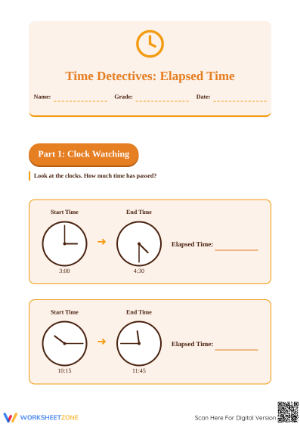
Students who read five-minute times reliably are ready for the extension work embedded in the word-problem worksheets: reasoning about what time an event ends, scheduling two activities back to back, and distinguishing between a.m. and p.m. for events near noon. Those tasks aren't a detour from 2nd grade time to the nearest five minutes worksheets practice — they're the evidence that a student has internalized the skill rather than memorized a procedure for a narrow range of clock positions.
Frequently Asked Questions
What standard does this set address?
The worksheets align to CCSS.MATH.CONTENT.2.MD.C.7, which requires second graders to read and write time from both analog and digital clocks to the nearest five minutes and to use a.m. and p.m. accurately. Each worksheet focuses on one or more components of that standard, so teachers can select specific exercises based on where students are in the unit.
My students can skip count by fives but still struggle to read the clock. Why?
Skip counting in isolation and skip counting around a clock face are genuinely different tasks. Students who recite 5, 10, 15, 20 without hesitation can still lose the thread when they have to locate the 7 on the clock face, translate it to 35, and simultaneously decide where the hour hand falls. The blank-clock labeling exercises bridge that gap by having students write minute values next to each numeral before attempting to read any times — the translation becomes visible rather than mental, which is where it needs to start.
How do I help students who keep adding an extra hour when the minute hand is near the 12?
This is the classic hour-hand creep error, and it responds to direct instruction, not more repetition of the same task. Show students — using a geared demonstration clock — that the hour hand travels one full slice between any two adjacent numbers during a single minute-hand revolution. Color-coding helps: as long as the hour hand is anywhere inside the slice between the 6 and the 7, the hour is 6. It does not become 7 until the minute hand completes the full circle and the hour hand crosses into the next slice. Once students think in zones rather than proximity, the error drops off quickly.
Do the worksheets include a.m. and p.m. practice?
Yes. Several worksheets pair a clock face with a short contextual image or description — a bowl of cereal, a window showing stars — and ask students to write the correct time and circle a.m. or p.m. The 2nd grade time to the nearest five minutes worksheets treats a.m./p.m. as part of clock fluency rather than a separate mini-unit, which matches how the standard frames it.
Which worksheets work best without teacher supervision in a math center?
The clock-reading and analog-to-digital matching worksheets run well as independent center tasks after students have had direct instruction on hand identification and skip counting. The hand-drawing worksheets are better kept near the teacher early in the unit — when a student draws the minute hand in the wrong position at a center, there is no one to catch it, and the error goes unaddressed until the next check-in. Use those with teacher proximity until students show consistent accuracy across at least two worksheets in a row.













 Interactive Worksheet Maker
 Quiz Maker
 Word Search Maker
 Crossword Puzzle Maker
 Word Scramble Generator
 Sentence Scramble Generator
 Handwriting Worksheet Generator
 Name Tracing Generator
 Fill In The Blank Generator