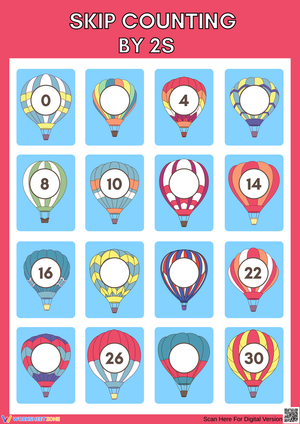
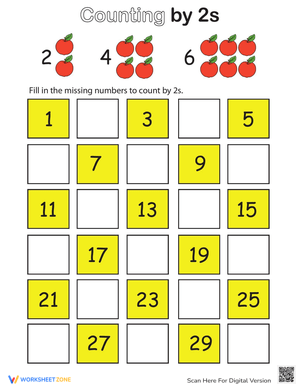
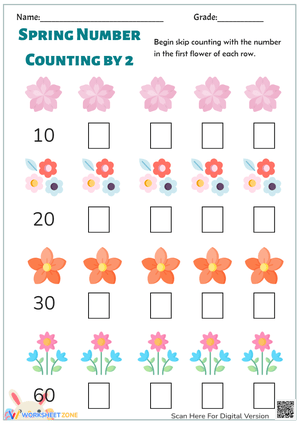
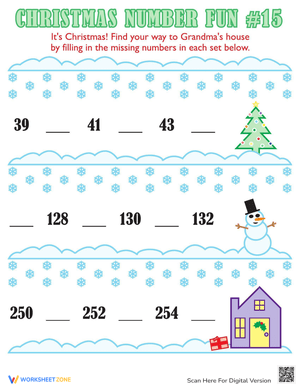
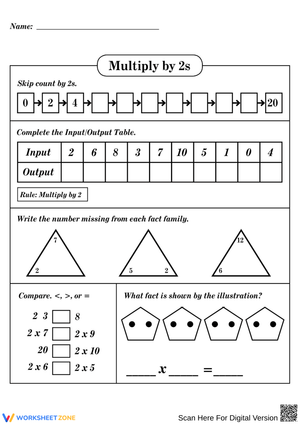
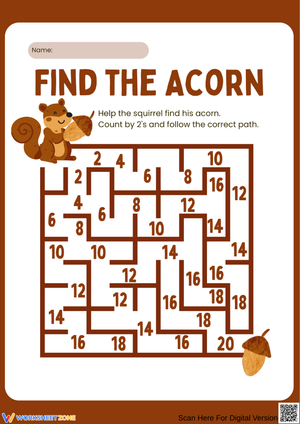
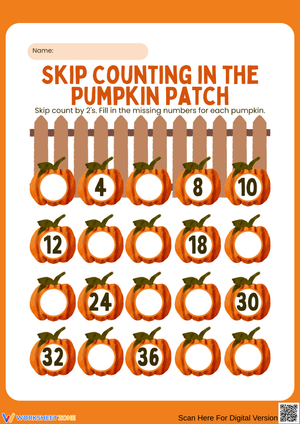
These by 2 worksheets for 2nd grade give teachers printable, ready-to-assign practice for skip counting by 2s — with enough variety in format and starting points that students can't coast on a memorized chant. The set covers number-line hops, hundreds-chart shading, fill-in sequences, and paired real-world objects, so the same underlying skill gets worked from several different angles before students move on.
What Students Practice Across These Worksheets
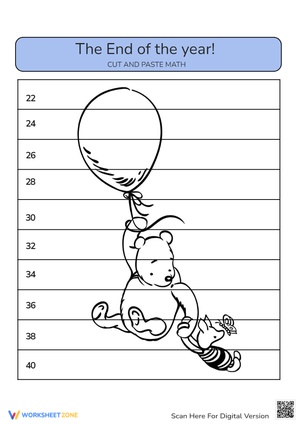
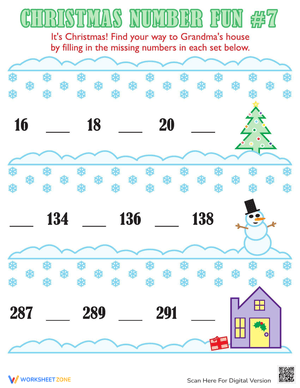
Each worksheet in this by 2 worksheets for 2nd grade collection targets a distinct piece of the skip-counting picture. Students underline even numbers on a hundreds chart, shade alternating squares, complete broken sequences where gaps fall mid-row rather than at predictable endpoints, and annotate number lines by marking each jump of two. Several worksheets ask students to write the pattern they notice in the ones digit — that the sequence always cycles through 0, 2, 4, 6, and 8 — which pushes them from rote repetition toward actual pattern recognition. A few items connect skip counting directly to even and odd numbers by asking students to circle paired groups of objects before writing the total.
What Student Work Reveals About This Skill
The most telling errors happen at decade transitions — the jump from 18 to 20, from 38 to 40, from 58 to 60. Students who have memorized the early sequence often stall exactly here and write 18 → 20 correctly, then write 28 → 38, because they are treating each decade as a separate list rather than applying a steady plus-two rule across the entire number line. Several worksheets in the set start sequences at 16, 34, or 52 specifically to push students through those transition points rather than let them lean on early-sequence recitation. The patterns that surface here are among the most reliable formative signals in early numeracy — they tell you clearly who is counting and who is reasoning.
A second pattern worth watching: students who count fluently from even starting points will often freeze or guess when asked to skip count beginning at an odd number like 3 or 7. They have internalized the even-number chant but have not separated the plus-two rule from the specific sequence. This shows up in the extension items included in the set and marks the exact boundary between procedural familiarity and conceptual understanding.
Where These Worksheets Fit in Your Teaching Week
Most teachers find the quickest entry point is arrival or morning work. A single sequence that begins mid-decade — starting at 44, for instance — takes about three minutes and gives a fast read on where students are that day. A student who writes 44, 46, 48, 50, 52 without pausing is in a different instructional place than one who hesitates after 48, and you can see that in the first few seconds of scanning the room.
For math centers, these work well as a paired task: one student reads the sequence aloud while the partner marks the jumps on a number line, then they swap roles. The by 2 worksheets for 2nd grade format prints easily in classroom sets, and individual worksheets can be pulled based on where a particular student is in the unit without having to sort through a larger packet. For exit tickets, three or four items targeting decade transitions — pulled from later in the set — are enough to tell you who needs reteaching before the multiplication unit starts and who is ready for something harder.
Standard Alignment
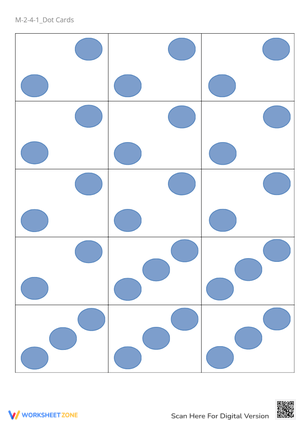
CCSS.MATH.CONTENT.2.OA.C.3 is the primary standard in play here, asking students to determine whether a group of objects (up to 20) has an odd or even number of members by pairing objects or counting by 2s. That means students need more than a chanted sequence — they need to connect counting to pairing. Worksheets that ask students to circle groups of two before writing the skip-count total build exactly that connection. The skill also supports CCSS.MATH.CONTENT.2.NBT.A.2, which covers skip counting within 1,000 by 5s, 10s, and 100s; fluency with the 2s pattern gives students the conceptual footing to generalize skip counting to other intervals when that work begins later in the same year.
Adjusting These Worksheets for Different Learners
Students who get stuck at decade transitions do better with a number line they can keep at their desk during fill-in work. A laminated strip from 0 to 100 lets them finger-hop from one even number to the next, which takes the pressure off working memory while the pattern consolidates through repetition. Once a student crosses those boundaries without the strip, pull it away — the visual support has done its job.
For students who have already internalized the even sequence, the by 2 worksheets for 2nd grade set includes extension prompts asking them to skip count by 2s starting from 1, 3, or 9. These work well as fast-finisher tasks and require no separate preparation. A student who can explain why 1 → 3 → 5 → 7 uses the same rule as 2 → 4 → 6 → 8 has genuinely understood plus-two as a principle, not just a pattern that happens to begin at an even number.
Frequently Asked Questions
How directly does skip counting by 2s connect to learning multiplication?
The connection is immediate. Reciting 2, 4, 6, 8, 10 is the same operation as solving 1×2, 2×2, 3×2, 4×2, 5×2 — repeated addition in sequence form. Students who enter third grade with the 2s skip-count automatic already have one full column of the multiplication table in memory. The difference between retrieving 7×2 = 14 and counting up to find it becomes noticeable the moment two-digit multiplication arrives, so the fluency built here pays forward directly.
What hands-on materials work well alongside these worksheets?
Connecting cubes snapped into pairs are the most straightforward manipulative for this skill. Students build a row of paired cubes, count the pairs aloud, then count the total by twos — it makes the grouping action physical before students encounter the abstract fill-in format. A floor number line made from painter's tape serves well as a whole-class launch activity, particularly when you want students to hop physically from number to number before they sit down to individual work.
How do I use these as formative assessment rather than just practice?
Pull three or four items from the set that specifically target decade transitions and assign them as a two-minute exit ticket. Rather than scoring each one, sort the papers into three groups: no errors, errors only at transitions, and scattered errors throughout. That sort takes under five minutes and tells you exactly which students need reteaching before moving forward and which are ready for the odd-start extension. The patterns in those exit tickets point to a specific instructional gap — not just that one exists, but precisely where.













 Interactive Worksheet Maker
 Quiz Maker
 Word Search Maker
 Crossword Puzzle Maker
 Word Scramble Generator
 Sentence Scramble Generator
 Handwriting Worksheet Generator
 Name Tracing Generator
 Fill In The Blank Generator