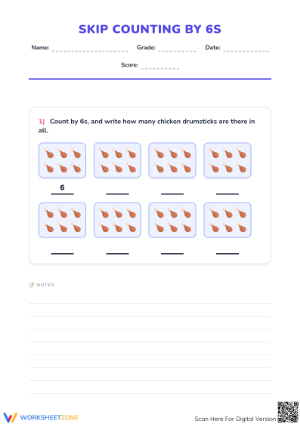
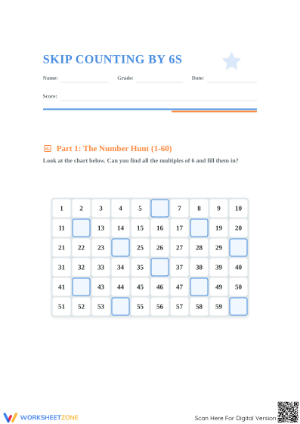
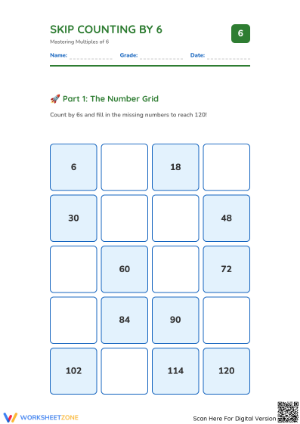
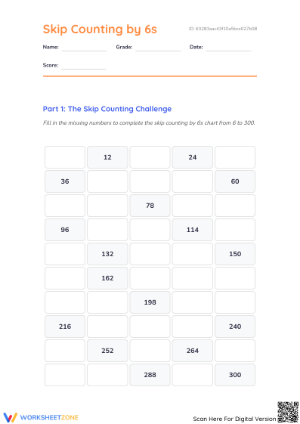
These 2nd grade by 6 printable worksheets resources give teachers a focused set of skip-counting practice across several distinct formats — filled number sequences, number line jumps, grid mazes, and short word problems built around real groups of six. Students who have already hit fluency with twos, fives, and tens will find sixes genuinely harder, and these worksheets address that specific difficulty rather than recycling generic sequence practice with a different number dropped in.
What's Inside the Set
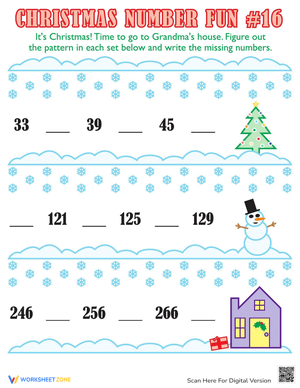
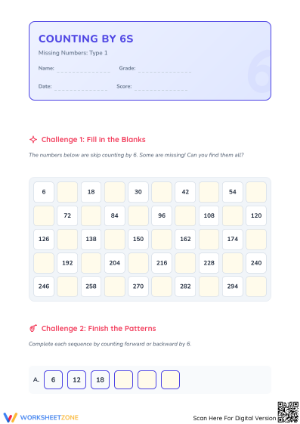
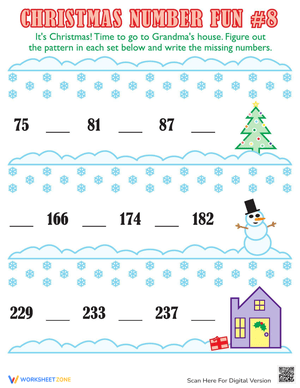
Each worksheet targets skip counting by sixes, but the format shifts enough across the set that students can't simply auto-fill by rote. Sequence-fill worksheets place the missing terms at irregular positions — in the middle of the chain, near the beginning, or at multiple non-consecutive spots — so students must count forward and backward rather than just extending a tail. Number line worksheets show each six-unit jump as a labeled arc, helping students see the distance covered with each step rather than treating the sequence as an abstract list. The maze worksheets ask students to trace or shade a path through a grid by touching only multiples of six, which requires them to distinguish correct terms from nearby distractors like 22 or 27. Word problems cap the set, framing sixes in concrete contexts — legs on a group of insects, juice boxes packed in rows — that pull students away from sequence recitation and toward applied reasoning.
The Ones-Digit Pattern That Makes Sixes Teachable
The ones-digit pattern within the sixes sequence — 6, 2, 8, 4, 0, repeating — is the most useful teaching tool here, and it's worth spending two or three minutes on it before students start any worksheet in the set. When a second grader counts 6, 12, 18, 24, 30, 36, 42, 48, 54, 60 and reads off only the ones digits, the loop becomes visible. Students who internalize that loop can predict whether their next answer is plausible before committing it to paper. The other structural feature worth flagging: every term in the sixes sequence is even. A student who lands on 23 or 37 knows immediately, without asking anyone, that an error occurred. In practice, this self-checking mechanism changes how students interact with independent work — they catch and correct mistakes mid-task rather than submitting a sequence with errors they never noticed.
Mistakes Students Make That These Worksheets Help You Catch
The jump from 18 to 24 is the most common sticking point, and it's worth planning for it explicitly rather than discovering it in a stack of graded work. Crossing through 20 requires holding 18 in working memory, adding six, and bridging through a decade boundary — a more demanding operation than adding six within a single decade. Many students write 18, 23: they default to adding five, the easier near-double, rather than six. Others navigate 18, 24 correctly through 30 but stall again at 54 to 60, which requires the same bridging logic. A separate and trickier pattern: students who produce a sequence that is internally consistent — every step exactly six apart — but started from the wrong anchor. That sequence looks fluent at first glance. Checking the first term is the fastest way to catch it.
How to Build These Worksheets Into Your Week
Sequence-fill and number line worksheets work well as Monday warm-ups — a quiet, low-stakes entry task that re-activates number sense after the weekend without requiring any whole-class setup to begin. The maze worksheets are better suited to math center rotations mid-week, where students need a format that holds independent attention for a sustained stretch and provides a clear finish line. Word problems belong later in the unit, once the sequence itself is reasonably automatic, so that reading comprehension demands don't compete with still-uncertain sequence retrieval. The 2nd grade by 6 printable worksheets set is organized so each worksheet stands alone — a teacher can pull the maze worksheet for centers on Tuesday without needing to assign the number line activity first.
For homework, the sequence-fill worksheets are the most practical choice: the task is self-evident to parents, no instructions required, and it gives families a direct view of what their child is working on. Paired checking — two students comparing their fills and reading the answers aloud together — adds a brief oral component and catches the copying errors that slip through silent independent practice.
Adjusting the Set for Different Learners
Students who are not yet secure adding across tens get the most from the number line worksheets first, where the arc of each six-unit jump is drawn out before any abstract filling-in is required. Pairing those students with a hundred chart where every sixth number is shaded lets them cross-reference their work without waiting on teacher feedback at each step. For students who grasp the sequence quickly, the maze and word problem worksheets raise the demand without requiring additional materials: the maze adds a spatial-reasoning layer, and the word problems ask students to apply the sequence rather than just recite it. Having early finishers write their own word problem using a multiple of six — a beetle with a certain number of legs, cartons arranged in equal rows — reveals depth of understanding that no fill-in-the-blank activity can replicate. The 2nd grade by 6 printable worksheets set is also accessible for ELL students in the visual formats, where the mathematical content travels independently of reading load.
Standard Alignment
The primary anchor is 2.NBT.2, which requires students to count within 1,000 and skip count by 5s, 10s, and 100s. Counting by sixes extends that standard's intent: students apply the same base-ten reasoning to a less familiar interval, which tests genuine understanding rather than memorized performance on the named numbers. The ones-digit pattern work in these 2nd grade by 6 printable worksheets resources also supports Mathematical Practice Standard MP.7 — "Look for and Make Use of Structure" — because students use a repeating structural pattern to predict and verify terms rather than computing from scratch each time. In terms of classroom placement, this set sits after twos and fives are secure and before formal multiplication is introduced in third grade. That window matters: second graders who can already count equal groups fluently by a non-standard interval arrive at multiplication with an experiential referent for what the operation actually means, not just a symbol to memorize.
Frequently Asked Questions
How does counting by sixes connect to multiplication, and when should I make that connection explicit with second graders?
Counting 6, 12, 18, 24 is the same computation as 1×6, 2×6, 3×6, 4×6. Most second graders don't need the formal symbolic language yet — the connection is most useful as a bridge when they hit third-grade multiplication. What's worth saying in second grade is simpler: these are equal groups, and counting groups is something they already know how to do. If a student asks why these numbers feel familiar, that's the moment to surface the connection. Otherwise, let the fluency build without the symbolic overlay competing for attention.
My students recite the sequence correctly aloud but freeze when a middle term is missing. Why does that keep happening?
Reciting from the beginning is a retrieval chain — each number cues the next. Finding a missing middle term is a different skill entirely: starting from a known anchor and counting forward or backward in six-unit increments, which draws on working memory rather than retrieval fluency. Students who perform well on oral recitation often struggle with the fill-in-the-blank format until they've had sustained practice entering the sequence at points other than the beginning. The worksheets that place blanks mid-sequence are built specifically to address this gap.
One of my students is not yet fluent with basic addition. Can I still use these worksheets with them?
Start with the number line worksheets. A student who isn't yet fluent adding six mentally can touch each mark on the number line as a concrete counting tool — moving six steps at a time — until partial memorization begins to take hold. The goal is to reduce the arithmetic demand enough that the student can engage with the sequence at all, then gradually withdraw the visual support as retrieval becomes more automatic. Jumping directly to sequence-fill with a student who isn't yet secure on addition to 20 tends to produce frustration rather than productive practice, and frustration at this stage delays the fluency you're trying to build.













 Interactive Worksheet Maker
 Quiz Maker
 Word Search Maker
 Crossword Puzzle Maker
 Word Scramble Generator
 Sentence Scramble Generator
 Handwriting Worksheet Generator
 Name Tracing Generator
 Fill In The Blank Generator