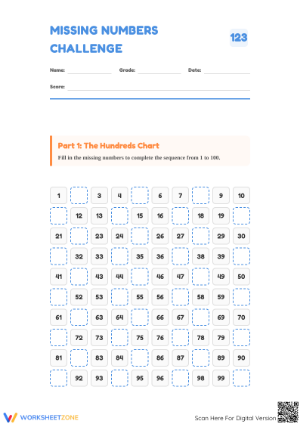
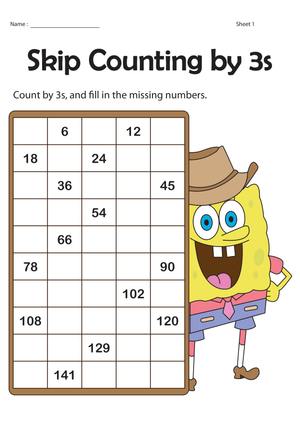
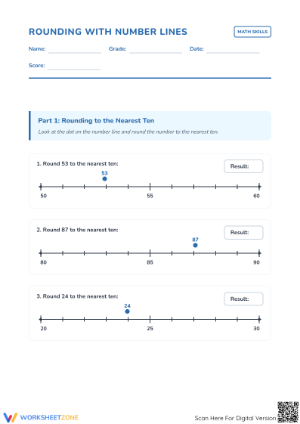
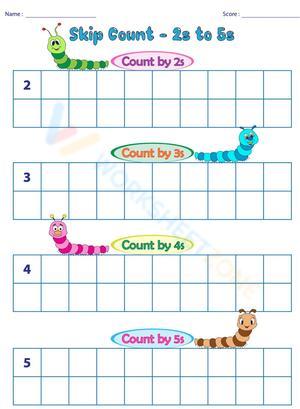
2nd grade by 3 worksheets give teachers printables for building the skip-counting sequence that trips up more second graders than most would predict. The jump from counting by twos and fives to counting by threes is steeper than it looks, and understanding exactly why changes how you teach the first lesson. This set covers missing number sequences, hundreds chart coloring, number line jumps, and path-tracing mazes — formats that test the concept from different angles rather than practicing the same skill repeatedly in different packaging.
What the Set Covers
Each worksheet targets a distinct piece of the plus-three sequence, which matters because students can pass one format and struggle with another. A student who fills in missing numbers from a given anchor might still hesitate on a blank number line, and one who correctly colors every third square on a hundreds chart might stall when a worksheet starts at a non-zero number. That gap — fluency in one format, not another — shows up regularly in second-grade work and is worth surfacing before it shows up on a unit assessment.
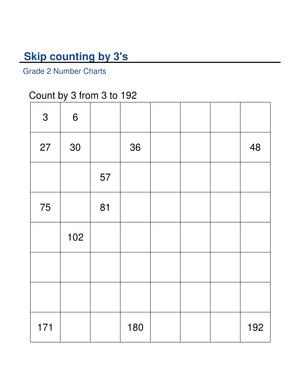
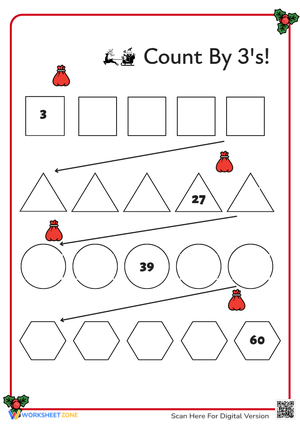
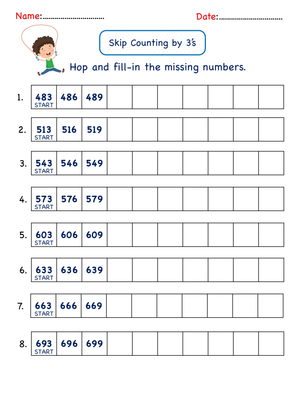
- Missing number sequences: Number strings with strategic blanks require students to produce each next value through mental addition. Early worksheets stay in the zero-to-thirty range; later ones push across decade boundaries, requiring students to add three to numbers like 27 or 38.
- Hundreds chart coloring: Students shade every third number and watch a diagonal pattern emerge across the grid. If a shaded square breaks the diagonal, the error is visible before the worksheet is complete — which is a more honest feedback loop than waiting for a teacher to mark it wrong.
- Number line jumps: Students draw arcs from one multiple to the next. The act of drawing each jump makes the repeated-addition structure of skip counting concrete in a way that a pre-printed sequence does not.
- Path-tracing mazes: Students navigate a grid by following correct multiples of three in order. The maze format slows impulsive students down and forces them to verify each choice before committing to a direction.
Error Patterns Worth Anticipating Before You Hand These Out
The most consistent mistake is a reversion to twos right after landing on six. A student writes 3, 6 — and then 8, not 9. This happens because six is even, and counting by twos is already automatic for most second graders. After any even number, the by-two habit fires on its own. It is not careless; it is an old skill interfering with a new one. Naming this specific swap before practice begins — "some of you are going to want to write 8 after 6 because your brain is used to counting by twos" — prevents a round of corrections that would otherwise take ten minutes to work through.
On hundreds chart worksheets, a different error appears at decade crossings. Students who are adding correctly sometimes shade the wrong square when they move from one row to the next — marking 28 instead of 30, because they counted three boxes from 27 rather than adding three. The diagonal pattern makes this visible, but only if students are using it as a check. A thirty-second model of what a correct diagonal looks like, done before independent practice, gives students the visual standard to compare against.
There is also a category of students who have memorized the chant — 3, 6, 9, 12 — but cannot apply the rule when a worksheet starts at 14 or 22. Their memorization begins at zero and does not generalize. This matters because the chant sounds like understanding, and worksheets that always start at zero will not catch it. Mixing in a few sequences with non-anchor start points is not about making the work harder; it is about making the gap visible while there is still time to address it.
Fitting These Worksheets Into Your Weekly Math Routine
Skip-counting fluency builds through short, repeated exposure, not single long lessons. 2nd grade by 3 worksheets fit naturally into the warm-up slot at the start of the math block. A missing number sequence takes four or five minutes, gets students doing mental addition before the main lesson begins, and lets you scan the room quickly for who is still counting up from zero on their fingers. By the second or third week of regular use, most students complete those sequences without restarting from the beginning each time — and that shift is the fluency indicator worth watching for.
Math centers are where the mazes and hundreds chart worksheets earn their place. Station work gives students the unrushed time to trace paths and color sequences at their own pace. Adding a small container of linking cubes to the station lets students who need it build the groups of three physically before recording the answer — building each group of three before counting the total is especially useful early in the unit, when the plus-three rule is still fragile. A simple answer key posted at the station lets students self-check and try again rather than waiting for a teacher to confirm they are on the right path.
For small-group reteach pulls — the ten or fifteen minutes while the rest of the class works independently — the number line jump worksheets generate conversation. Have two students work through the same number line and compare their arc drawings. Disagreements about where a jump lands almost always surface the underlying confusion faster than a worksheet completed in silence, and the discussion is usually short enough that you still have time to do a second example before sending students back.
Standard Alignment
Skip counting by threes is not explicitly named in the second-grade CCSS standards, which specify fives, tens, and hundreds under 2.NBT.2. In classroom terms, this set functions as enrichment that reaches forward — directly preparing students for 3.OA.C.7, which requires fluency with multiplication facts. Teachers who introduce the sequence in second grade are building the retrieval memory that makes third-grade multiplication facts less effortful. The by-threes sequence also reinforces 2.OA.C.3, the odd and even standard, because the alternating odd-even rhythm of the sequence gives students ongoing practice in classifying numbers as they count — 3 is odd, 6 is even, 9 is odd, 12 is even — without making the classification the stated goal of the lesson.
Adjusting the Work for Different Starting Points
For students who are still consolidating counting by fives, adding a reference strip — the sequence 0, 3, 6, 9 through 30 printed along the top of each worksheet — reduces the mental load enough to let them focus on pattern recognition rather than calculation. Pull the strip once a student can complete the first ten values correctly without looking. That transfer moment, not a fixed number of worksheets, is the right signal that the support is no longer needed.
2nd grade by 3 worksheets can be extended for students who master the zero-anchor sequence quickly by shifting the starting point. A sequence beginning at 2 — producing 2, 5, 8, 11 — or a number line running backward from 36 tests whether students understand "add three" as a portable rule rather than a memorized list. A handful of students each year will find backward sequences genuinely difficult even after strong forward performance, and that gap is worth noting because it tends to appear in subtraction work as well.
Frequently Asked Questions
How early in second grade should I introduce counting by threes?
Most second graders are ready after they have solid fluency with twos and fives — typically mid-fall, once two-digit mental addition is reasonably stable. Introducing it earlier, before students can reliably add three to numbers like 17 or 24 without restarting from zero, tends to produce surface-level chanting that does not transfer to number line or hundreds chart tasks. A late-fall introduction gives students the arithmetic foundation for the pattern to stick rather than just be repeated.
Can completed worksheets serve as formative assessment?
Yes, and the error patterns are specific enough to inform grouping decisions. A student whose work shows a consistent reversion to even numbers after six needs different follow-up than one who handles the zero-anchor sequence correctly but stalls at non-standard start points. Collecting one worksheet per student at the end of the week tells you more than a separate quiz would, because the format variety means different gaps show up across different tasks in the set.
How do I use these worksheets with students who have the chant memorized but do not understand the rule?
Switch to formats that break the chant-based approach — particularly number line jumps and the non-anchor sequences described in the differentiation section. Students who rely on rote memory almost always hesitate when a number line requires them to start at 15 rather than zero, because the memorized sequence starts at zero and does not generalize past that. That hesitation is diagnostic. 2nd grade by 3 worksheets in those formats surface the understanding gap in a way that a standard fill-in-the-blank sequence starting at zero never will.













 Interactive Worksheet Maker
 Quiz Maker
 Word Search Maker
 Crossword Puzzle Maker
 Word Scramble Generator
 Sentence Scramble Generator
 Handwriting Worksheet Generator
 Name Tracing Generator
 Fill In The Blank Generator