These 2nd grade by 10 printable worksheets address the specific place value work that second graders need before multi-digit addition starts to make sense. The set covers on-decade sequences starting at zero and the harder off-decade runs that begin at numbers like 17 or 43 — the ones that reveal whether a student truly understands the tens digit or has simply memorized a sequence by ear. Teachers who have watched a child sail through 10, 20, 30 and then freeze at 47, 57, 67 know why both skill types belong in the same unit.
What's Inside the Set
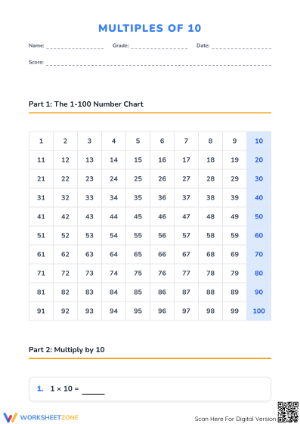
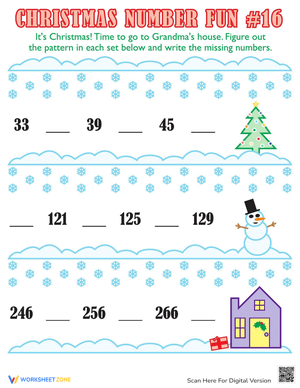
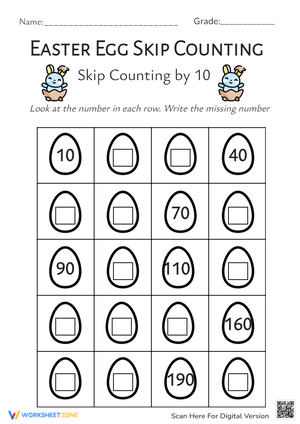
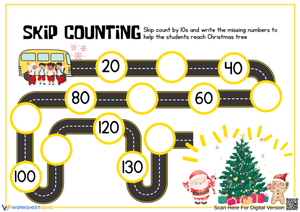
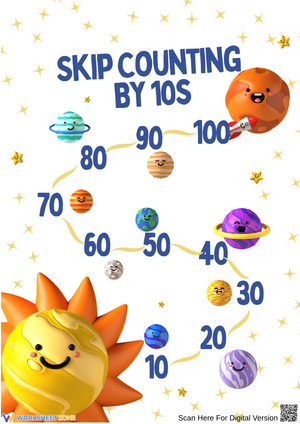
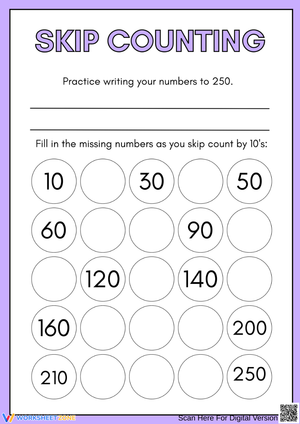
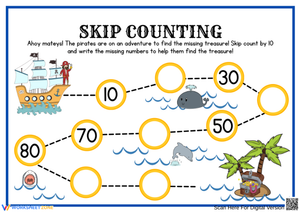
The worksheets approach the skill from several directions. Hundreds chart activities ask students to shade every multiple of ten, which makes the vertical column pattern visible in a way that number sequences alone cannot replicate. Number line worksheets require students to mark and label each jump of ten, reinforcing that the interval stays constant whether they are moving from 0 to 10 or from 340 to 350. Fill-in-the-blank sequences appear in a mix of formats — some built around thematic imagery, others plain — so students who need a visual anchor have one without losing the mathematical focus of the task.
Off-decade counting gets its own dedicated worksheets rather than appearing as a footnote at the end of an on-decade exercise. Starting sequences at 4, 14, 24 or at 36, 46, 56 forces students to isolate the tens digit and hold the ones digit constant — which is the precise cognitive move that 2.NBT.A.2 is asking for.
Standard Alignment
The set directly targets CCSS.MATH.CONTENT.2.NBT.A.2, the Number and Operations in Base Ten standard requiring second graders to count within 1,000 and skip-count by 5s, 10s, and 100s. In most second-grade pacing guides, this standard lands in the first or second instructional unit, which means teachers reach for a 2nd grade by 10 printable worksheets early — often while students are still building the foundational vocabulary for place value. The assessment tasks associated with this standard ask students not just to recite a sequence but to extend one, spot an error in a given sequence, and explain what changes and what stays the same. Each worksheet here addresses at least one of those three demands.
The Errors Teachers Should Anticipate in This Unit
The most common error on on-decade worksheets is not the one most teachers expect. Students who correctly write 10, 20, 30 will sometimes shift to writing 100, 200, 300 when the visual context changes — particularly on number lines that begin mid-page. They are matching a visual pattern rather than tracking the tens digit. The response is not more repetition on the same format; it is switching to a different worksheet format early so students have to locate the underlying pattern rather than rely on spatial memory.
Off-decade sequences produce a second, more diagnostic error. Given the sequence 13, 23, ___, 43, a student might write 33 correctly but explain that they "counted up three more from 30." That explanation tells you the student is counting by ones from 30 to 33, not adding ten to 23. The procedure gives the right answer; the reasoning is wrong. Identifying that before the multiplication unit — where adding ten is the conceptual engine — saves a significant amount of reteaching time.
Getting the Most From These Worksheets in Your Planning
The most effective use of a 2nd grade by 10 printable worksheets is spaced across several weeks rather than stacked into a single skip-counting unit. Introduce on-decade sequences during whole-group instruction with a projected hundreds chart, then move to independent practice with fill-in-the-blank formats once students can articulate what the tens digit is doing. Hold the off-decade worksheets until students show a stable on-decade foundation — usually four to five school days later — and run them through small-group rotation first so you can hear student reasoning before they practice independently.
The eight minutes before dismissal is a surprisingly productive slot for this kind of practice. The task is short enough to complete, and the daily repetition across two or three weeks does real cumulative work. Morning warm-ups are the other natural fit: one worksheet at the start of math block activates prior knowledge and narrows the attentional ramp before the new lesson begins. For formative purposes, a five-question mixed sequence — two on-decade, two off-decade, one with the first term missing rather than a middle term — takes about five minutes and tells you exactly which students are ready to move on.
Adapting the Set for Mixed-Ability Classrooms
For students who are still unsteady on basic two-digit counting, start with the hundreds chart shading worksheets rather than fill-in-the-blank sequences. The visual structure reduces the working memory load enough that students can concentrate on the pattern rather than the recall task. Once a student can shade the chart without prompting, the transition to sequence worksheets is short — they have already built the mental image that makes the abstract format legible.
Students who move through on-decade and off-decade sequences quickly are ready for a different kind of push. Assign a 2nd grade by 10 printable worksheets from the set and ask students to write the rule governing their completed sequence in their own words, then generate two original sequences for a partner to finish. If a student's written rule only accounts for multiples of ten, you know the off-decade concept has not yet transferred — and you have a concrete artifact to inform your next small-group pull.
Frequently Asked Questions
What is the difference between on-decade and off-decade skip counting, and when should each be taught?
On-decade sequences start at zero or a multiple of ten: 0, 10, 20, 30. Off-decade sequences start anywhere else: 7, 17, 27, 37. Both fall under CCSS.MATH.CONTENT.2.NBT.A.2, but off-decade counting is harder because students cannot use a zero in the ones place as a visual anchor. Most second-grade pacing guides introduce on-decade sequences first, then return to off-decade work four to six weeks later once students have a stable sense of what the tens digit is doing.
How do I know if a student has actually internalized the pattern versus memorized the sequence?
Give them a sequence with the first number missing rather than a middle number. Students who have memorized 10, 20, 30 as a chant will often stall when asked to work backward or enter mid-sequence. Students who understand the place value structure can start anywhere — they know the tens digit increases by one each time regardless of where the sequence begins. Listening to how a student explains their answer out loud is equally telling: "I added ten each time" is different from "I just knew it goes 50."
Are these worksheets useful for third graders who missed this skill?
Yes. Third graders who did not fully master off-decade skip counting show the gap quickly when multiplication by ten is introduced — they treat 7 × 10 as a fact to memorize rather than a pattern to apply. The off-decade worksheets here move fast enough that a third grader does not feel like they are doing second-grade work, and the place value reasoning they build directly supports the third-grade standard for multiplying one-digit numbers by multiples of ten.













 Interactive Worksheet Maker
 Quiz Maker
 Word Search Maker
 Crossword Puzzle Maker
 Word Scramble Generator
 Sentence Scramble Generator
 Handwriting Worksheet Generator
 Name Tracing Generator
 Fill In The Blank Generator