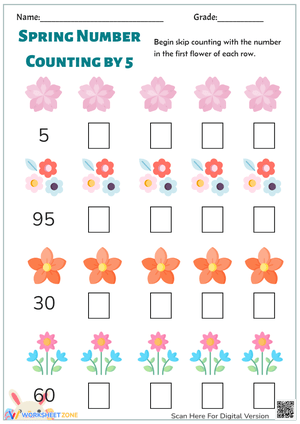
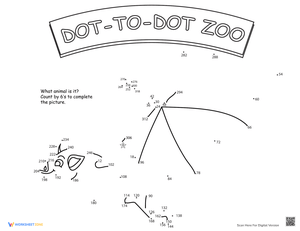
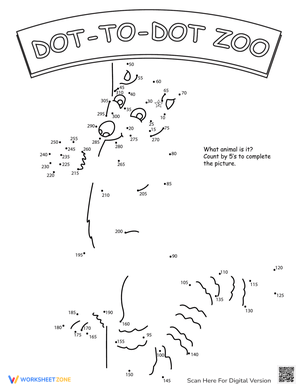
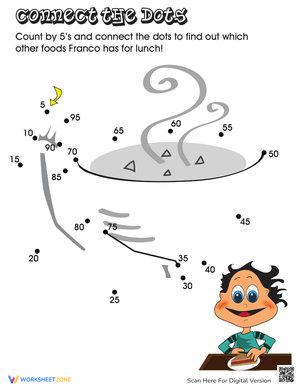
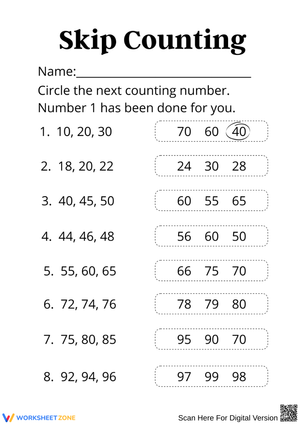
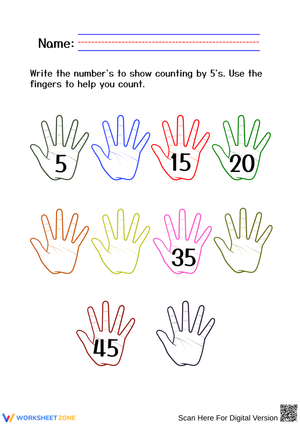
These by 5 pdf worksheets for 2nd grade give teachers a focused set of practice materials built around one of the most overlooked entry points into multiplication readiness: the fives sequence. The set covers the full range of second-grade skip counting work — from reading and extending number sequences to counting backward by fives and working past the hundred mark into three-digit territory. Every worksheet targets a discrete piece of that progression, so teachers can assign exactly what a student needs rather than sorting through a mixed packet.
What Students Do Across These Worksheets
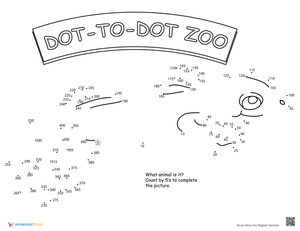
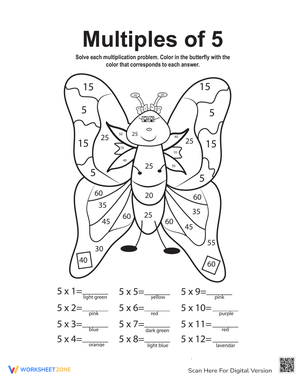
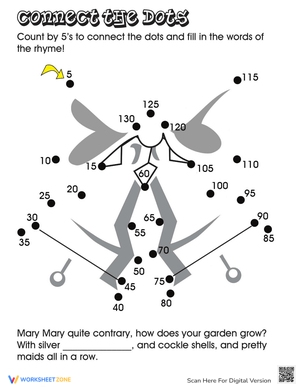
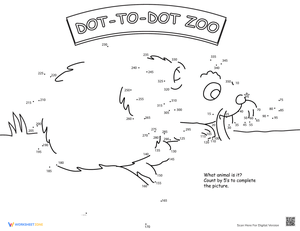
The formats push students to do something specific with the fives sequence — not just read it, but produce it, mark it, and apply it. Core worksheet types in the set include:
- Hundreds chart worksheets, where students circle every fifth number and identify the vertical column pattern that emerges
- Number line worksheets that ask students to draw equal jumps and label each landing point
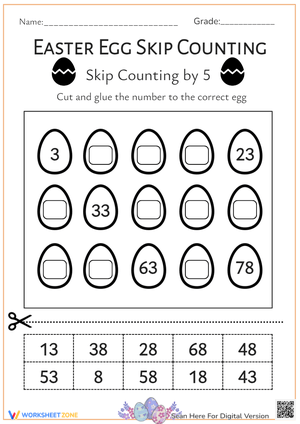
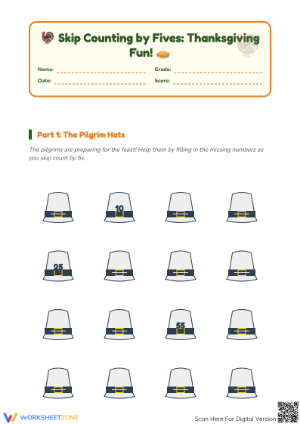
- Missing-number sequences with gaps placed at the beginning, middle, and end of the string — not always left to right, which prevents a simple fill-in strategy from carrying students through
- Word problems using nickels, tally marks, and grouped objects, where the counting does real computational work rather than decorative pattern practice
Two worksheet types are worth noting separately. The backward-counting worksheets have students start at numbers like 80 or 155 and count down by fives — harder than it sounds at this grade, and directly useful for subtraction reasoning and later division work. The random-start worksheets open sequences at numbers like 45, 130, or 315, requiring students to enter the pattern mid-stream without the anchor of zero. Both formats appear far less often in published programs than they should.
Connections to Clock Reading, Money, and Multiplication
Telling minutes on an analog clock depends entirely on skip counting by fives from 12 around the face. Students who can count 5, 10, 15, 20 fluently reach the correct minute almost automatically; students who can't are forced to count individual tick marks, which slows them down and causes errors under timed conditions. The connection to money is equally direct: counting nickels is a fives problem, and the step from five nickels equals 25 cents to five times five equals 25 is one of the cleaner transitions 2nd grade offers between arithmetic and early multiplicative thinking. Some worksheets in the set bring in clock-face visuals and coin graphics to make those connections explicit rather than leaving them for students to discover independently during a separate unit.
Common Counting Mistakes Teachers Should Anticipate
The most consistent error in actual student work is what happens at century transitions — specifically the jump from 95 to 100 to 105. Students who have landed on 100 hundreds of times often write 95, 100, 200 because the hundreds digit changing feels like starting over. A useful pre-teaching move: show students the sequence 095, 100, 105, 110 with just the last two digits circled. Seeing that the ones-and-tens pattern is identical to 05, 10, 15, 20 is often enough to break the misconception before it takes hold.
A second error is subtler. Students who have only practiced starting at zero or five struggle to enter the sequence at 35 or 70. They back up mentally to the nearest safe number — usually 0 or 5 — and count forward from there, which technically works but falls apart with higher starting points and is far too slow to support any real fluency. The random-start worksheets expose this habit quickly. Once a teacher sees a student counting on fingers from 0 to reach 65, the next instructional move is obvious.
How to Build These Worksheets Into Your Lesson Plans
The missing-number and random-start worksheets make solid three-to-five-minute warm-ups at the start of a math block. They are quick to distribute, require no setup, and give teachers a fast read on who is still struggling before the main lesson begins. The by 5 pdf worksheets for 2nd grade that feature hundreds charts and coin graphics work better at math centers — the visual content rewards slower, more careful work, and students can move through them at their own pace while the teacher runs a small group. Slip them into dry-erase pockets and students can reuse each worksheet multiple times without burning through copies.
For small-group pull-outs, the backward-counting worksheets double as a quick diagnostic. Have students work the first five problems aloud, and it becomes immediately clear who has internalized the sequence and who is reconstructing it from zero on every problem. The word problem worksheets belong toward the end of a unit, after procedural fluency with the sequence is in place. Asking students to count nickels in a word problem before they can reliably produce the fives sequence independently puts the application before the skill — and frustration follows quickly.
Standard Alignment
These worksheets align with CCSS Math 2.NBT.A.2, which requires students to skip count by 5s, 10s, and 100s within 1000. That standard does real instructional work in 2nd grade: it formally extends skip counting beyond what students practiced in 1st grade and adds the expectation that counting continues well past 100, including three-digit sequences and non-zero starting points. Addressing the standard fully means covering forward counting, backward counting, random starting points, and three-digit territory — all of which the worksheets in this set include. The standard also positions students directly for the multiplication and division work beginning in 3rd grade, so fluency built in 2nd grade carries forward in a concrete way.
Adjusting the Set for Students at Different Levels
Students who are still building basic number sense do better starting with hundreds chart worksheets, where the pattern is visible in the grid structure before they have to generate anything independently. Pair those with worksheets that provide a partial sequence — the first three or four numbers already filled in — so students can see the rhythm and extend it rather than constructing the full sequence from scratch. This is not a simpler task; it is a more supported entry into the same task. Students who move through forward sequences quickly should work the random-start and backward-counting worksheets, which demand flexible retrieval rather than rote pattern repetition.
The by 5 pdf worksheets for 2nd grade that center on word problems naturally create a second tier of difficulty — students who can fill in a number line may still find it harder to extract the skip-counting structure from a word problem about stacks of nickels or rows of tally marks. Using those worksheets selectively, with students who already have solid procedural footing, prevents the frustration of asking for abstraction before the underlying fluency is ready to support it.
Frequently Asked Questions
Do these worksheets include counting backward by fives?
Yes. Several worksheets ask students to count down by fives from starting points like 80, 100, or 155. Backward counting is consistently under-practiced in standard math programs, even though it directly supports subtraction reasoning and later division work. These worksheets treat it as a discrete skill worth explicit practice, not a footnote at the bottom of a forward-counting sheet.
Can I use these with students who are not yet ready to work past 100?
The set includes worksheets that stay within 100 and worksheets that extend into three-digit sequences. Students who are not yet ready for the century transition can work entirely within the within-100 worksheets and still build meaningful fives fluency. The by 5 pdf worksheets for 2nd grade that begin sequences in the hundreds can be introduced once those students are ready to cross the 100 boundary — typically once they understand that the ones-and-tens pattern does not reset when the hundreds digit changes.
How do the clock-related worksheets connect skip counting to time telling?
Some worksheets pair number sequences directly with clock-face graphics, asking students to write the skip-counted values at each number position around the face. That pairing makes the connection explicit — students see why the 3 marks 15 minutes and the 7 marks 35 minutes — rather than leaving it as a separate lesson to bridge later. If clock reading is already running as a unit in your room, these worksheets serve as useful parallel practice during the same instructional weeks without requiring any additional setup on your end.













 Interactive Worksheet Maker
 Quiz Maker
 Word Search Maker
 Crossword Puzzle Maker
 Word Scramble Generator
 Sentence Scramble Generator
 Handwriting Worksheet Generator
 Name Tracing Generator
 Fill In The Blank Generator