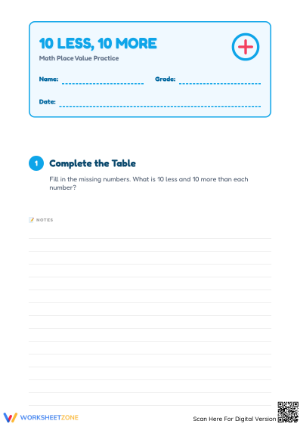
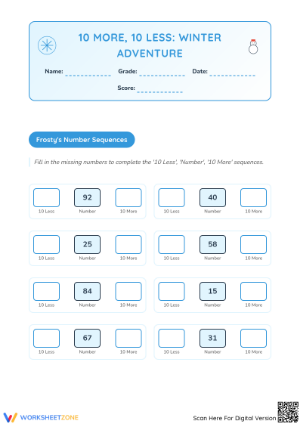
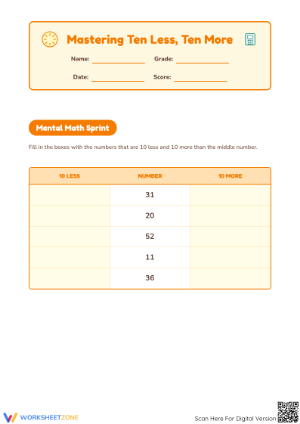
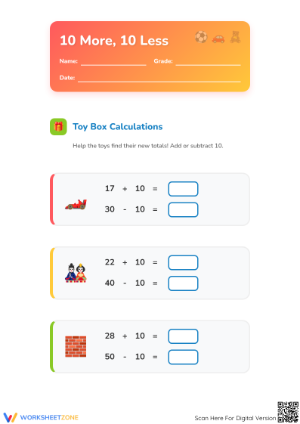
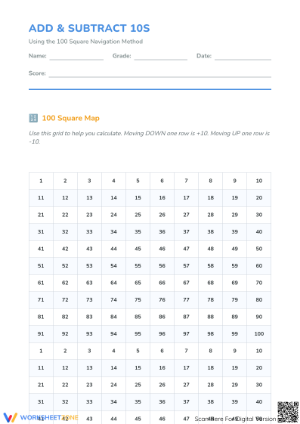
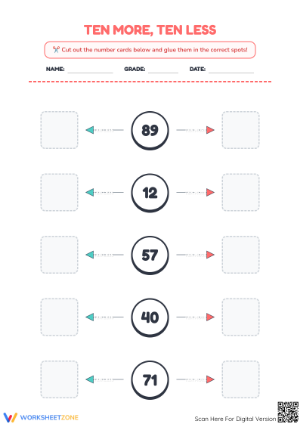
These 10 more 10 less printable worksheets for 2nd grade move students off the number line and into the tens place — the cognitive shift that separates counting-dependent kids from those who can actually think in groups of ten. The set covers both pattern recognition and fluency practice, plus the multi-directional formats that reveal whether students genuinely understand place value or have only memorized which digit to change. That distinction matters more than it looks: students who memorized a surface rule without understanding it typically hit a wall when multi-digit addition with regrouping arrives later in the year.
What the Set Covers
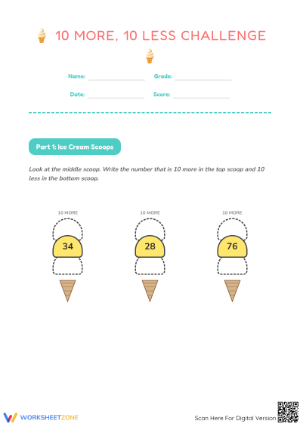
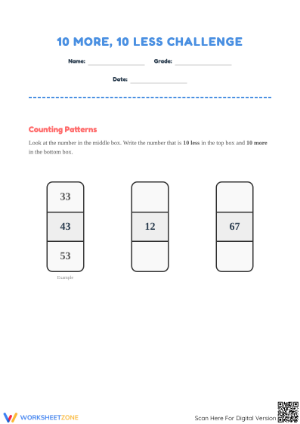
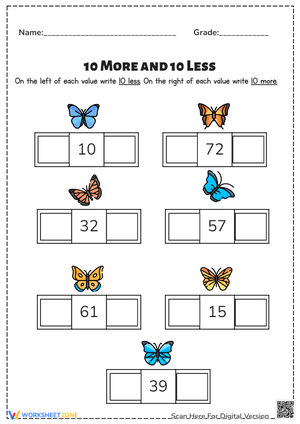
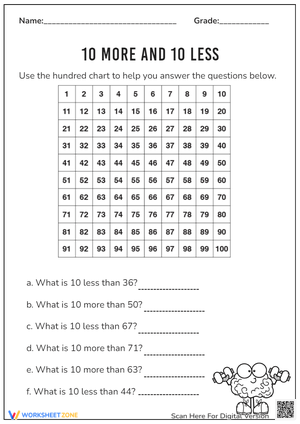
The worksheets approach this skill from several angles, because straight input-output practice builds speed but doesn't always show teachers whether a student understands why the tens digit changes. The formats across the set include:
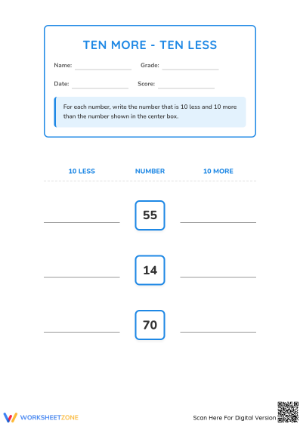
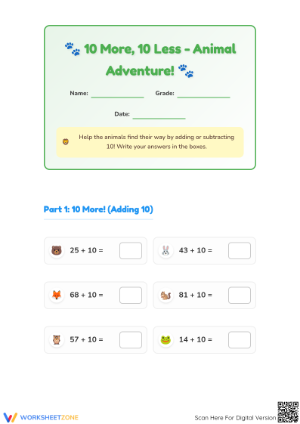
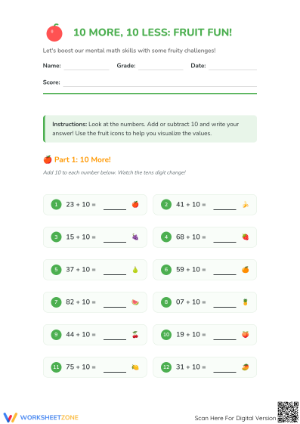
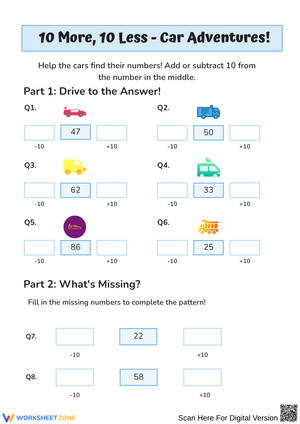
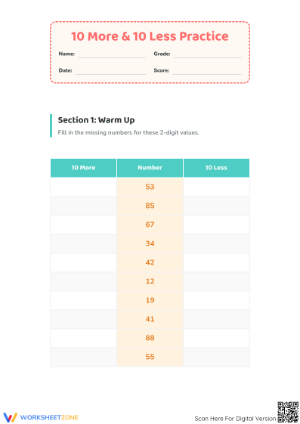
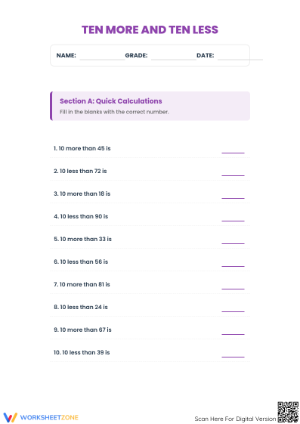
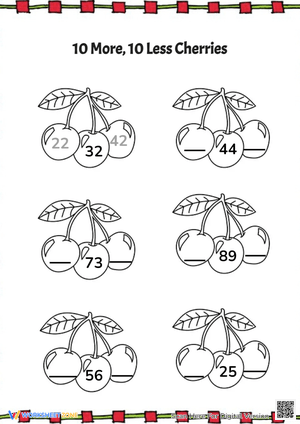
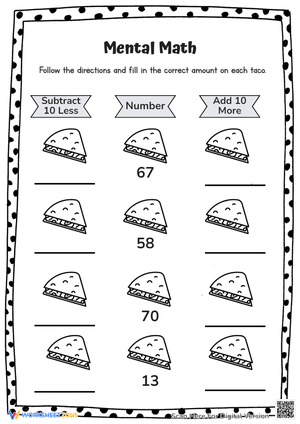
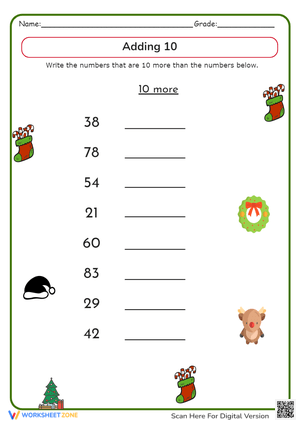
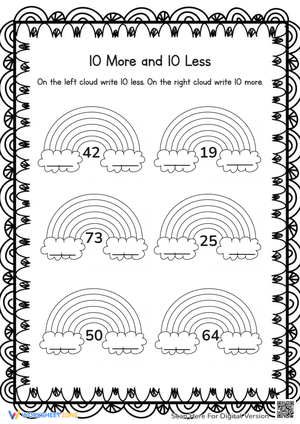
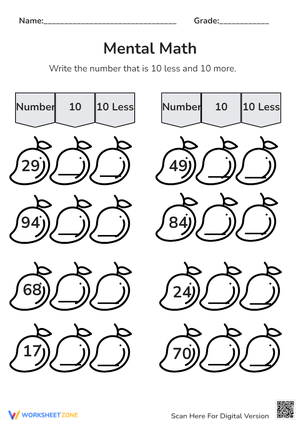
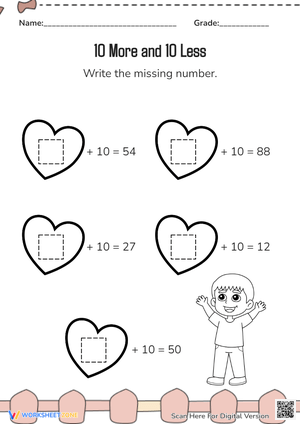
- Input-output problems with two-digit numbers — given a number, write 10 more and 10 less directly below it
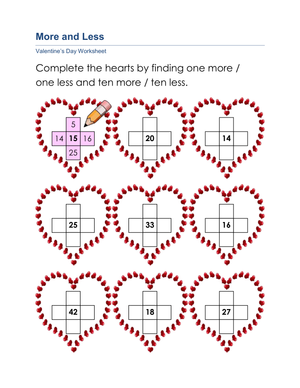
- Number-neighbor puzzles using hundreds chart fragments — a cross-shaped grid where students fill in all four neighbors of a central number, applying 10 more, 10 less, 1 more, and 1 less simultaneously
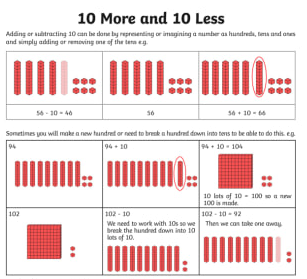
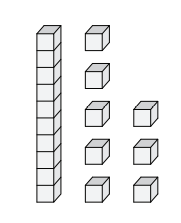
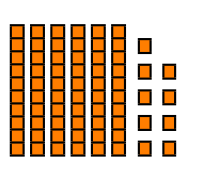
- Base-ten block visuals where the illustration anchors the place-value shift before students work the number sentence abstractly
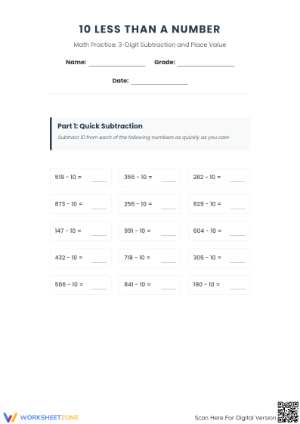
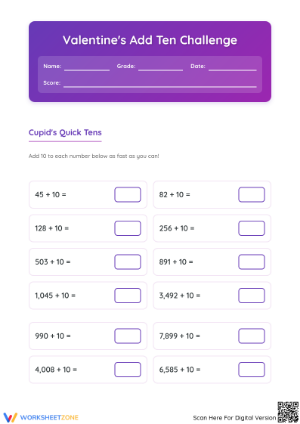
- Three-digit extension problems, including numbers that cross a hundred boundary — 10 more than 195, 10 less than 304
The number-neighbor puzzle format is harder than it looks. Because it requires students to hold all four directions at once, it surfaces errors that straight problems miss entirely — a student can complete every input-output problem correctly and still stumble on the puzzle when the spatial demand changes.
Error Patterns Worth Catching Before They Become Habits
The most common error is changing the ones digit instead of the tens digit. A student who can recite "add ten to the tens place" will still write 46 for "10 more than 45." This isn't carelessness — it's a scanning habit. Students who make this error tend to look left to right across the number and land on the rightmost digit. Watching where their pencil hovers before they write confirms the pattern nearly every time.
Crossing-hundred problems produce a different and more diagnostic error. Ten more than 195 is 205, but a significant portion of 2nd graders write 1105 — they increment the tens digit to 10 without understanding that ten tens regroup into a hundred. A smaller group writes 196, falling back to adding 1 rather than 10. Neither error is random: the 1105 writers understand the tens digit should change but have no regroup concept; the 196 writers have lost track of the magnitude of the operation entirely. Both tell you something precise about what needs addressing.
A smaller but consistent error appears in the reverse direction. Students who correctly say "10 less than 100 is 90" in conversation will hesitate — and sometimes answer incorrectly — when the same relationship is written as 100 − 10. The phrase "10 less than" is more transparent to 7- and 8-year-olds than subtraction notation, and worksheets that alternate between both phrasings help close that gap steadily.
Building These Worksheets Into Your Lesson Plans
The 5-to-8-minute window before math workshop rotations begin is where these worksheets fit most naturally — one worksheet, no setup, a clear independent task while the teacher finishes transitioning groups or reviewing the previous station. Students who finish early get a specific direction: circle every answer where the tens digit became zero or where a new hundred appeared. That annotation gives early finishers a genuine task and primes the brief discussion that follows rotations rather than leaving fast workers idle.
These 10 more 10 less printable worksheets for 2nd grade work especially well in the Monday morning warm-up slot because of the spaced retrieval effect. Returning to a skill after a two-day gap strengthens long-term retention more reliably than three consecutive daily sessions. One worksheet on Monday, nothing Tuesday and Wednesday, another on Thursday — that rhythm keeps the concept active across the week without crowding other instruction. Over a two-week unit, this spacing produces more durable fluency than a daily drill approach.
The number-neighbor puzzle worksheets also serve double duty as formative tools. Because they require all four operations at once — 1 more, 1 less, 10 more, 10 less — a completed puzzle shows exactly which direction or magnitude is still shaky. A student who fills in left and right correctly but stumbles on up and down has solid 1 more/1 less and incomplete 10 more/10 less. That's a precise diagnostic read in about four minutes of independent work, without pulling a separate assessment instrument.
Standard Alignment
CCSS.MATH.CONTENT.2.NBT.B.8 requires students to mentally add and subtract 10 and 100 to numbers in the 100–900 range. One planning note worth flagging: the standard specifies three-digit numbers, but students who arrive at that work without two-digit fluency will struggle. The worksheets in this set cover both the two-digit foundation and the three-digit range the standard actually assesses, so there's no need to treat these as separate units — the lower-range worksheets build the concept and the higher-range ones meet the standard as written.
The connection to 2.NBT.A.1 is equally direct. That standard asks students to understand place value in three-digit numbers — specifically, that each digit represents hundreds, tens, or ones. A student who explains why 10 more than 450 is 460 by saying "one ten added to the five tens already there, with the hundreds and ones unchanged" is demonstrating conceptual mastery of 2.NBT.A.1 through a calculation. That kind of dual-standard evidence is worth collecting during these practice sessions.
Adjusting the Work for Different Learners
Students who still rely on visual support do well with the base-ten block worksheets, but the most effective immediate intervention isn't the illustration itself — it's a marking habit. Before writing any answer, students circle the tens digit in the original number. That two-second step prevents the ones-digit error almost entirely, because it forces students to look at the correct column before executing the operation. It also builds the column-awareness they'll need when regrouping demands the same focused attention.
For students who have moved past two-digit fluency, the crossing-hundred problems are the appropriate next challenge. These 10 more 10 less printable worksheets for 2nd grade that include numbers like 295, 304, 497, and 503 give those students meaningful extension rather than repetition. The hundred-crossing problems require a qualitatively different move — a student can't just increment a digit, because a tens digit of 10 means something else has to change. That's a genuine conceptual challenge, not a harder version of the same procedure.
Students in the middle range — solid on two-digit work, not yet confident with three digits — benefit most from the number-neighbor puzzle format. The cross structure forces all four directions at once, which surfaces gaps they didn't know they had and builds the spatial number sense that transfers to mental math strategies later in the year.
Frequently Asked Questions
How do I know when a student is ready to stop using a hundreds chart alongside these worksheets?
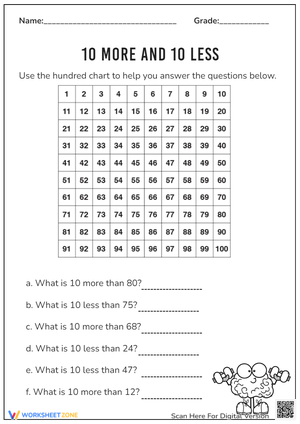
Watch the verification behavior, not just the accuracy. A student who solves a problem and then checks it against the chart is still chart-dependent. A student who works independently and only glances at the chart after finishing is in transition. When the chart goes untouched across two consecutive worksheets with no errors, the student has internalized the pattern. This progression typically takes two to four weeks of regular short practice — not a sudden breakthrough, just a gradual taper that you'll notice if you're watching for it.
What's the practical difference between the input-output problems and the number-neighbor puzzles, and when should I use each?
Input-output problems build procedural speed and work well for daily warm-up practice — low cognitive load, clear task, fast completion. Number-neighbor puzzles are primarily diagnostic: they reveal which direction or magnitude is still shaky, and they're best used when you need a clear picture of where each student stands before deciding who needs small-group work. Use straight problems to build fluency; reach for the puzzle format when you need information.
Do students need to have mastered 1 more and 1 less before these worksheets will be useful?
Not for the straight input-output format — a student can learn to add ten without first being fluent with adding one, and those worksheets work fine in isolation. The number-neighbor puzzles are a different case; they require all four operations simultaneously, and students who are still shaky on 1 more/1 less will find that format genuinely overwhelming rather than productively challenging. If you're introducing these 10 more 10 less printable worksheets for 2nd grade to a class that hasn't yet solidified 1 more/1 less, start with the straight format and hold the puzzle worksheets until both skills are in place.













 Interactive Worksheet Maker
 Quiz Maker
 Word Search Maker
 Crossword Puzzle Maker
 Word Scramble Generator
 Sentence Scramble Generator
 Handwriting Worksheet Generator
 Name Tracing Generator
 Fill In The Blank Generator