


























Views
Downloads
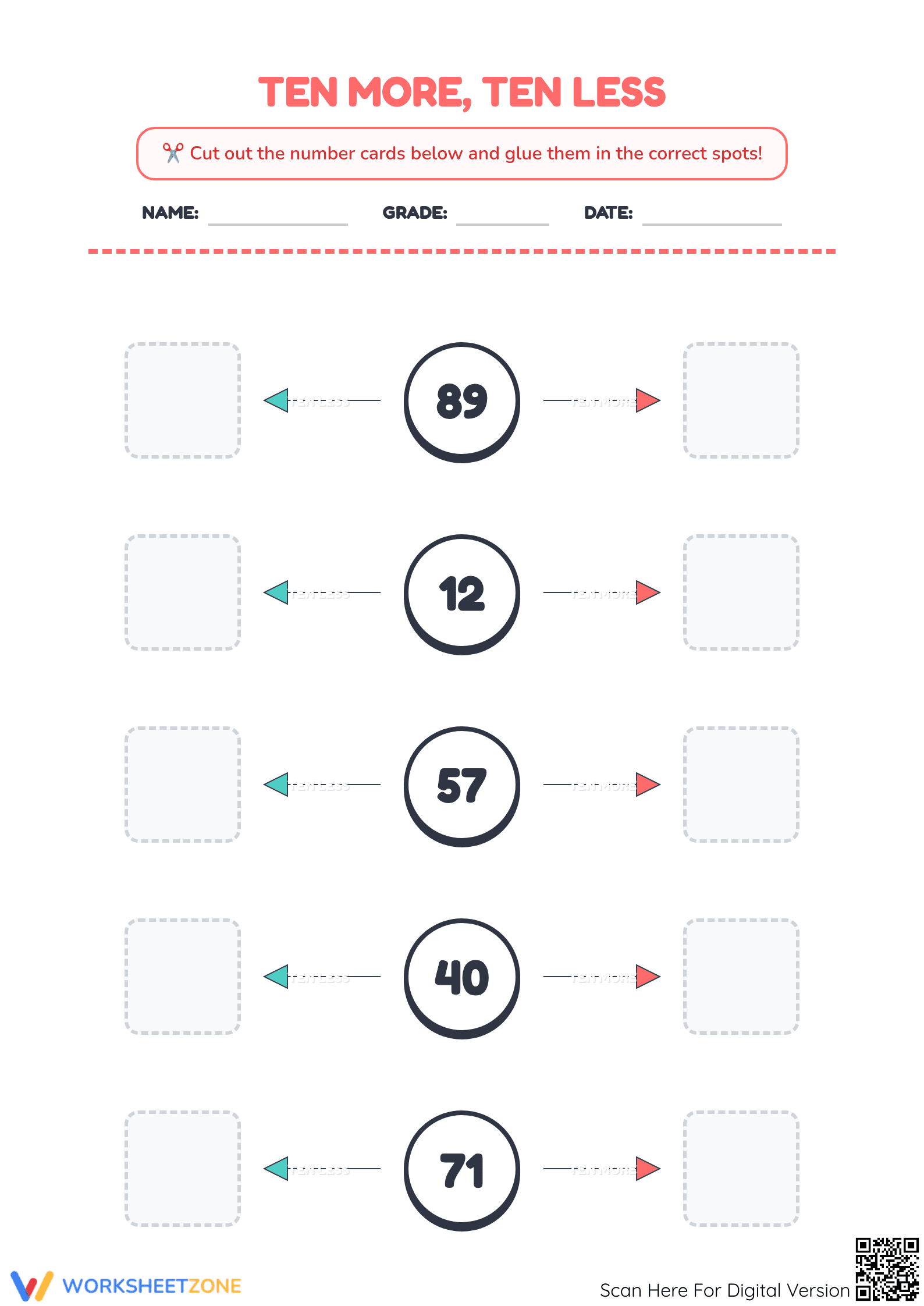


10 More 10 Less Worksheet | Grade 2 Math Printable
Paste this activity's link or code into your existing LMS (Google Classroom, Canvas, Teams, Schoology, Moodle, etc.).
Students can open and work on the activity right away, with no student login required.
You'll still be able to track student progress and results from your teacher account.
This hands-on math worksheet helps second-grade students master mental math by finding ten more and ten less than a given two-digit number. By using a cut-and-glue format, learners actively engage with place value concepts, building fluency for advanced addition strategies.
At a Glance
- Grade: 2 · Subject: Math
- Standard:
CCSS.MATH.CONTENT.2.NBT.B.8— Mentally add or subtract 10 from a given number- Skill Focus: Finding 10 more and 10 less
- Format: 2 pages · 10 problems · No answer key · PDF
- Best For: Independent math centers
- Time: 15–20 minutes
This printable resource includes two pages designed for interactive learning. The first page features five central two-digit numbers with blank spaces for ten less and ten more. The second page provides ten dashed number cards. Students evaluate each central number, locate the correct values from their cut-out bank, and glue them into the boxes. This activity naturally limits errors by providing a specific set of matching numbers.
- Guided practice: Model the first problem (89) on the board, demonstrating how the tens digit changes.
- Supported practice: Students place the cut-out pieces in the boxes without gluing, allowing for teacher review.
- Independent practice: Learners finalize their answers by gluing the numbers into the correct spots.
This approach follows a gradual-release model, ensuring students build confidence before committing to their final answers.
This activity is directly aligned to CCSS.MATH.CONTENT.2.NBT.B.8, which requires students to mentally add 10 or 100 to a given number, and mentally subtract 10 or 100 from a given number. By focusing specifically on the increments of ten with two-digit numbers, it also reinforces foundational first-grade place value skills. Both standard codes can be copied directly into lesson plans, IEP goals, or district curriculum mapping tools.
This worksheet is highly effective as an independent math center activity. It also serves as engaging morning work to review place value concepts. Teachers can use this time for formative assessment by observing whether learners correctly identify the shifting tens digit instead of counting by ones. Expect completion within 15 to 20 minutes.
This resource is ideal for second-grade students developing mental math fluency, as well as third-graders who need a quick review of basic place value manipulation. The tactile nature of the cut-and-paste format provides excellent differentiation for kinesthetic learners and students developing fine motor skills. For a complete lesson, pair this activity with a hundreds chart anchor chart so students can visually track how moving up or down one row changes the number by exactly ten.
Developing mental math fluency with increments of ten is a critical stepping stone for elementary mathematics. According to a RAND AIRS 2024 report on early numeracy interventions, students who regularly engage in tactile, manipulative-based activities demonstrate a higher retention rate of place value concepts compared to those using traditional rote worksheets. This resource supports that pedagogical approach by combining fine motor skills with cognitive math tasks. By aligning with CCSS.MATH.CONTENT.2.NBT.B.8, the activity ensures students can mentally add or subtract 10 from a given number with confidence. The physical act of sorting and gluing the correct values helps solidify the relationship between digits, moving learners away from inefficient counting-by-ones strategies and toward true mathematical fluency. This targeted practice builds the necessary cognitive framework for future success in multi-digit addition and subtraction.


