


























Views
Downloads
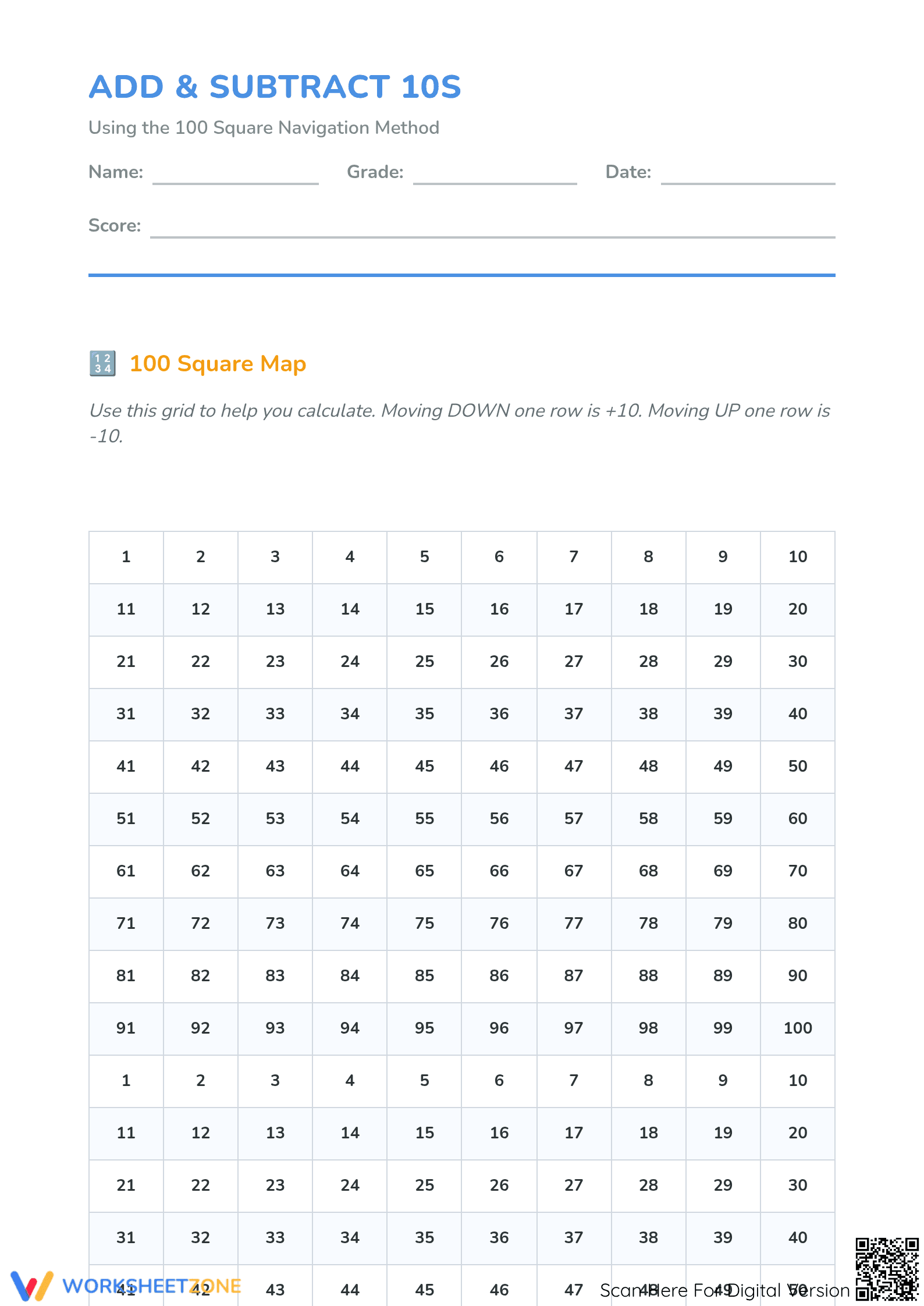



Essential Grade 2 Addition & Subtraction 10s Worksheet
Paste this activity's link or code into your existing LMS (Google Classroom, Canvas, Teams, Schoology, Moodle, etc.).
Students can open and work on the activity right away, with no student login required.
You'll still be able to track student progress and results from your teacher account.
This Grade 2 math worksheet provides comprehensive practice for adding and subtracting multiples of ten using the 100 square navigation method. Students develop mental math capabilities by visualizing movements on a numerical grid, transforming arithmetic into a spatial task. This resource ensures mastery of place value while building essential computational fluency.
At a Glance
- Grade: 2 · Subject: Math
- Standard:
2.NBT.B.8— Mentally add 10 or 100 to a given number and mentally subtract 10 or 100- Skill Focus: 100 Square Navigation
- Format: 4 pages · 36 problems · Answer key included · PDF
- Best For: Independent practice and mental math skill warm-ups
- Time: 20–30 minutes
What's Inside
This four-page packet is organized to guide students through addition and subtraction mastery. It begins with a 100 Square Map teaching the navigation logic: moving down for addition and up for subtraction. The following pages feature 16 targeted computation problems, 10 mixed practice equations, 4 realistic story problems, and 6 grid pattern challenges. A full answer key is provided to facilitate quick grading and immediate student feedback.
Zero-Prep Workflow
The zero-prep design allows teachers to integrate this into any lesson in under two minutes. Step one: Print the four-page PDF (30 seconds). Step two: Distribute the packets (30 seconds); the first page includes a built-in reference grid. Step three: Review the work using the included answer key (45 seconds). This streamlined workflow makes it an ideal choice for emergency sub plans or daily warm-ups.
Standards Alignment
The primary focus is `2.NBT.B.8`, which states that students should mentally add 10 or 100 to a given number and mentally subtract 10 or 100 from a given number. By using the 100 square, students also strengthen their understanding of `2.NBT.B.5`, relating the addition and subtraction to place value. Both standard codes can be copied directly into lesson plans, IEP goals, or district curriculum mapping tools.
How to Use It
Incorporate this worksheet during the independent practice phase of a lesson on place value or as a morning work assignment. Teachers should observe students during the Grid Patterns section to ensure they are identifying the +/- 10 relationship rather than just counting by ones. Expect most Grade 2 students to complete the entire packet within twenty-five minutes of focused work.
Who It's For
This resource is designed for Grade 2 students mastering basic addition and Grade 3 students requiring remedial mental math support. It pairs naturally with a physical 100-bead abacus or a large-format classroom hundreds chart. The clear visual layout supports English Language Learners and students with dyscalculia by providing a consistent spatial anchor for numeric operations.
Effective mental math instruction relies on bridging concrete representations with abstract symbols, a transition facilitated by the 100 square grid. According to EdReports 2024, high-quality instructional materials must prioritize the development of deep conceptual understanding alongside procedural skill. This worksheet aligns with that requirement by using the spatial "move down/up" logic to ground the mathematical operation of adding or subtracting ten. Research from Fisher & Frey (2014) emphasizes the importance of scaffolds like the hundreds chart in supporting students as they move toward independent mental computation. By providing 36 varied tasks, including story problems and pattern recognition, this resource ensures that students are not merely rote counting but are actively engaging with the base-ten structure of our number system. The inclusion of the 2.NBT.B.8 standard ensures that students are meeting recognized benchmarks for mathematical proficiency in the early elementary years. This systematic approach reduces cognitive load while increasing student confidence.


