




























Views
Plays


10 More 10 Less Base Ten Blocks | Grade 1 Printable

Paste this activity's link or code into your existing LMS (Google Classroom, Canvas, Teams, Schoology, Moodle, etc.).
Students can open and work on the activity right away, with no student login required.
You'll still be able to track student progress and results from your teacher account.
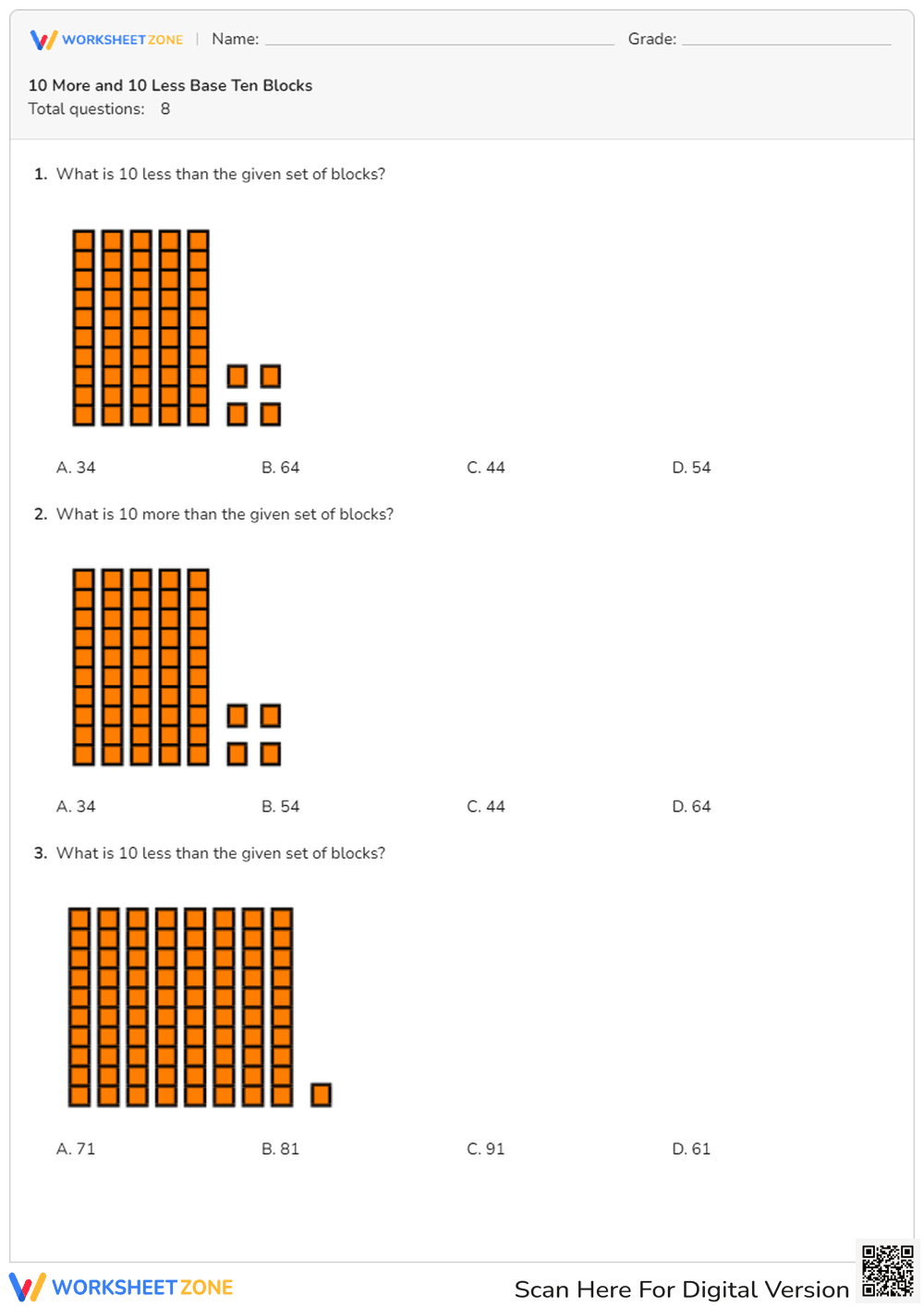
This Grade 1 math worksheet helps students master finding 10 more and 10 less than a given number using visual base ten blocks. By counting the tens rods and ones units, learners build a strong foundation in place value and mental math strategies without relying on rote memorization.
At a Glance
- Grade: 1 · Subject: Math
- Standard:
CCSS.MATH.CONTENT.1.NBT.C.5— Find 10 more or 10 less than a number- Skill Focus: 10 More and 10 Less with Base Ten Blocks
- Format: 3 pages · 8 problems · Answer key included · PDF
- Best For: Independent practice and review
- Time: 10–15 minutes
What's Inside
Inside this printable resource, educators will find three pages containing eight multiple-choice questions. Each problem presents a clear illustration of base ten blocks alongside a prompt asking students to identify either ten more or ten less than the depicted amount. The visual scaffolds help bridge the gap between concrete manipulatives and abstract numerical reasoning. A complete answer key is included for quick grading.
Zero-Prep Workflow
This resource is designed for immediate classroom implementation with a zero-prep workflow.
- Print (1 minute): Simply download the PDF and print the three-page student packet.
- Distribute (1 minute): Hand out the worksheets as a warm-up, math center activity, or independent assignment.
- Review (3 minutes): Use the included answer key to quickly check student comprehension or facilitate a whole-class review.
With under two minutes of total teacher prep time, this activity is highly suitable for emergency sub plans or last-minute schedule changes.
Standards Alignment
This worksheet is directly aligned to primary standard CCSS.MATH.CONTENT.1.NBT.C.5, which requires students to mentally find 10 more or 10 less than a given two-digit number without having to count. The visual base ten blocks provide the necessary scaffolding to develop this mental math fluency. Both standard codes can be copied directly into lesson plans, IEP goals, or district curriculum mapping tools.
How to Use It
Teachers can utilize this worksheet during math centers as an independent reinforcement activity after direct instruction on place value. Alternatively, it serves as an excellent formative assessment tool; observe whether students are recounting all the individual blocks or correctly identifying that only the tens digit changes. Expected completion time ranges from 10 to 15 minutes, making it a perfect morning work assignment.
Who It's For
This resource is primarily designed for first-grade students developing their understanding of two-digit numbers and place value. It also provides excellent remediation for second graders who need visual support to grasp mental math concepts. Pair this worksheet with physical base ten blocks during small group instruction to support kinesthetic learners.
Developing fluency with place value concepts is a critical milestone in early elementary mathematics. According to EdReports 2024, instructional materials that connect visual representations to abstract numerical concepts significantly improve student retention and mathematical reasoning. This worksheet targets CCSS.MATH.CONTENT.1.NBT.C.5, helping students find 10 more or 10 less than a number by leveraging base ten block illustrations. By visually demonstrating that adding or subtracting ten only changes the tens place, students transition away from inefficient counting-by-ones strategies. Providing structured, visual practice opportunities ensures that learners build the mental math automaticity required for more complex addition and subtraction tasks in later grades. This evidence-based approach aligns with best practices for developing deep conceptual understanding in early numeracy.


