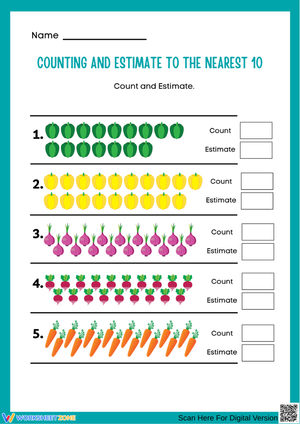
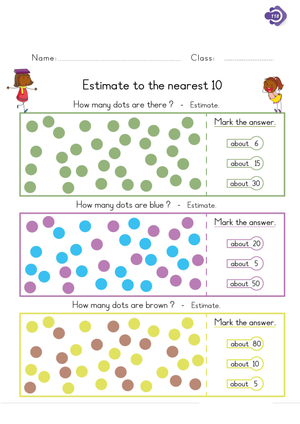
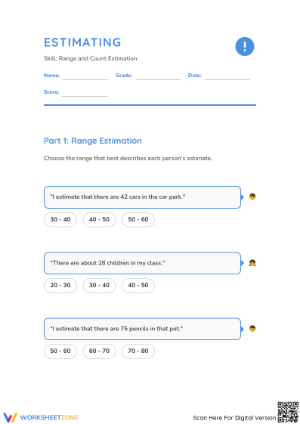
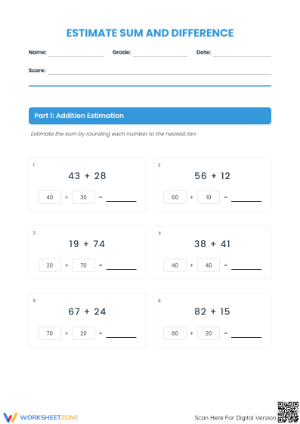
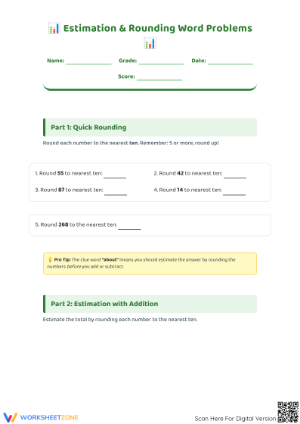
2nd grade estimation pdf worksheets give students structured, repeatable practice with the number sense skill that separates confident mental math from anxious finger-counting — the ability to judge whether a number is in the right neighborhood before committing to an exact answer. The set targets quantity estimation, rounding two-digit numbers to the nearest ten, and estimating sums and differences within 100. Each worksheet prints immediately and fits naturally as a warm-up, a center task, or a quick formative check at the close of a lesson.
Student Mistakes Worth Catching Before They Stick
The most persistent estimation trouble in second grade is not that students don't know the rounding rules — it's that they treat estimation as a different kind of exact calculation. When asked to estimate 47 + 32, a student who has internalized rounding will sometimes round correctly (50 + 30), then second-guess themselves and write 79 instead of 80. They know the precise answer, and writing a rounded number feels dishonest to them. This belief — that there is always one right answer in math — is the underlying obstacle, not the procedure.
Two other patterns appear consistently in second-grade estimation work. Students who skip benchmark groups of 10 and try to count every item in a jar individually will almost always undercount; they lose track partway through and arrive at a number below the actual total. And when rounding numbers that end in 5, students frequently round down regardless of the rule they were taught. Flagging 5 as a "goes up" digit explicitly before students begin the worksheet prevents at least half of those errors from appearing in their work.
What the Worksheets Cover
Each worksheet in this set addresses one of the estimation skill areas second graders are expected to develop across the year. The 2nd grade estimation pdf worksheets span the following types of practice:
- Quantity estimation: Students look at a group of objects — dots, counters, illustrated items — and record their best estimate before counting, using groups of 10 as reference points.
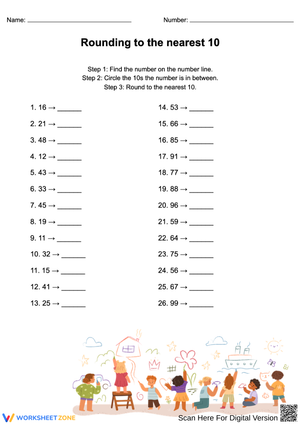
- Rounding to the nearest ten: Students identify which ten a given number is closest to, with a number line built into several worksheets for students who need a visual anchor.
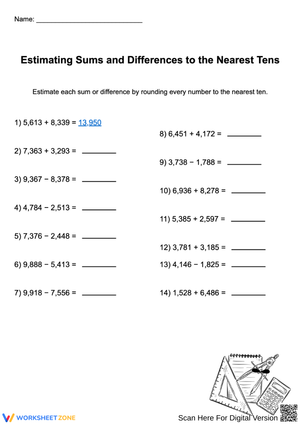
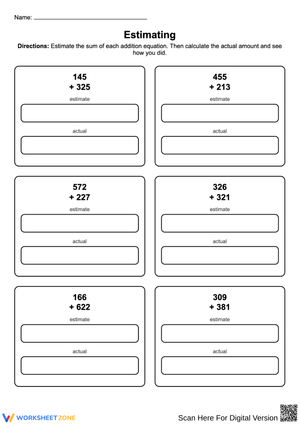
- Estimating sums and differences: Students round each addend or minuend to the nearest ten, compute the estimated result, then compare it to the exact answer.
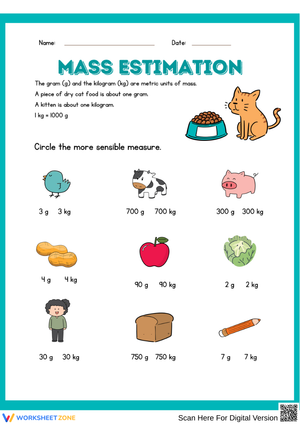
- Measurement estimation: Students predict the length of familiar objects in inches or centimeters before measuring, connecting printed practice to a tangible real-world context.
- Reasonableness checks: Students see a completed calculation and decide whether the answer makes sense, marking yes or no and writing a brief explanation of their reasoning.
That last type is worth assigning later in a unit rather than at the start. Students need enough rounding fluency before that task feels manageable; given too early, it creates frustration rather than insight.
Lesson-Planning Moves That Work With This Set
Estimation practice lands best when it is brief and front-loaded in the math block. A three-minute warm-up using one estimation worksheet before moving into computation practice primes students to think about reasonable answers rather than just grinding through procedures. Actually say your reasoning aloud when modeling — "47 is close to 50, 32 is close to 30, so I'd expect something near 80" — before students work independently. Second graders need to hear what an estimation strategy sounds like before they can produce one on their own.
For math center rotations, pair these 2nd grade estimation pdf worksheets with a small jar of counters. Students estimate and record, then count the jar to check. The physical verification step makes the comparison between estimate and exact answer concrete rather than abstract, and it keeps center time self-managing since students can check their own work without waiting for teacher input.
These worksheets also serve well as exit checks. After a lesson on rounding to the nearest ten, give students one estimation problem as they pack up. What you collect in that two-minute window tells you more about readiness than most formal assessments: students who round to get 40 + 20 and write "60" are ready for the next day's lesson; students who write 43 as their estimate have not internalized the rounding step and need a brief reteach before moving on.
Standard Alignment
These worksheets align to two core Common Core State Standards for Mathematics at the second-grade level. Standard 2.OA.A.1 requires students to use addition and subtraction within 100 to solve word problems and determine whether answers are reasonable — which is the heart of estimation practice at this level. Standard 2.NBT.B.5 supports fluency with addition and subtraction within 100, providing the computational base that makes estimation meaningful; students who cannot yet add two-digit numbers with confidence find estimation tasks disorienting because they are managing two cognitive demands simultaneously.
Worksheets focused on measurement estimation address 2.MD.A.3, which asks students to estimate lengths in standard units and compare those estimates to measured results. Teachers who introduce estimation during a measurement unit rather than a number sense unit will find that strand of the set slots directly into that instructional sequence.
Adjusting the Work Across Readiness Levels
Because the resources are individual downloadable worksheets, teachers can assign different sheets to different groups without any visible differentiation — a practical advantage when students are sensitive about receiving work that looks different from their classmates'. Students who are still building fluency with numbers to 50 can work through quantity estimation and rounding tasks within that range. Students working at grade level handle the full 100-range tasks that form the core of the set.
For students who have moved beyond grade-level expectations, the 2nd grade estimation pdf worksheets can be extended in two ways without needing new materials: first, require a written explanation after each problem ("I estimated 50 because..."), which adds language and reasoning demands to an otherwise straightforward task; second, ask students to generate their own estimation problems for a partner to solve, which requires understanding the structure deeply enough to produce original examples. Both extensions work within a single worksheet without any changes to the printed format.
Frequently Asked Questions
What estimation skills should second graders have by end of year?
By the end of second grade, students should reliably round two-digit numbers to the nearest ten, use benchmark groups of 10 to estimate object quantities, estimate sums and differences within 100, and judge whether a computed answer is reasonable. The goal is building the habit of checking reasonableness, not arriving at a precise approximation every time.
What is the difference between rounding and estimation in second-grade math?
Rounding is a procedure — finding the nearest ten or hundred for a given number. Estimation is the applied skill that uses rounding as one of its tools. When a student rounds 47 to 50 and 32 to 30 before predicting a sum of 80, they are estimating; rounding was the step that got them there. Second graders sometimes conflate these because they learn rounding first and estimation second, so the distinction needs explicit classroom discussion rather than just worksheet practice.
How frequently should students work on estimation to build lasting fluency?
Spaced practice across several weeks produces more durable results than a concentrated estimation unit. Three or four brief encounters per week — a warm-up here, a center task there, an exit check before dismissal — build estimation fluency more reliably than a week of daily estimation lessons followed by a long gap. The worksheets in this set lend themselves to exactly that distributed pattern, since each one is a self-contained task that takes five minutes or less to complete.













 Interactive Worksheet Maker
 Quiz Maker
 Word Search Maker
 Crossword Puzzle Maker
 Word Scramble Generator
 Sentence Scramble Generator
 Handwriting Worksheet Generator
 Name Tracing Generator
 Fill In The Blank Generator