If you teach 2nd grade, D'Nealian handwriting sits at a real turning point in your literacy block. Students arrive already able to print slanted manuscript letters, and this is the year most D'Nealian sequences ask them to carry those shapes into cursive. That timing isn't accidental. The slant and small tails your students practiced in earlier print work were designed to become the connecting strokes of cursive, so 2nd grade becomes the moment the payoff shows up on the page.
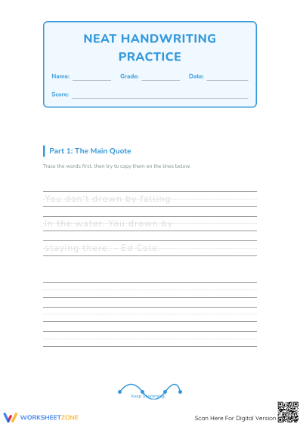
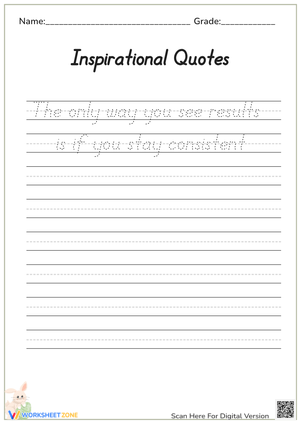
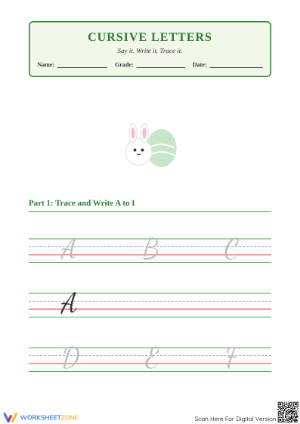
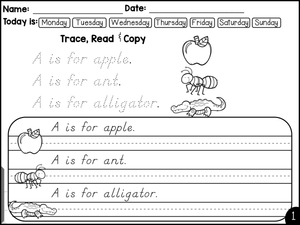
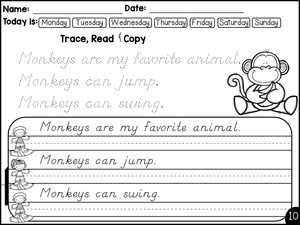
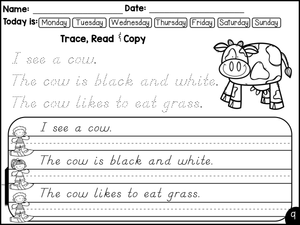
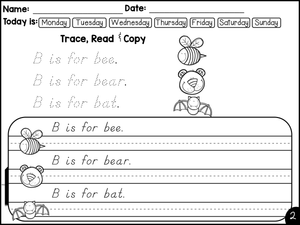
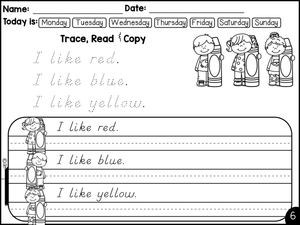
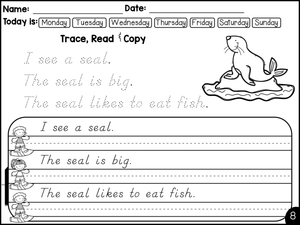
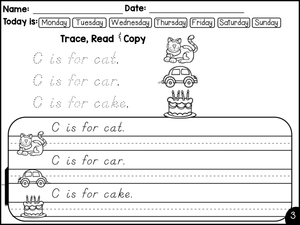
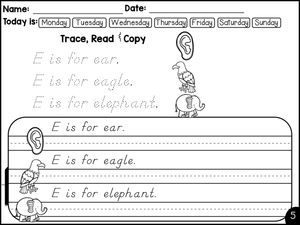
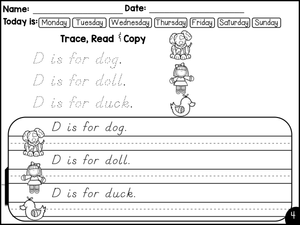
Worksheetzone's 2nd grade D'Nealian handwriting worksheets are built for that transition. They give you review pages for slanted manuscript, tracing rows for cursive lowercase, and formation models for cursive capitals, so you can move a whole class or a small intervention group at the pace your data supports.
What Sets D'Nealian Apart
D'Nealian was developed by classroom teacher Donald N. Thurber and introduced commercially in 1978. Instead of the straight lines and separate circles of ball-and-stick print, it uses a continuous, slanted stroke with small tails often called 'monkey tails.' Those tails are the design's whole point: they pre-teach the joins students will need when letters start connecting.
Here's the detail that changes how you plan instruction: about 80% of D'Nealian print letters share the same basic form as their cursive counterpart. For a 2nd grader, that means the cursive unit isn't 26 brand-new shapes to memorize. It's a smaller set of genuinely new forms plus many familiar shapes that simply need a connecting stroke. Sequencing your worksheets around that 80/20 split lets you spend the most practice time on the few letters that actually change, instead of re-teaching letters students already own.
A Step-by-Step Cursive Transition Sequence
A reliable 2nd grade sequence moves in three phases. Start by reviewing slanted manuscript so the slant and tails are automatic before anything connects. Then introduce cursive lowercase, grouping letters by stroke family rather than alphabetical order. Finally, layer in cursive capitals, which students use less often and can learn after lowercase feels secure.
- Phase 1 — Manuscript review: Confirm slant, size, and tail placement on lowercase print letters.
- Phase 2 — Cursive lowercase: Teach in stroke families such as the hills, loops, and tails so muscle memory transfers.
- Phase 3 — Cursive capitals: Add uppercase forms for names, sentence starts, and proper nouns once lowercase is fluent.
Keep each daily dose short. Five to ten focused minutes with a single stroke family usually beats one long weekly session, because handwriting is a motor skill that rewards frequent, spaced practice. Watch for fatigue, too. If pencil grip tightens or letters shrink halfway down a page, that's a signal to shorten the set, not to push through.
Tackling Reversal Letters Like b/d and p/g
Reversals are the errors that worry 2nd grade teachers most, and D'Nealian's continuous-stroke design is often cited by publishers as a way to cut down on them. Because b, d, p, and g each begin with a distinct starting stroke rather than a shared circle, students are less likely to build the wrong letter by attaching a stick to the wrong side of a ball.
When a student still confuses b and d, have them verbalize the starting point as they trace: b starts with the tall line, d starts with the round belly. Pairing that self-talk with D'Nealian tracing rows gives striving writers a consistent motor routine instead of a guess.
Build a quick self-check into the routine. After a tracing row, ask students to circle their best-formed letter and their trickiest one, then attempt the tricky letter three more times. That habit turns a worksheet into a feedback loop and keeps reversal practice targeted instead of random.
Classroom Implementation
Fold D'Nealian practice into routines you already run. Use a manuscript review page as a morning warm-up, then rotate cursive lowercase tracing into small-group or center time so you can watch grips and starting points up close. Reserve cursive capitals for the writing tasks where they matter, like heading a paper or signing a name.
- Anchor practice to real writing: have students recopy one sentence from their journal in the target style.
- Use worksheets as formative checks — circle the two letters each student most needs and reteach only those.
- Send a single practice row home rather than a full packet to keep families supporting, not overwhelming.
Consistency across the day helps more than any single sheet. When the model on your board, your worksheet, and your feedback language all describe the same starting strokes, students stop guessing which version is right and settle into one reliable motor pattern.
Frequently Asked Questions
1. What is D'Nealian handwriting and how is it different from other programs?
D'Nealian is a handwriting style that teaches slanted, continuous-stroke manuscript letters with small tails, introduced commercially in 1978. Unlike ball-and-stick print, its shapes are designed to flow directly into cursive, so students learn print in a way that previews the joins cursive requires.
2. At what grade do students start cursive in D'Nealian?
In a typical D'Nealian sequence, 2nd grade is the year students move from manuscript into cursive. They usually begin with cursive lowercase letters and add cursive capitals once lowercase formation is secure.
3. Does research support D'Nealian over other handwriting styles?
The research is mixed. A study archived in ERIC and reporting from the early 1990s found no clear evidence that D'Nealian produces better handwriting than traditional methods, so it's best chosen for its consistent stroke logic rather than a promise of superior results.
4. How can teachers use D'Nealian worksheets for intervention in 2nd grade?
Use them as short, repeatable routines: a manuscript warm-up, a guided cursive formation model, and a few independent tracing rows students self-check. Target the specific letters a striving writer reverses or misforms rather than assigning full alphabet packets.












 Interactive Worksheet Maker
 Quiz Maker
 Word Search Maker
 Crossword Puzzle Maker
 Word Scramble Generator
 Sentence Scramble Generator
 Handwriting Worksheet Generator
 Name Tracing Generator
 Fill In The Blank Generator