


























Views
Downloads

Printable Student Desk Name Tags | Grade K-2 Ready
Paste this activity's link or code into your existing LMS (Google Classroom, Canvas, Teams, Schoology, Moodle, etc.).
Students can open and work on the activity right away, with no student login required.
You'll still be able to track student progress and results from your teacher account.
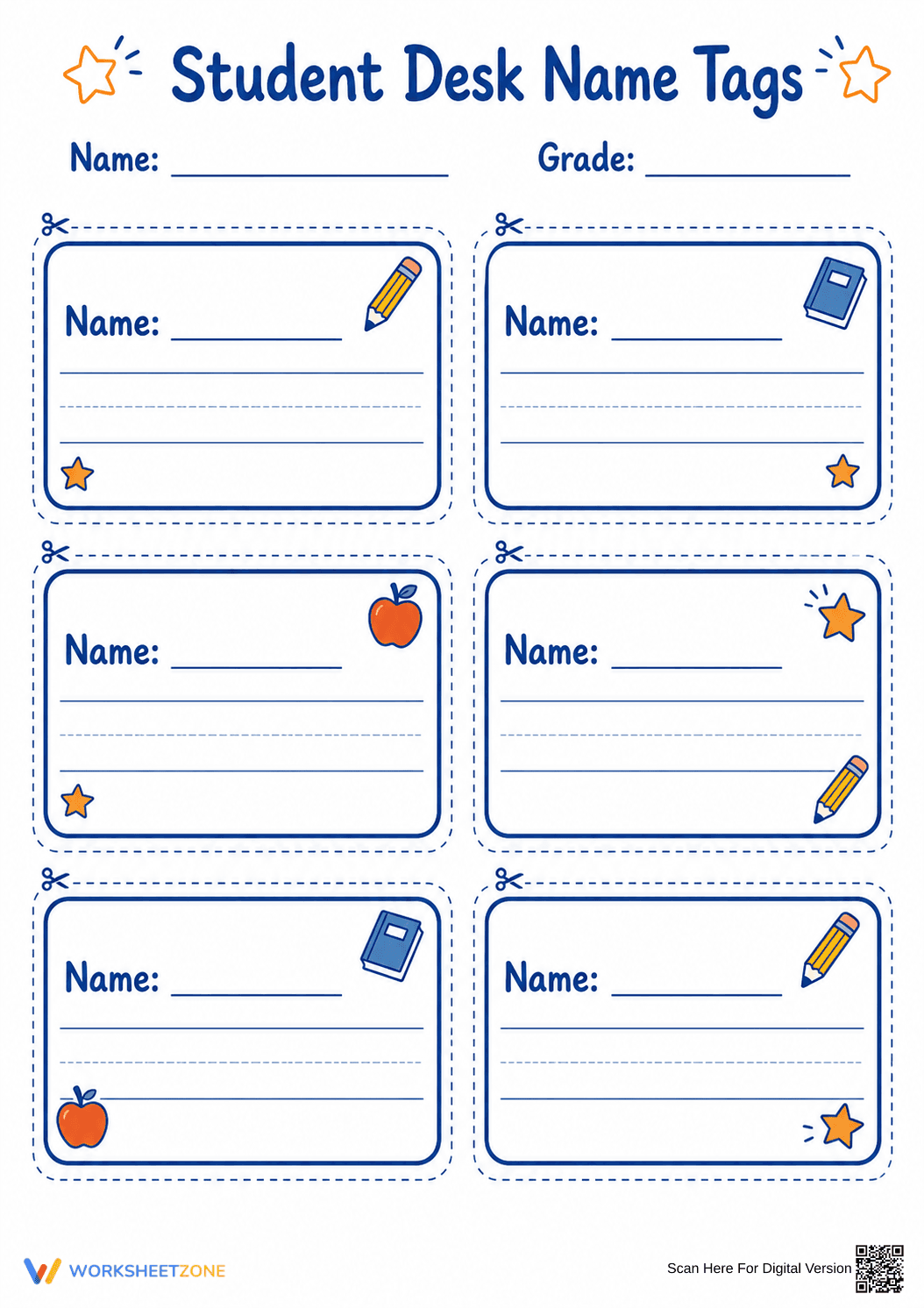
These printable student desk name tags provide a structured space for early learners to practice writing their names while helping teachers organize the classroom. Featuring clear handwriting guidelines and cheerful school icons, this resource establishes ownership of student spaces and reinforces foundational letter formation from the very first day of school.
At a Glance
- Grade: K-2 · Subject: Classroom Management
- Standard:
CCSS.ELA-LITERACY.L.K.1.A— Print upper- and lowercase letters- Skill Focus: Name writing and letter formation
- Format: 1 page · 6 name tags · No answer key · PDF
- Best For: Back to school organization
- Time: 5–10 minutes
This single-page printable includes six desk name tags arranged for easy cutting. Each tag features primary handwriting lines—a solid top line, dashed middle line, and solid bottom line—to guide proper letter height. The design incorporates engaging classroom icons like apples, pencils, and books, adding visual interest without distracting from the writing space. Dotted borders surround each tag to ensure straight cuts when preparing materials.
Setting up these name tags requires minimal effort.
- Print (1 minute): Generate copies on standard A4 paper or cardstock.
- Distribute (2 minutes): Cut along the dotted lines to separate the six tags.
- Review (2 minutes): Place on desks for students to fill out, or write names in advance.
Total teacher prep time is under five minutes, offering an efficient solution for classroom labeling.
This resource aligns with CCSS.ELA-LITERACY.L.K.1.A: Print many upper- and lowercase letters. By utilizing the provided handwriting lines, students practice spatial awareness and proper letter formation when writing their own names. It also supports general classroom management and environmental print recognition. Both standard codes can be copied directly into lesson plans, IEP goals, or district curriculum mapping tools.
These tags serve multiple purposes. During the first week of school, use them as a morning work activity where students practice writing their names upon arrival. Alternatively, use them as flexible labels for cubbies or supply bins. As a formative assessment observation tip, watch how students grip their pencils and align their letters to the dashed midline while filling out their tags. Expected completion time is brief, typically taking students just a few minutes.
This printable is designed primarily for kindergarten through second-grade students who are still mastering letter formation and require visual boundaries for writing. For differentiation, teachers can write the names using a yellow highlighter for students who need tracing support, while advanced students can write both their first and last names independently. This resource pairs perfectly with back-to-school anchor charts about classroom rules and routines.
Establishing a predictable classroom environment and practicing foundational writing skills are critical components of early childhood education. This resource supports CCSS.ELA-LITERACY.L.K.1.A by requiring students to print upper- and lowercase letters within structured handwriting lines. According to Fisher & Frey (2014), creating a structured, print-rich environment fosters student independence and reinforces daily literacy habits. When students see their own names clearly displayed on their desks, it builds a strong sense of belonging and provides a constant, personalized model of environmental print. The inclusion of primary writing lines ensures that the simple act of labeling a desk becomes a meaningful exercise in spatial awareness and fine motor control. By integrating functional classroom management tools with targeted letter formation practice, educators maximize instructional time and establish clear routines.


