Color-Coded Emotional Regulation: Using 2nd Grade Worksheets for Classroom Management
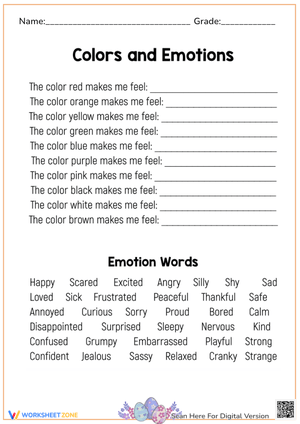
These 2nd grade emotional color worksheets pdf resources give teachers a structured, low-prep way to build emotional literacy with second graders — at exactly the developmental moment when kids can start naming feelings beyond "happy" or "upset" but still need a consistent visual reference to do it reliably. Each worksheet targets one piece of the self-regulation cycle: sorting emotions into color zones, identifying personal triggers, matching coping strategies to specific states, and self-monitoring in real time. The set is built for daily use across the school week, not as a standalone lesson.
What's Inside the Set
The 2nd grade emotional color worksheets pdf collection works through the four-zone color framework — green, yellow, red, and blue — and builds student competency across several interconnected skills. The set asks students to:
- Sort feeling words and images into the correct color zone and explain their reasoning
- Write or draw about personal triggers for each zone
- Match coping strategies to the emotional states where they apply
- Trace a scenario from calm to escalation and back to calm, making the regulation cycle visible rather than abstract
- Use body-sensation prompts ("Where do you feel it in your body?") and self-check boxes marked before and after an activity
The vocabulary throughout stays within a second-grade reading level while naming specific emotions — not just "mad" but "frustrated," "furious," or "overwhelmed." Students who can distinguish frustrated from furious are far better positioned to choose an appropriate coping tool than students who only know they're somewhere in the red.
Where These Worksheets Fit Into the School Day
The most effective entry point is the morning meeting, where a brief check-in worksheet functions as an emotional weather report before instruction starts. This takes under four minutes: students mark their zone, choose one feeling word, and identify one coping strategy they'll use if needed. The teacher does a quick visual scan rather than asking students to share aloud — a small move that protects students who are genuinely elevated from feeling put on the spot in front of the class.
Transitions are the second high-value window. The minutes after returning from specials — PE in particular — are consistently when self-regulation is most challenged. Keeping a laminated zone chart at each table and asking students to silently check in as they sit down catches escalating states before they become disruptions. A two-minute re-anchoring moment there costs far less instructional time than managing the fallout from an unchecked meltdown.
Formal worksheet introduction fits best in the dedicated SEL block or advisory time, where students can work through a new skill without the cognitive pressure of an upcoming academic task. Once a skill is introduced, it can resurface as a warm-up in any block — three minutes, one worksheet, a brief whole-class debrief before moving on.
Student Mistakes to Address Before They Become Habits
The most persistent mistake isn't mis-sorting an emotion — it's believing that landing in the yellow or red zone is itself the problem. Students who internalize this idea will hide their true emotional state on check-ins rather than report honestly. Explicit teacher discussion at the time of introduction is essential: all zones are information, not grades on behavior.
A separate pattern shows up specifically with the blue zone. Students often interpret blue-zone feelings — sadness, fatigue, disconnection — as simply being bad at paying attention, and they resist identifying there because it feels like an admission of failure. Worksheets that include physical sensation cues ("Do your shoulders feel heavy? Is it hard to keep your eyes open?") help students recognize blue-zone states before they dismiss them as laziness.
Some students, particularly those with strong verbal ability, report what they think the teacher wants to see. These students will mark "green" on nearly every check-in regardless of their actual state. Pairing the written worksheet with a brief private signal — a sticky note placed face-down on the desk, or a quiet thumbs check — keeps self-reporting more honest without requiring public disclosure.
Standard Alignment
These worksheets map to CASEL's core competencies of self-awareness and self-management — specifically, the ability to identify one's emotions and link those states to appropriate regulatory responses. In most states, those competencies anchor the SEL standards embedded in K-2 frameworks, including Illinois SEL Standard 1A (identify and manage one's emotions and behavior) and Ohio's Social and Emotional Learning Standards for kindergarten through second grade. Schools operating within a Multi-Tiered System of Supports will find these worksheets compatible with Tier 1 whole-class instruction and Tier 2 small-group support, and they fit naturally into documentation for students whose behavior intervention plans target emotional regulation as a specific skill.
Tailoring the Practice for Students at Different Readiness Levels
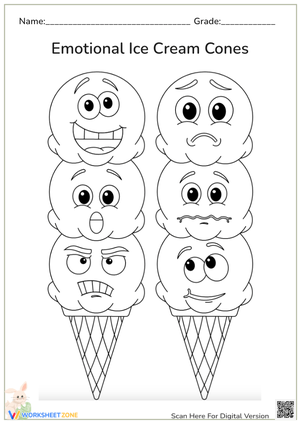
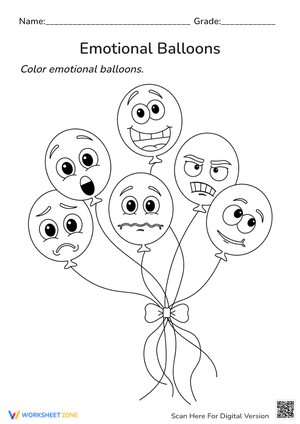
For students still building reading fluency, the worksheets work better with a picture-based modification: add or substitute feeling-face images for printed emotion words so the task stays focused on emotional recognition rather than decoding. Without this adjustment, the SEL activity becomes an unintentional reading assessment.
Students who quickly grasp the four-zone model benefit from extension work that asks them to map sequences rather than single moments. Instead of "I am in the yellow zone right now," they trace a full arc — what triggered the shift, which zone they entered, what strategy they chose, and which zone they returned to. That kind of written reflection builds the executive functioning skills that go well beyond basic emotion labeling.
For students flagged with ADHD, anxiety, or sensory sensitivities, these 2nd grade emotional color worksheets pdf materials offer something verbal check-ins do not: a low-pressure, private way to communicate internal states without eye contact, speech, or public disclosure. One honest limitation worth naming upfront: students who are highly literal may find the metaphorical use of color genuinely confusing and need repeated, direct clarification — green does not mean "good kid," and red does not mean "bad kid."
Frequently Asked Questions
What color model do these worksheets use?
The worksheets follow a four-zone framework: green (calm, focused, ready to learn), yellow (heightened — nervous, excited, frustrated, or silly), red (intense — rage, panic, extreme distress), and blue (low-energy — sad, tired, sick, or bored). The model groups emotions by the body's arousal level, not by whether a feeling is pleasant or unpleasant. That's an important distinction to teach explicitly — students initially assume yellow and red are both "bad" while green and blue are both "fine," which misses the point of the system entirely.
How often should students complete these worksheets?
Daily zone check-ins take only a few minutes and are worth doing every school day. More extended activities — scenario tracing, coping strategy matching, trigger identification — fit best in the SEL block two or three times per week. One pattern worth avoiding: using the 2nd grade emotional color worksheets pdf materials as a default cool-down consequence. When worksheets become a behavior management tool rather than a skill-building one, students stop engaging with them meaningfully.
Can families use these at home?
Yes, and the consistency amplifies the effect significantly. When students encounter the same color language at home, in the car, and at school, the self-regulation habit generalizes beyond the classroom rather than staying school-specific. Sending one or two worksheets home per month with a brief note explaining the zone model builds a shared family vocabulary without overwhelming parents with a complex new system to learn from scratch.
Are these appropriate for students receiving counseling or intervention services?
These worksheets align well with Tier 2 support work and are frequently used by school counselors in small-group sessions. A counselor can use the scenario-tracing worksheet to guide conversation about specific events a student has actually experienced, making the reflection more personalized than whole-class instruction allows. The worksheets are not a replacement for clinical intervention, but they give counselors and students a shared language to build on across settings.
Clear All