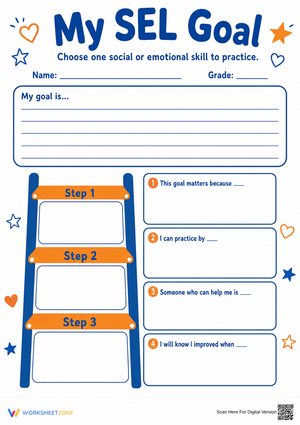
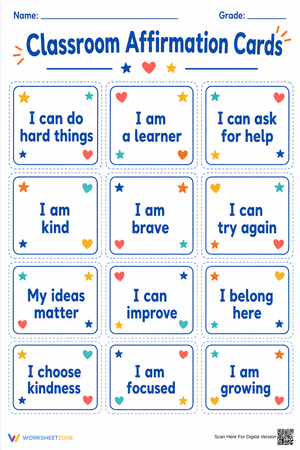
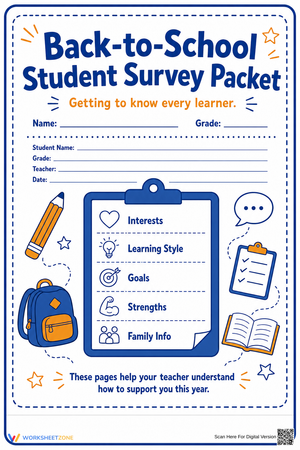
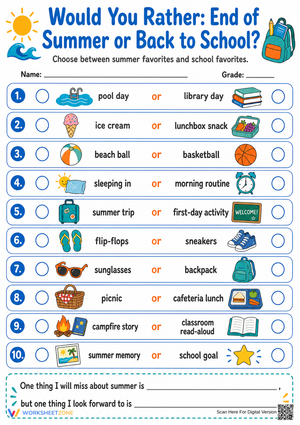
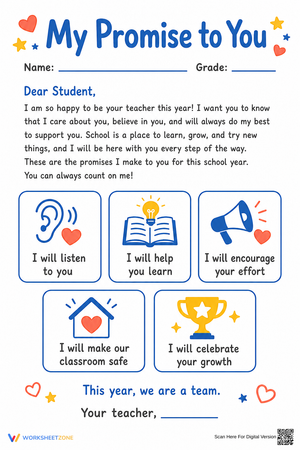
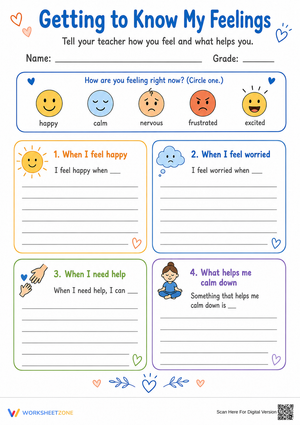
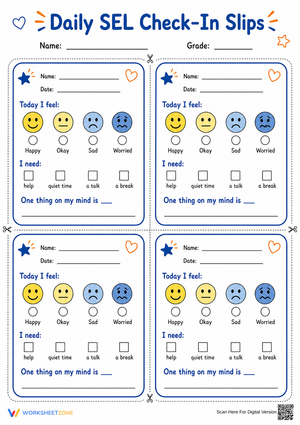
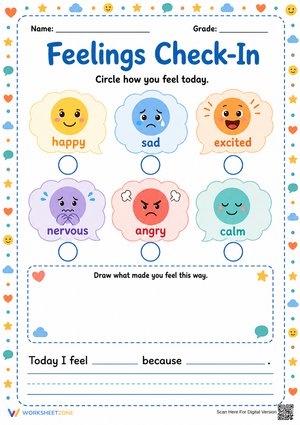
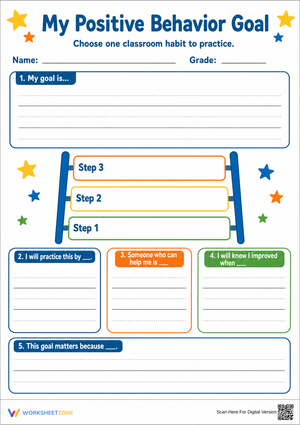
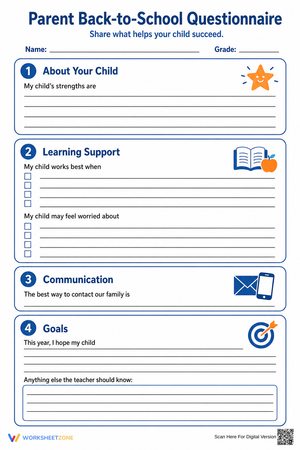
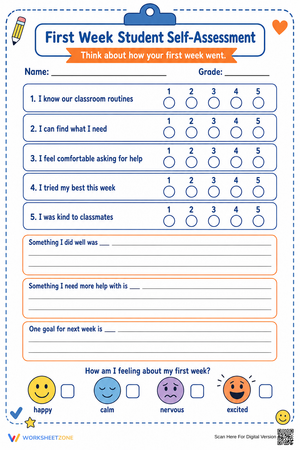
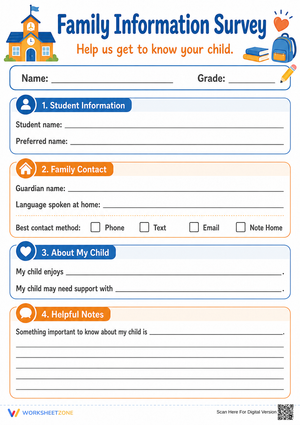
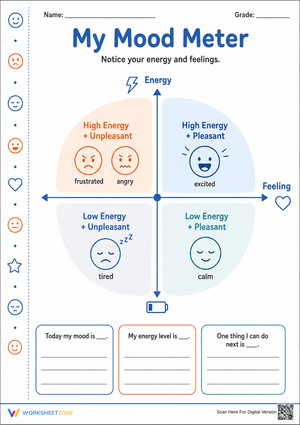
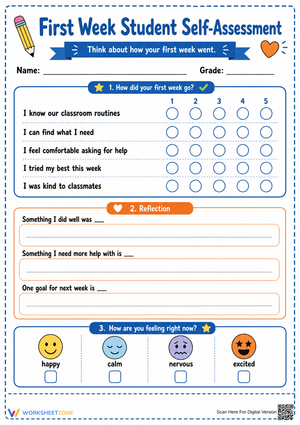
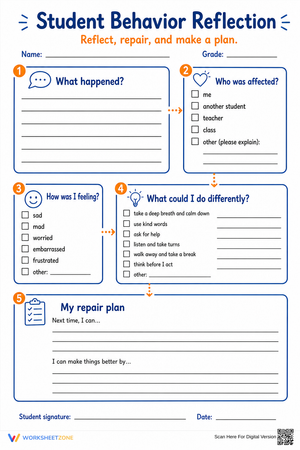
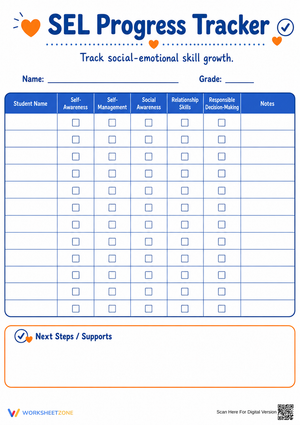
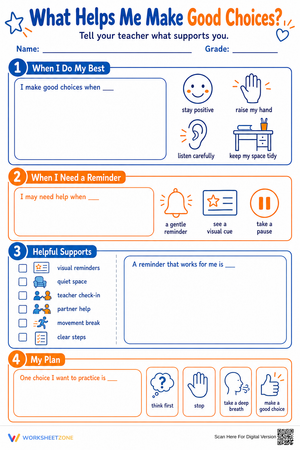
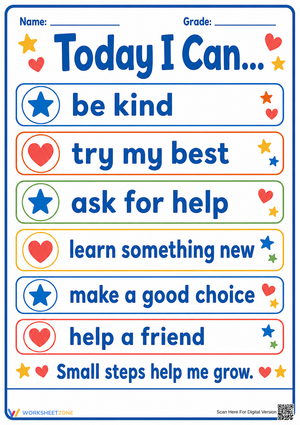
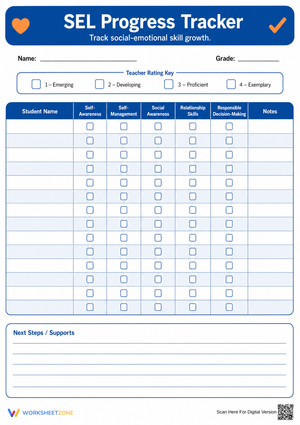
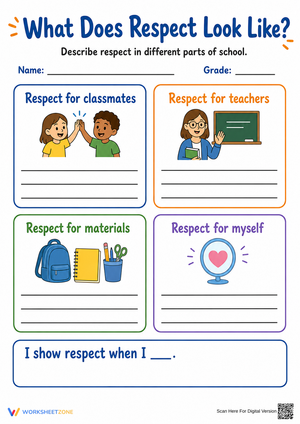
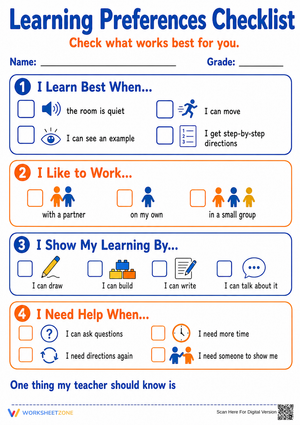
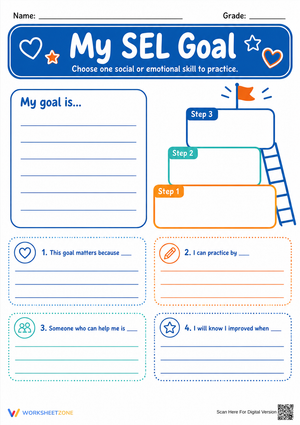
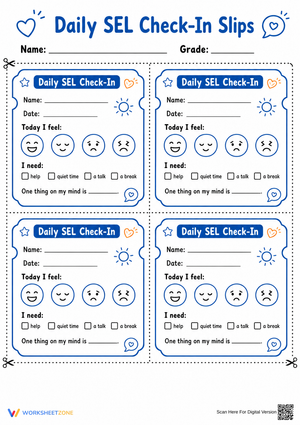
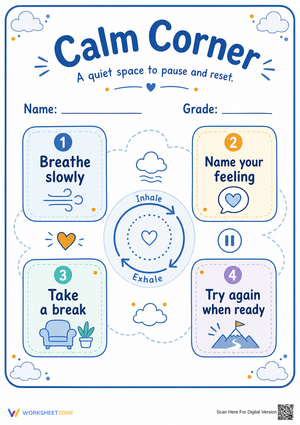
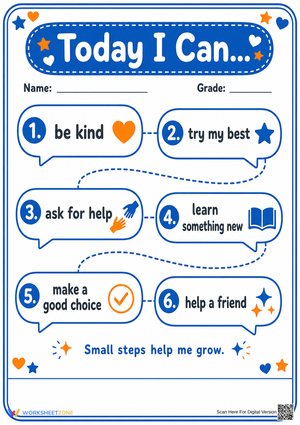
These social emotional learning worksheets pdf for 2nd grade address the moment when children start to hold two social realities at once — their own feelings and someone else's. Most 7- and 8-year-olds arrive with a handful of emotion words and almost no language for the gradations between "fine" and "furious." The set builds that vocabulary alongside the regulation strategies students need when feelings get too big to manage alone, with each worksheet functioning as a standalone activity that fits into a morning meeting, a calm-down corner, or a brief small-group check-in without requiring any particular sequence.
The Specific Skills Each Worksheet Targets
The worksheets work across five SEL competencies, always through concrete scenario-based tasks rather than abstract definitions. At age 7 and 8, concept-building happens through story and situation. Students who can articulate what a character in a scenario is feeling — and why — are more likely to apply that same language when they are mid-conflict on the playground.
- Emotional vocabulary expansion: Students move past "mad" and "sad" to label gradations — frustrated, disappointed, embarrassed, left out. Several worksheets use a feelings intensity scale where students mark where a feeling sits on a 1-to-5 range before deciding how to respond.
- Coping strategy selection: Rather than memorizing a list, students practice matching the strategy to the size of the feeling — box breathing for a small frustration, a movement break when the feeling is bigger.
- Body signal recognition: Students identify the physical signals — a tight chest, clenched hands, a racing heartbeat — that indicate stress is building before it escalates into a behavioral response.
- Perspective-taking: Scenario-based worksheets ask students to name how a classmate likely feels after being excluded from a game, then write or draw one specific response they could offer. The constraint of generating a single response forces more deliberate thinking than open-ended prompts.
- "I feel" communication: Students practice structured sentence frames for expressing needs without assigning blame — rehearsing a communication pattern before they need it in an actual conflict.
How to Work These Worksheets Into Your Lesson Plans
The most effective approach is frequency over duration. A five-minute SEL check-in three mornings a week builds more durable habits than a single forty-minute unit once a month. These worksheets fit naturally into the eight minutes of transition time after morning meeting ends and before the first academic block begins — a window that otherwise disappears into routine management. Pulling one feelings intensity worksheet as a Monday warm-up gives students a low-stakes re-entry into the school week and surfaces who came in already carrying something heavy.
A calm-down corner only works when it contains materials students already know. Unfamiliar worksheets in a cool-down space sit untouched. If students have practiced the body-scan worksheet during a whole-class morning meeting, they will actually reach for it when they are dysregulated. Running each worksheet as a shared activity first, then placing it in the calm-down space, takes about ten minutes upfront and results in genuinely independent student use later.
Pairing worksheets with read-alouds is also effective. After a picture book with a clear emotional arc — a character who feels left out, makes a poor choice, and then repairs the relationship — a perspective-taking worksheet gives students a structured way to analyze the character's experience rather than just retelling the plot. The distance of a fictional character makes it easier for students to name difficult emotions they might resist acknowledging in themselves.
Patterns in Student Work Worth Watching For
The most consistent error at this age is flattening emotions into two categories: things that feel good and things that feel bad. When a worksheet asks students to label a scenario with a word like "frustrated," "disappointed," or "embarrassed," many second graders default to the first emotion word they recognize rather than the one that fits the scenario most accurately. A student who writes "he is sad" for a situation that clearly depicts embarrassment is not careless — they have simply not yet built the distinction between those two states. These worksheets make that gap visible quickly, which is more useful to the teacher than assuming the gap does not exist.
A second pattern: when a worksheet offers a choice board of coping strategies and asks students to circle the one they would use, a significant number of second graders circle several — or all of them. That response reveals the student has not yet internalized that strategies are situational. They are treating the task as "collect the good ones" rather than "choose the right one for this moment." Naming that pattern briefly in a whole-class debrief — "we are selecting what fits the situation, not building a collection" — typically resolves it within one or two additional practice rounds.
Adjusting the Worksheets Across a Range of Learners
These social emotional learning worksheets pdf for 2nd grade reach students across a wide performance range without requiring structural overhauls, but the specific adjustments look different depending on who is in the room.
For students working below grade level in reading or language, the scenario-based tasks hold up well when the teacher reads the prompt aloud. The core work — drawing where a feeling lives in the body, circling an intensity level, selecting a coping strategy from a visual choice board — does not depend on strong decoding. These students often engage more fully with SEL tasks than with academic worksheets because the content draws on lived experience they already carry.
For students who move through the basic tasks quickly, the most productive extension is asking them to write a second scenario that would produce the same emotion at a different intensity level. A student who correctly identifies "frustrated" for a broken-pencil scenario can then write a situation that would produce frustration at a 4 rather than a 2. That task requires understanding that emotions are not binary — which is the deeper conceptual move the grade level is actually working toward.
English language learners benefit from having the feelings vocabulary visible during the worksheet — a small bilingual feelings chart placed alongside the task. Not because the reasoning is too difficult, but because retrieving the correct English word for an emotion a student fully understands in their home language is a separate cognitive demand from the SEL thinking the worksheet is assessing. Separating those two demands produces more accurate information about what the student actually knows.
Standard Alignment
The worksheets align with CASEL's five core competencies: self-awareness, self-management, social awareness, relationship skills, and responsible decision-making. In states with adopted SEL standards — including Illinois (ISBE), Michigan (MAISA), and Washington (OSPI) — the competencies addressed map to early elementary benchmarks for recognizing and managing emotions and demonstrating empathy in peer relationships.
Within the ELA curriculum, social emotional learning worksheets pdf for 2nd grade connect directly to CCSS.ELA-LITERACY.SL.2.1, which calls for students to participate in collaborative conversations with diverse partners. The conflict-resolution and perspective-taking work these worksheets provide is precisely the rehearsal that standard describes. When SEL instruction and literacy instruction share language — "What is the character feeling? What evidence do you have?" — second graders build both competencies at once without treating them as separate subjects.
Frequently Asked Questions
Is it realistic to use these worksheets every day, or does that become rote?
Routine is the point. Social emotional learning worksheets pdf for 2nd grade work through repetition — not rote repetition, but the kind where a familiar format carries new content each time. A feelings intensity worksheet used Monday through Thursday stays meaningful as long as the scenarios change: a conflict at lunch, a hard moment at home, a frustrating classroom task. The stable format reduces the cognitive overhead of following new directions, so students can focus on the emotional reasoning rather than figuring out what they are supposed to do.
What do I do when a student refuses to complete an SEL worksheet?
Refusal is usually information. A student who shuts down during a perspective-taking exercise about being left out of a game may be living that experience right now. Forcing completion is counterproductive; a quiet check-in about whether the topic feels too close is more useful. Keeping a less emotionally charged alternative available — something focused on personal strengths or goal-setting rather than conflict — gives the student a way to participate without re-entering something raw.
How do I involve families without turning it into homework?
Send home finished worksheets with a brief note explaining the vocabulary the class is using — the specific feelings words, the coping strategy names, the sentence frames. When a parent knows their child practiced saying "I feel frustrated when..." at school, they can prompt the same language at home without needing to introduce a new concept. That kind of reinforcement matters more than any dedicated SEL assignment sent home, and it takes about two minutes to prepare.