These 12th grade linear equations worksheets pdf resources give teachers structured practice for the skills seniors need before college placement exams and first-semester university math — three-variable systems, matrix algebra, linear programming, and SAT-style equation fluency. The set moves from organized elimination work into applied optimization, building procedural fluency alongside the mathematical modeling skills that show up in actual engineering and economics courses.
What's Inside the Set
Four major strands define the content:
- Three-variable systems: Students use elimination and substitution in sequence — reducing a 3×3 system to a 2×2, then down to a single equation they can solve directly. Each worksheet in this strand anchors the procedure to a real-world context: distributing production costs across three departments, mixing three solutions to a target concentration, or allocating limited resources across competing demands.
- Matrix algebra: Operations include addition, subtraction, multiplication, determinant calculation, and matrix inversion. Students apply these tools to solve systems using Cramer's Rule and matrix inversion, and they work through Gaussian elimination from augmented matrix form to reduced row-echelon form by hand.
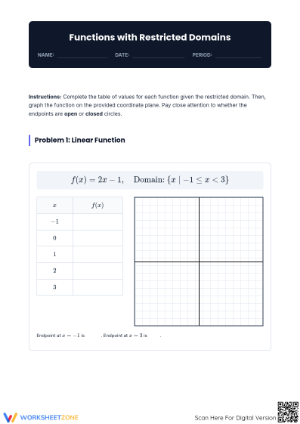
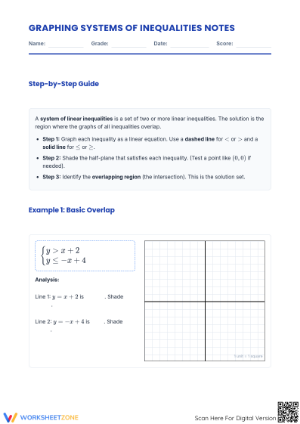
- Linear programming: Students graph systems of linear inequalities to identify feasible regions, locate corner points, and evaluate an objective function at each vertex. Problems draw from logistics and production contexts where setting up the constraint system correctly is the analytical challenge — not just the arithmetic that follows.
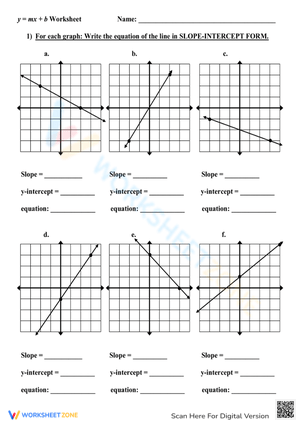
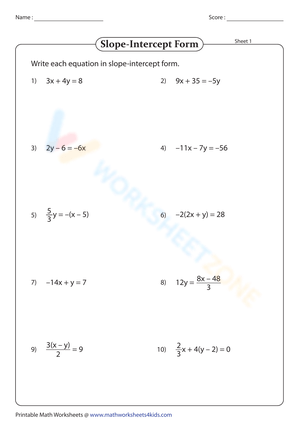
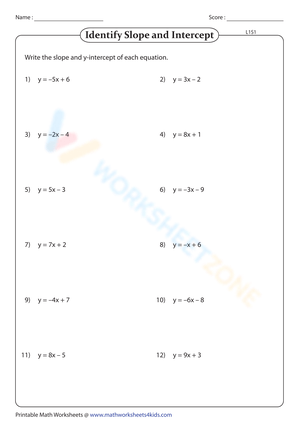
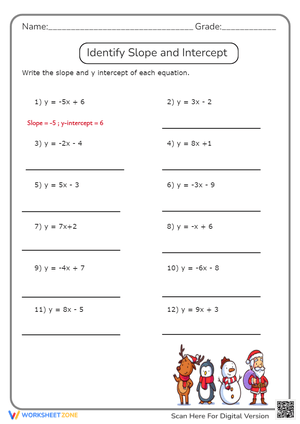
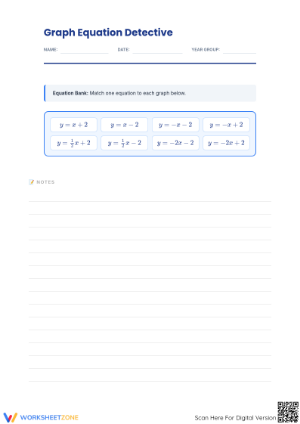
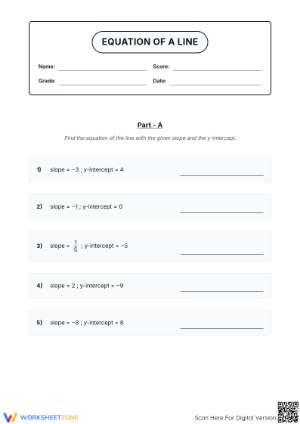
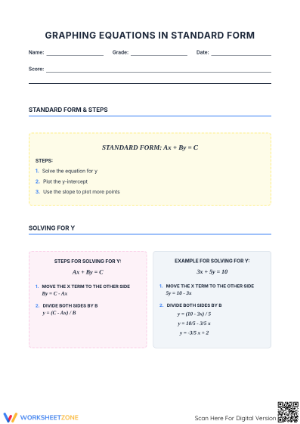
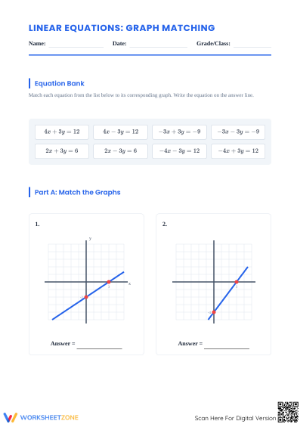
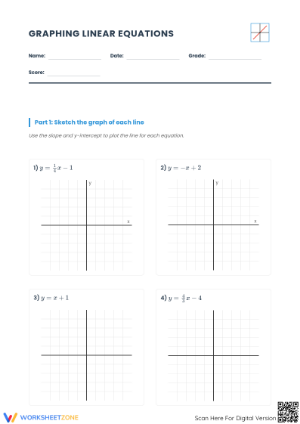
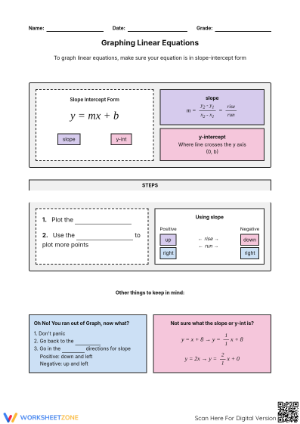
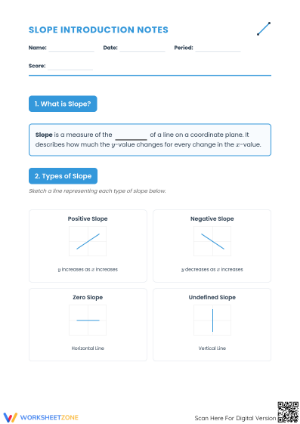
- SAT and ACT equation fluency: Several worksheets target the formats students encounter on college entrance exams: slope-intercept, point-slope, and standard form, along with questions that require determining the number of solutions a system has without fully solving it.
The 12th grade linear equations worksheets pdf set is structured so teachers can assign strands independently based on where a class is in the unit — the matrix algebra worksheets don't assume students have already worked through three-variable systems, and linear programming can run as a standalone capstone if the unit sequence calls for it.
Errors Worth Anticipating Before They Reach the Test
Three-variable elimination produces a failure pattern worth naming explicitly. After a successful first round of elimination, students create a two-variable system and feel confident — then a sign error in the second round produces a wrong answer that looks completely plausible. Because the error lives inside a derived equation rather than the original problem, there's no easy anchor to check against. Making back-substitution a required step, and showing students what a failed check looks like in actual worked examples, catches this before it becomes a test-day surprise.
Matrix multiplication trips up students who have solid arithmetic and strong scalar intuition. The issue is non-commutativity: AB and BA produce different results, and students who have internalized the commutative property across years of arithmetic don't instinctively abandon it here. The worksheets address this by pairing problems where the order of multiplication changes the product visibly — students who reverse the row-by-column sequence get a different answer, which makes the rule concrete rather than merely stated.
In linear programming, the most common error isn't graphing the feasible region — it's testing an interior point of that region instead of a vertex when evaluating the objective function. Students produce a numerical answer and don't notice anything is wrong, because the mistake yields a result rather than a blank. This requires deliberate classroom attention: students need to understand why the optimal solution always lives at a vertex, not just how to find vertices mechanically.
One more pattern worth addressing directly: when row reduction produces a row of zeros on the left side of the augmented matrix, students frequently declare the system inconsistent and write "no solution." The distinction matters. A row that reduces to 0 = 0 indicates a dependent system with infinitely many solutions. A row that reduces to something like 0 = 5 is the actual inconsistency. Both look similar until students examine the right side of the matrix, and making that comparison explicit prevents a persistent conceptual mix-up.
How to Work These Worksheets Into Your Unit Sequence
Three-variable elimination makes a strong Monday warm-up after a weekend gap. The spaced retrieval pressure surfaces errors that same-week practice won't catch — students who handled the procedure confidently on Friday will occasionally struggle Monday morning, and that diagnostic information is worth having before the unit moves to matrices. A quick five-problem warm-up reveals which students need another guided example and which are ready to advance.
The matrix operation worksheets fit a focused 30-minute block mid-unit, and they work best before graphing calculators are introduced for row reduction. Students who work through Gaussian elimination by hand first have a reference point for evaluating whether a calculator output makes sense. Skipping the manual step tends to produce students who trust results without any feel for what row operations are doing to the underlying system of equations.
Linear programming belongs at the end of the systems unit, not the beginning. Students need to be comfortable graphing linear inequalities and locating intersection points before the optimization layer adds conceptual weight. Assigning a linear programming worksheet before that graphing fluency is in place creates the kind of frustration that comes from managing too many unfamiliar ideas simultaneously, rather than the productive struggle that comes from applying known skills in a new structure.
For the SAT-aligned worksheets in the 12th grade linear equations worksheets pdf set, timed practice sessions pay off more than untimed review. Students who have content mastery but slow execution — a real and separate problem from understanding — benefit from a firm time ceiling that starts loose and tightens across several sessions. A student who understands slope-intercept form thoroughly but spends three minutes per problem will still underperform on test day.
Standard Alignment
Three CCSS High School Algebra standards anchor this set. HSA-REI.C.6 — solving systems of linear equations exactly and approximately — covers the three-variable and matrix algebra work. HSA-REI.D.12 — graphing the solutions of linear inequalities in two variables — maps directly to the linear programming strand, specifically the feasible region and vertex identification work. HSA-CED.A.3 — representing constraints with systems of equations and inequalities and interpreting solutions in context — applies across all four strands, but most directly to the real-world setups in the three-variable and linear programming worksheets.
These three standards cluster at the end of the high school algebra progression, which is why the set functions as capstone material rather than mid-course review. Teachers planning around CCSS will find this work sits naturally in the second semester of a senior math course, after students have solidified two-variable system solving in prior years.
Adjusting the Worksheets for a Range of Learners
Students who aren't yet fully fluent with two-variable systems can use the early three-variable worksheets as intensive organized-elimination practice. The techniques transfer directly, and giving these students the first elimination step completed lets them focus on the decision-making in rounds two and three rather than stalling at the entry point. That targeted support — reducing the procedural burden at entry without simplifying the core algebraic challenge — keeps them working within the material rather than around it.
For students ready to go further, the matrix worksheets extend naturally into the geometry of linear transformations. A student who understands the determinant as a number can be pushed to understand it as the scaling factor for area in a transformed space — a conceptual shift that pays off in physics and computer science coursework. The 12th grade linear equations worksheets pdf collection gives teachers the raw material to push students who are ready without building separate assignments from scratch.
For students preparing specifically for AP-level work or college placement tests, the SAT-aligned worksheets function well as timed diagnostic tools. A 20-minute timed session on the equation fluency worksheets gives a teacher real data on which students are ready for test conditions and which need targeted work on a specific form or concept.
Frequently Asked Questions
How do you solve a system of three linear equations by elimination?
The process runs in two rounds. In the first, choose one variable to eliminate and combine pairs of the three equations to produce two new equations, each containing two variables. In the second round, eliminate a second variable from those two equations to get a single-variable equation you can solve. Back-substitute that value upward through the chain to find the remaining unknowns. The most important procedural habit is labeling each derived equation clearly, so when the final check fails, you can trace exactly where an error entered rather than restarting from scratch.
What is the difference between a consistent and an inconsistent system?
A consistent system has at least one solution — either a unique point where all equations agree, or infinitely many solutions when the equations describe the same line or plane. An inconsistent system has no solution because the equations are contradictory: parallel lines in two dimensions, or planes with no common intersection in three. In matrix form, inconsistency surfaces as a row that reduces to a false statement — 0 = 5 is the standard example. A row that reduces to 0 = 0 is not an inconsistency; it indicates a dependent system with infinitely many solutions, and the two outcomes require different interpretations.
How does Cramer's Rule work, and when should teachers introduce it?
Cramer's Rule expresses each variable's value as a ratio of determinants — the determinant of a modified coefficient matrix over the determinant of the original coefficient matrix. It's worth teaching because it makes transparent why a zero determinant signals trouble: a singular matrix means the system is either inconsistent or dependent, and Cramer's Rule breaks down at that point in an informative way. Practically, the rule becomes unwieldy for systems larger than 3×3. It works best as a second method students use to verify answers they've already found by elimination, before Gaussian elimination takes over as the primary tool.
What linear equation topics appear most consistently on the SAT?
The SAT tests linear equation content in several recurring formats: writing an equation from two points or from a stated slope and intercept, solving a two-variable system, and interpreting the slope or y-intercept of a line in a real-world context. The question type that costs students the most points relative to its difficulty is the "number of solutions" problem — students must determine, without fully solving, whether a system has one solution, no solution, or infinitely many, using the relationship between the equations' coefficients and constants. That skill requires conceptual understanding of what the algebra represents, not just procedural execution, and it's worth building into practice sessions as a distinct focus.
Why does linear programming appear in the 12th grade curriculum?
Linear programming marks the point where systems of inequalities stop being abstract and start modeling real decisions under constraints. The mathematical moves — graphing inequalities, locating corner points, evaluating an objective function — build on skills students already hold from earlier coursework. What's new is the problem structure itself: multiple constraints that must all hold simultaneously, with an explicit goal of maximizing or minimizing a quantity. That structure is foundational for operations research, economics, and data science, and students who encounter it in a high school setting arrive at college coursework with a concrete reference point rather than meeting the concept entirely cold.












 Interactive Worksheet Maker
 Quiz Maker
 Word Search Maker
 Crossword Puzzle Maker
 Word Scramble Generator
 Sentence Scramble Generator
 Handwriting Worksheet Generator
 Name Tracing Generator
 Fill In The Blank Generator