These equations worksheets for 12th grade give teachers targeted practice across the four equation families that define senior-year algebra: rational, radical, logarithmic and exponential, and trigonometric. Each worksheet focuses on a specific skill within those categories rather than blending everything into one sprawling problem set, which means teachers can assign them surgically — dropping a radical equations worksheet the day after introducing index notation, not two weeks later when the concept has gone stale.
The Equation Types Covered
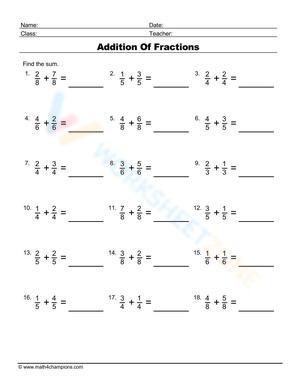
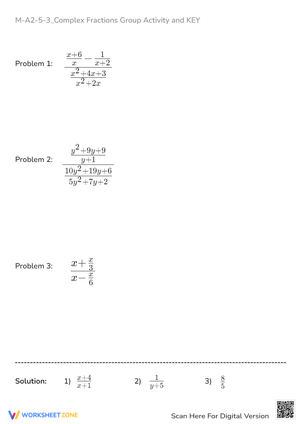
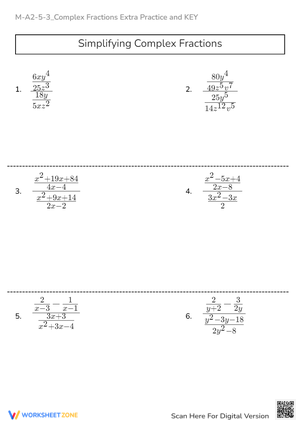
Rational equations open the set. Students reduce complex fractions, find least common denominators across polynomial expressions, identify values that make denominators zero, and — critically — check whether their solutions survive domain restrictions. This is harder than it sounds: the algebra frequently produces a clean-looking answer that turns out to be excluded from the domain, and students who skip the verification step miss that entirely.
Radical equations follow. Each worksheet in this section involves isolating the radical, raising both sides to the appropriate power, and solving the resulting polynomial or linear equation. Square roots are the entry point, but the set also includes cube roots and higher-order indices so students encounter cases where extraneous solutions can and cannot appear — understanding when they're possible is as important as knowing to check for them.
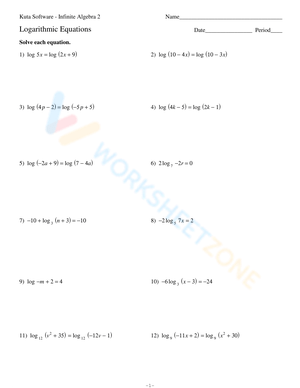
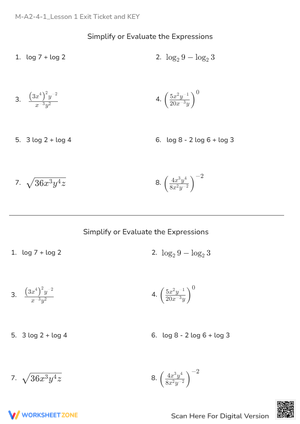
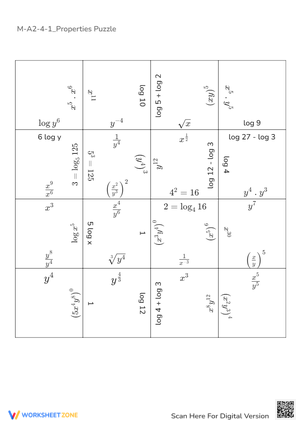
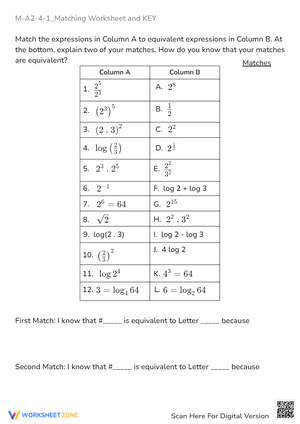
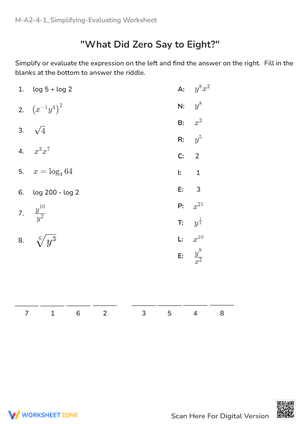
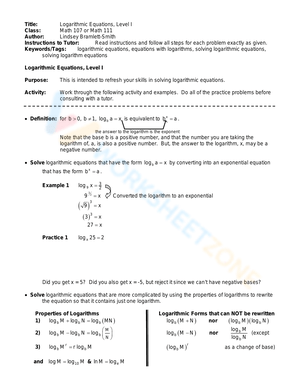
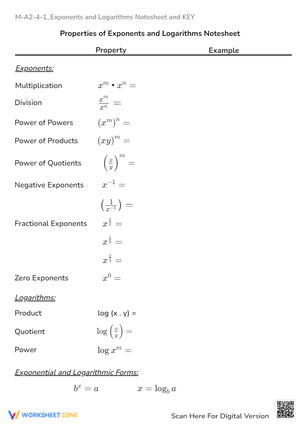
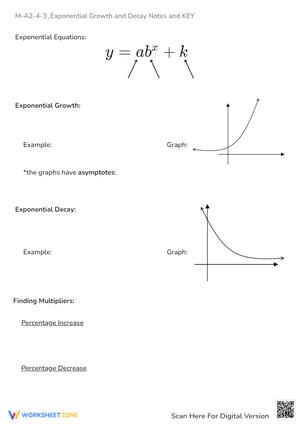
The logarithmic and exponential worksheets move in two directions: from exponential form into logarithmic form and back, and from abstract log properties into multi-step equations that require the change-of-base formula or natural logarithms. These pair well with the trig section because both require students to apply a property rule before any direct solving is possible — a structural parallel that helps students see algebraic manipulation as a broader toolkit rather than a set of topic-specific tricks.
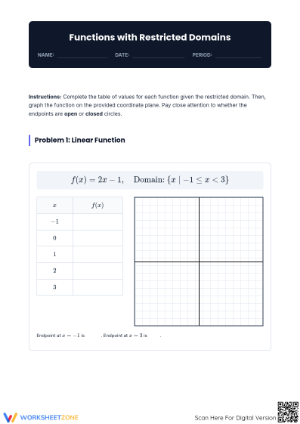
Trigonometric equations round out the set. Problems ask students to apply Pythagorean identities, double-angle formulas, and sum-to-product transformations to simplify expressions before isolating the trig function. Solving within a restricted interval like [0, 2π) is the standard expectation at this level, and multiple worksheets in this section emphasize listing every valid solution — not just the reference angle.
Student Errors That Show Up Consistently at This Level
The most predictable mistake across all four equation types is the failure to verify answers. Students who correctly apply the quadratic formula to a rationalized radical equation will often write down both roots without checking either against the original. The error isn't algebraic — the math is right — it's procedural. A student who gets x = 4 and x = −1 from a square-root equation may not notice that substituting −1 produces a negative radicand in the original expression. That check takes thirty seconds, and most students skip it every single time until they've been burned by it on a test.
In logarithmic equations, the consistent error involves misapplying the product rule. Students who correctly remember that log(a) + log(b) = log(ab) will attempt the reverse when expanding: they try to split log(a + b) into log(a) + log(b), which doesn't work. Writing a concrete counterexample on the board — log(10 + 90) ≠ log(10) + log(90) — does more to dislodge that misconception than restating the rule three times. These worksheets surface this error reliably because they include expressions that look expandable but aren't.
With trigonometric equations, the recurring issue is solution completeness. Students find the reference angle, correctly identify the two quadrants where the trig function holds, and then stop — forgetting that the question asks for all solutions in [0, 2π). They hand in one answer instead of two. Students who have the unit circle memorized still make this mistake because they're thinking about solving the equation, not about the interval requirement.
Fitting These Worksheets Into Your Weekly Rotation
The most effective use pattern is assignment immediately after direct instruction — same day or the following morning — rather than saving the worksheets for end-of-unit review. Spaced retrieval research is clear that early practice with corrective feedback shapes long-term retention more reliably than massed review sessions clustered before an assessment. Practically, that means using the rational equations worksheet the day students first grapple with restricted domains, not in the review week before finals.
The equations worksheets for 12th grade also work well as a five-minute warm-up tool. Giving students one problem from a previous worksheet type at the start of class — a logarithmic equation on the day you're teaching trig identities — keeps earlier material active without consuming significant instructional time. Monday mornings after a weekend break are the natural slot for this, since retrieval difficulty after a gap actually strengthens retention rather than undermining it.
For small-group intervention, the format is direct: pull the three students who flagged on a log-properties exit ticket and work through two or three problems from the corresponding worksheet together. The individual problem structure makes it easy to pause mid-solution and ask "what would happen if you applied the product rule here?" — a question that's hard to pose during whole-class lecture but natural when you're sitting at a table with a small group.
Adjusting the Set for Mixed Readiness Levels
Students who are solid on quadratic methods but weak on logarithmic reasoning need a different entry point than students who can fluently manipulate log expressions but lose track of their algebra mid-problem. The worksheets within each section increase in complexity, so teachers can assign the first half to students who need more procedural consolidation and the full worksheet to students who are ready for multi-concept problems.
For students who need more support before working independently, the rational and radical worksheets — with their built-in verification requirement — provide useful structure. Asking those students to write out every check step explicitly slows them down in a productive way: completing the arithmetic for "substitute x = −1 back into the original" makes the verification step concrete rather than something to rush past.
Advanced students benefit from a different kind of push. Rather than simply assigning harder problems, ask them to write an explanation of why a particular step is mandatory — why checking for extraneous solutions in a radical equation is not optional, for instance. That shifts the cognitive demand from procedural execution to mathematical justification, which is exactly the level of reasoning equations worksheets for 12th grade are preparing students to sustain in college-level courses.
Standard Alignment
These worksheets align with the Common Core High School Algebra and Functions domains. Rational and radical equations address HSA-REI.A.2, which requires students to solve simple rational and radical equations while recognizing how extraneous solutions arise. Logarithmic and exponential equations connect to HSF-LE.A.4, covering natural logarithms and the relationship between the two forms. Trigonometric equations fall under HSF-TF.B.7, which involves using inverse functions to solve equations and specifying an appropriate domain for the modeling context. In course placement terms, this material typically appears in Pre-Calculus, Advanced Algebra, or Math Analysis — the courses that serve as direct preparation for AP Calculus or dual-enrollment college math.
Frequently Asked Questions
Do these worksheets address extraneous solutions explicitly, or do students have to remember to check on their own?
The radical and rational worksheets treat verification as a required step built into the problem format — students are expected to substitute each answer back into the original equation as part of showing their work. That structure removes the decision of whether to check and builds the habit before students encounter problems where the prompt isn't there.
Are these resources appropriate for Pre-Calculus, or are they geared toward Algebra 2?
The content fits both courses, though the emphasis shifts. In Algebra 2, rational and radical equations carry most of the weight, with logarithms introduced late in the year. In Pre-Calculus, logarithmic, exponential, and trigonometric equations take on more significance. Teachers using equations worksheets for 12th grade in a Pre-Calculus context will likely lean on the log/exponential and trig sections most heavily, while Algebra 2 teachers will rely more on the rational and radical material.
How long does a typical worksheet take during class time?
Most students finish an individual worksheet in 15 to 25 minutes of independent work, depending on the section. Trigonometric equation worksheets tend to run longer because each problem requires preliminary work — applying an identity, solving the simplified equation, then identifying all solutions within the given interval. Rational equation worksheets move faster once students have the LCD process internalized. In a 50-minute block, pairing two related worksheets gives most students enough material without running short or waiting idly.
Do these worksheets connect to standardized test content?
The problem types mirror what appears on the SAT Math section, ACT Math, and common state end-of-course assessments for pre-calculus. Rational equations with domain restrictions, exponential equations requiring logarithmic reasoning, and trig equations with interval constraints all appear in standardized testing contexts. Using the set for timed practice in the weeks before a major assessment gives students repeated exposure to exactly the problem structures they'll encounter.