




























Views
Downloads


Printable Equation of a Line Worksheet | Grade 10-12 Math

Paste this activity's link or code into your existing LMS (Google Classroom, Canvas, Teams, Schoology, Moodle, etc.).
Students can open and work on the activity right away, with no student login required.
You'll still be able to track student progress and results from your teacher account.
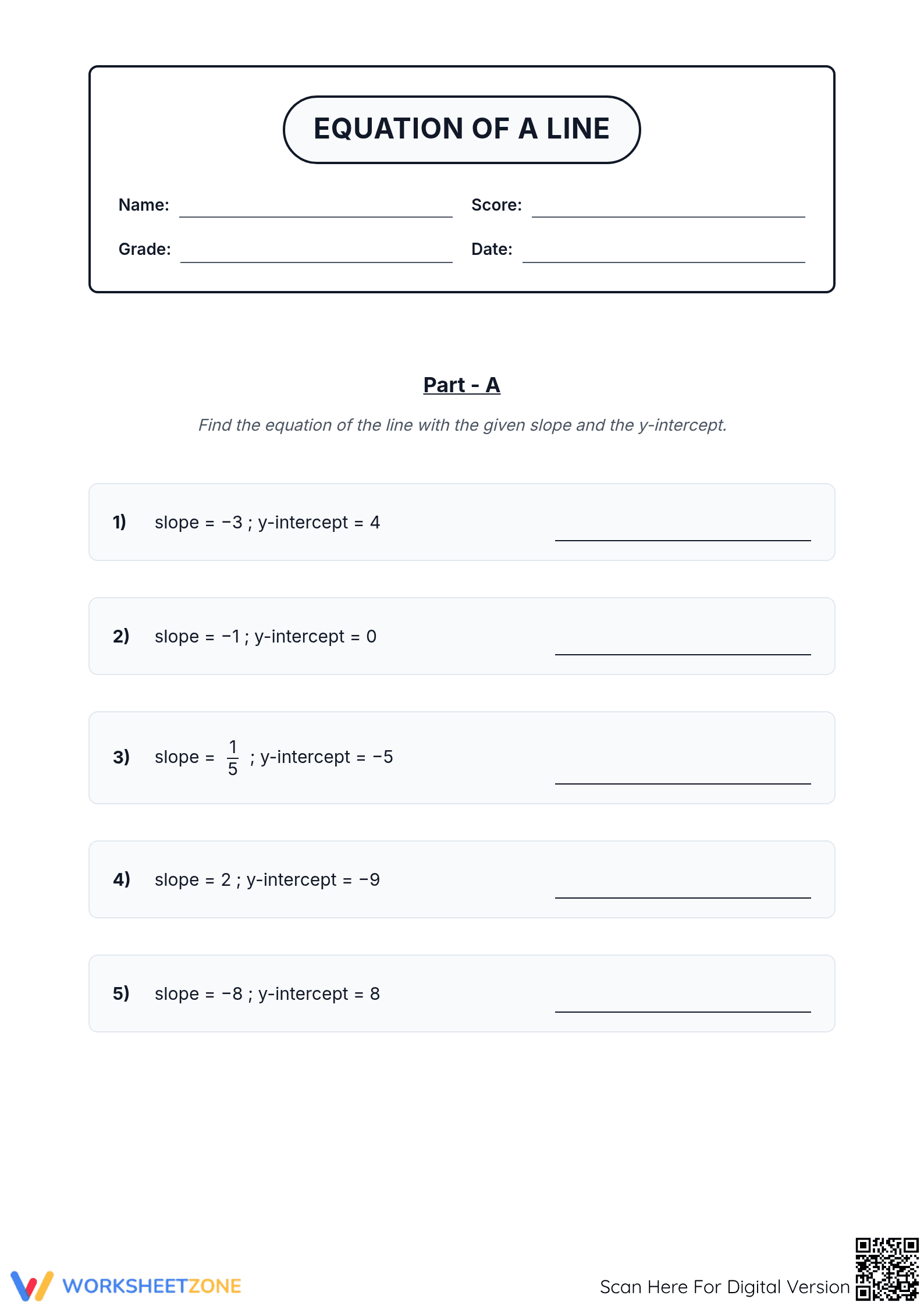
This high school mathematics resource focuses on the essential skill of constructing linear equations from specific data points. Students will practice translating given slope and y-intercept values into the standard slope-intercept form. By working through these problems, learners solidify their understanding of how algebraic variables represent physical attributes of a line on a coordinate plane.
At a Glance
- Grade: 10–12 · Subject: Algebra
- Standard:
HSA-CED.A.2— Create linear equations in two variables to represent relationships between quantities- Skill Focus: Slope-Intercept Form ($y=mx+b$)
- Format: 2 pages · 10 problems · Answer key included · PDF
- Best For: Independent practice or homework reinforcement
- Time: 20–30 minutes
What's Inside: This 2-page PDF contains two distinct sections designed to build confidence and accuracy. Part A features 8 direct-application problems where students are provided with the numerical slope and y-intercept. Part B offers 2 conceptual problems requiring students to extract these values from descriptive text, including a problem involving a tangent line. A complete answer key is provided for immediate grading.
Skill Progression
- Guided Practice: The first five problems use whole numbers and simple fractions to help students memorize the structure of the $y=mx+b$ equation without complex arithmetic.
- Supported Practice: Problems 6 through 8 introduce negative coefficients and fractional intercepts, requiring students to maintain sign accuracy while substituting values into the formula.
- Independent Practice: The final section challenges students to interpret verbal descriptions of lines, such as identifying a y-intercept from where a line cuts the y-axis, ensuring conceptual mastery.
This sequence follows a gradual-release model, moving from basic substitution to contextual interpretation of linear characteristics.
Standards Alignment
This worksheet is primarily aligned to HSA-CED.A.2: Create equations in two or more variables to represent relationships between quantities; graph equations on coordinate axes with labels and scales. It also supports HSA-REI.D.10 by reinforcing the idea that the graph of an equation in two variables is the set of all its solutions plotted in the coordinate plane. Both standard codes can be copied directly into lesson plans, IEP goals, or district curriculum mapping tools.
How to Use It
Use this resource as a high-impact bell ringer at the start of a Geometry or Algebra 2 unit to review foundational linear concepts. It also serves as an effective formative assessment tool; teachers should observe if students correctly handle the subtraction of negative y-intercepts (e.g., $y = mx - 9$). Most students will complete the 10 tasks within 25 minutes during a quiet study block.
Who It's For
This resource is designed for high school students in Grades 10 through 12 who require targeted practice or a refresher on linear functions. It is particularly useful for students preparing for standardized tests that heavily feature coordinate geometry. Teachers can pair this with a graphing calculator activity or a coordinate plane anchor chart to provide a multimodal learning experience for diverse learners.
Research indicates that focused practice with structural algebraic forms, like those in this worksheet, is a critical predictor of success in higher-level calculus. By isolating the slope-intercept form, students reduce cognitive load, concentrating on the precise relationship between rate of change and y-intercept. This targeted approach, coupled with immediate feedback from the answer key, significantly improves long-term retention of algebraic rules, providing essential scaffolding for more complex linear transformations and systems of equations in advanced coursework.


