


























Views
Downloads


Essential Graphing Linear Equations Worksheet | Grade 8-12
Paste this activity's link or code into your existing LMS (Google Classroom, Canvas, Teams, Schoology, Moodle, etc.).
Students can open and work on the activity right away, with no student login required.
You'll still be able to track student progress and results from your teacher account.
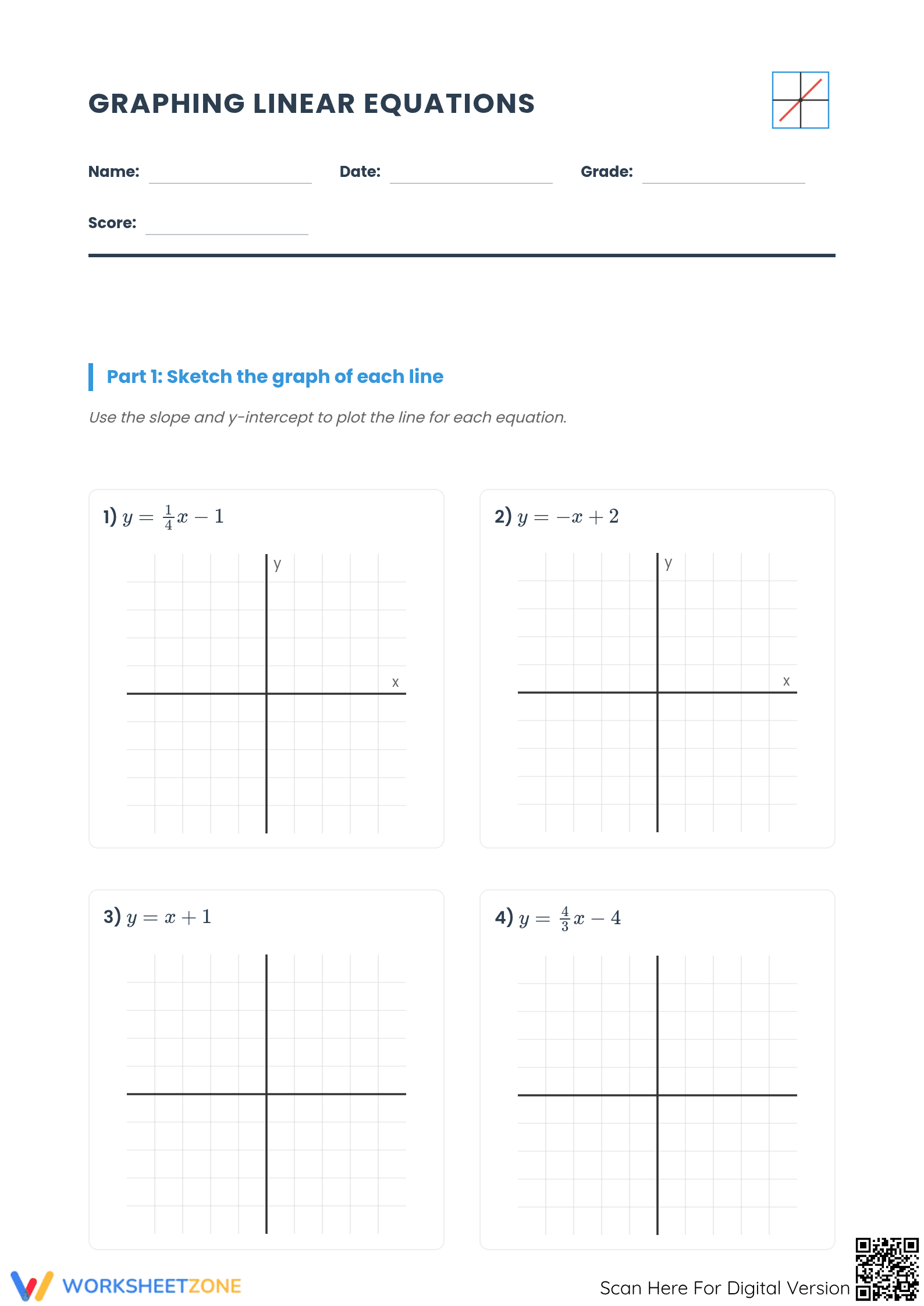
Master the fundamentals of coordinate geometry with this comprehensive graphing linear equations worksheet. Designed for middle and high school students, this resource provides structured practice in visualizing algebraic relationships. Students will progress from simple slope-intercept sketches to complex equation rearrangements, ensuring a deep understanding of how variables interact on a Cartesian plane.
At a Glance
- Grade: 8–12 · Subject: Math
- Standard:
CCSS.MATH.CONTENT.8.EE.B.5— Graph linear equations and interpret the unit rate as the slope- Skill Focus: Slope-intercept form and intercepts
- Format: 4 pages · 17 problems · Answer key included · PDF
- Best For: Core instruction or algebra review
- Time: 40–50 minutes
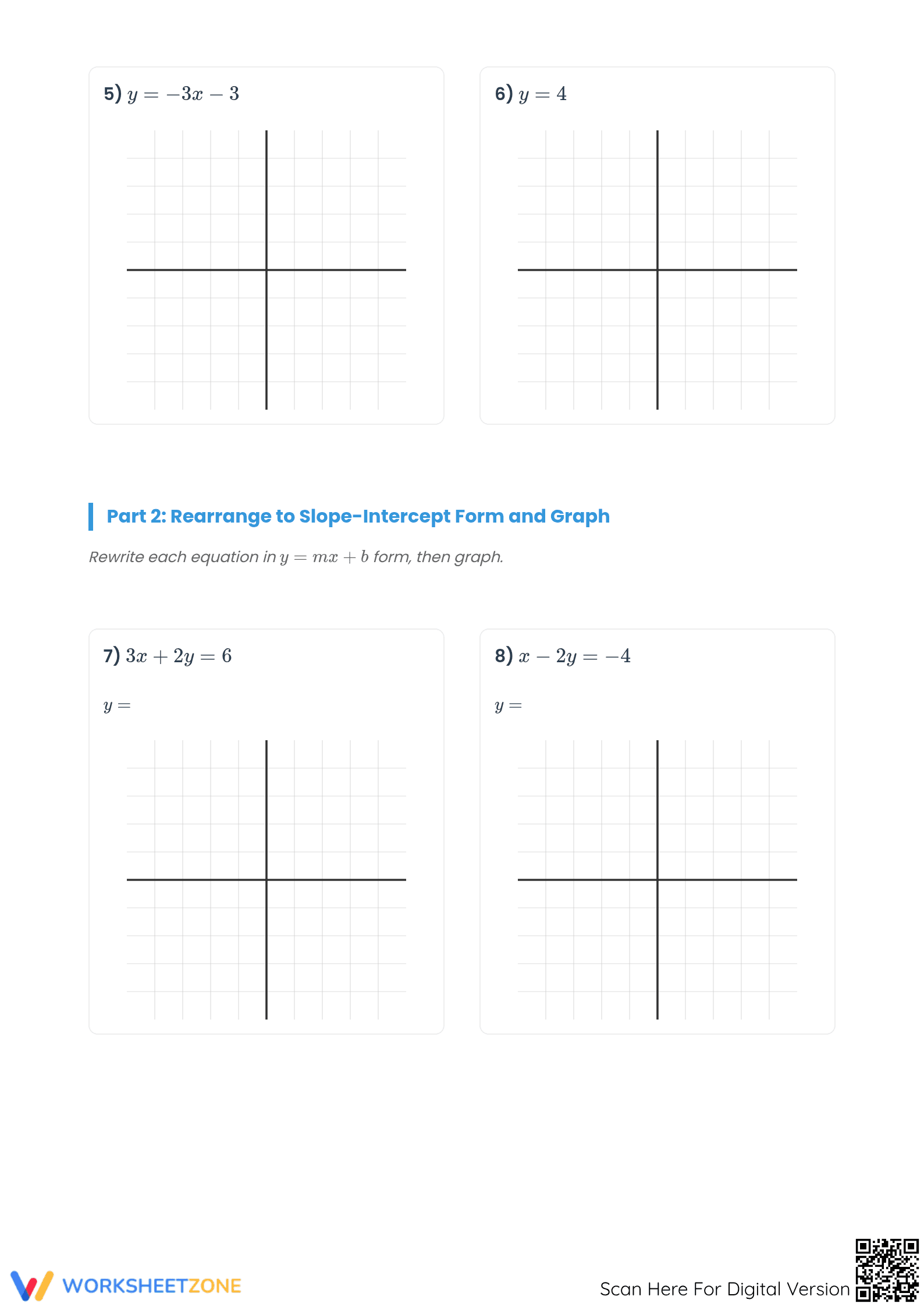
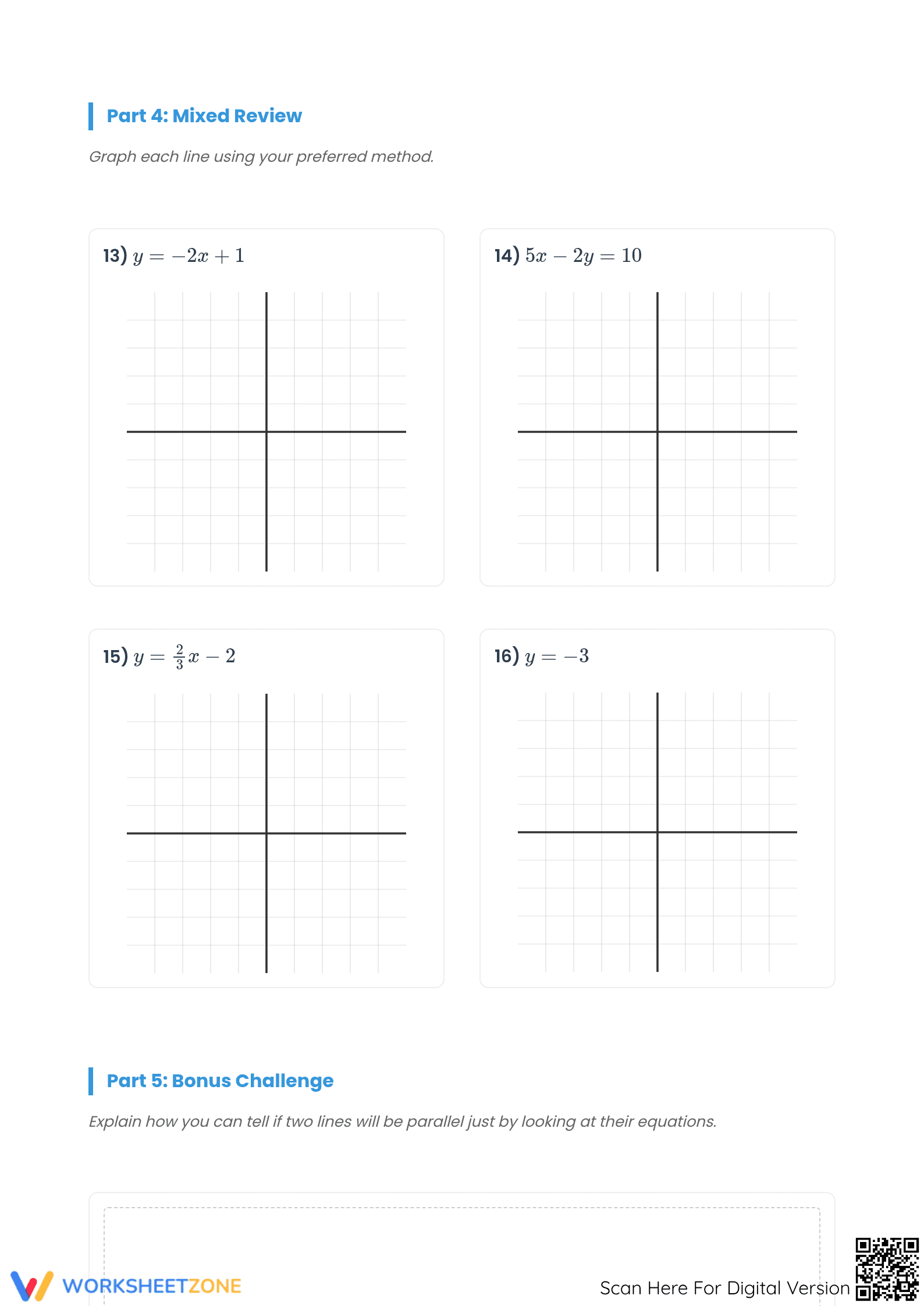
This four-page instructional packet includes sixteen core problems and a conceptual bonus challenge. It features clear coordinate grids for every task, dedicated space for algebraic work, and a full answer key. The layout is optimized for clarity, with distinct sections for different graphing methods and a scan-ready QR code for digital access.
The worksheet employs a strategic three-phase progression. It starts with Guided Practice, providing six problems in slope-intercept form to establish foundational plotting mechanics. Transitioning to Supported Practice, students solve four problems requiring algebraic rearrangement into slope-intercept form and two problems using intercepts, bridging calculation with visualization. The final Independent Practice phase features a four-problem mixed review and a conceptual bonus challenge on parallel lines. This scaffolded approach ensures students master each sub-skill before tackling complex variations.
This resource is aligned to CCSS.MATH.CONTENT.8.EE.B.5: "Graph linear equations and understand that the unit rate is the slope of the graph." It also supports high school algebra standards regarding the representation of solutions in a coordinate plane. Both standard codes can be copied directly into lesson plans, IEP goals, or district curriculum mapping tools.
Use this worksheet as a primary practice set during your linear functions unit or as a comprehensive sub plan. For best results, assign Part 1 after direct instruction on slope, then use Part 2 and 3 as formative assessments for algebraic manipulation. Teachers should observe students during the rearrangement phase to ensure they are correctly applying inverse operations before graphing. Expected completion time is one full class period.
This resource is ideal for Grade 8 Pre-Algebra students and high school Algebra 1 learners. It provides necessary scaffolding for students who struggle with multi-step processes while offering enough rigor for advanced learners. It pairs naturally with a graphing calculator demonstration or a digital coordinate plane activity for interactive reinforcement.
Aligned to CCSS.MATH.CONTENT.8.EE.B.5, this resource focuses on graphing linear equations and interpreting slope. Fisher & Frey (2014) emphasize that scaffolded practice is vital for mathematical fluency, a principle applied here through the transition from basic sketches to algebraic rearrangement. Students engage with sixteen problems and a bonus challenge, moving from concrete plotting to abstract reasoning about parallel line properties. This progression supports the development of procedural fluency and conceptual understanding required by modern standards. By integrating intercepts and various equation forms, the worksheet ensures students can flexibly navigate the coordinate plane. Such comprehensive practice is shown by RAND AIRS 2024 to significantly improve student performance on high-stakes assessments by reinforcing the link between algebraic expressions and geometric representations. This capsule provides a standalone summary for lesson planning and curriculum mapping.


