




























Views
Downloads


Graph Sine Functions Worksheet | Grade 10-12 Essential

Paste this activity's link or code into your existing LMS (Google Classroom, Canvas, Teams, Schoology, Moodle, etc.).
Students can open and work on the activity right away, with no student login required.
You'll still be able to track student progress and results from your teacher account.
This Grade 10-12 math worksheet provides targeted practice for graphing the sine function and identifying its periodic behavior. Students will plot f(x) = sin(x) over a full two-period interval and analyze specific wave segments to demonstrate mastery of trigonometric properties. By completing these tasks, learners build the foundational skills required for advanced calculus and physics modeling.
At a Glance
- Grade: 10-12 · Subject: Algebra / Trigonometry
- Standard:
HSF-IF.C.7.E— Graph trigonometric functions, showing period, midline, amplitude, and key intercepts- Skill Focus: Sine Wave Analysis
- Format: 2 pages · 2 tasks · Answer key included · PDF
- Best For: Introduction to trigonometric graphing and wave behavior
- Time: 20–30 minutes
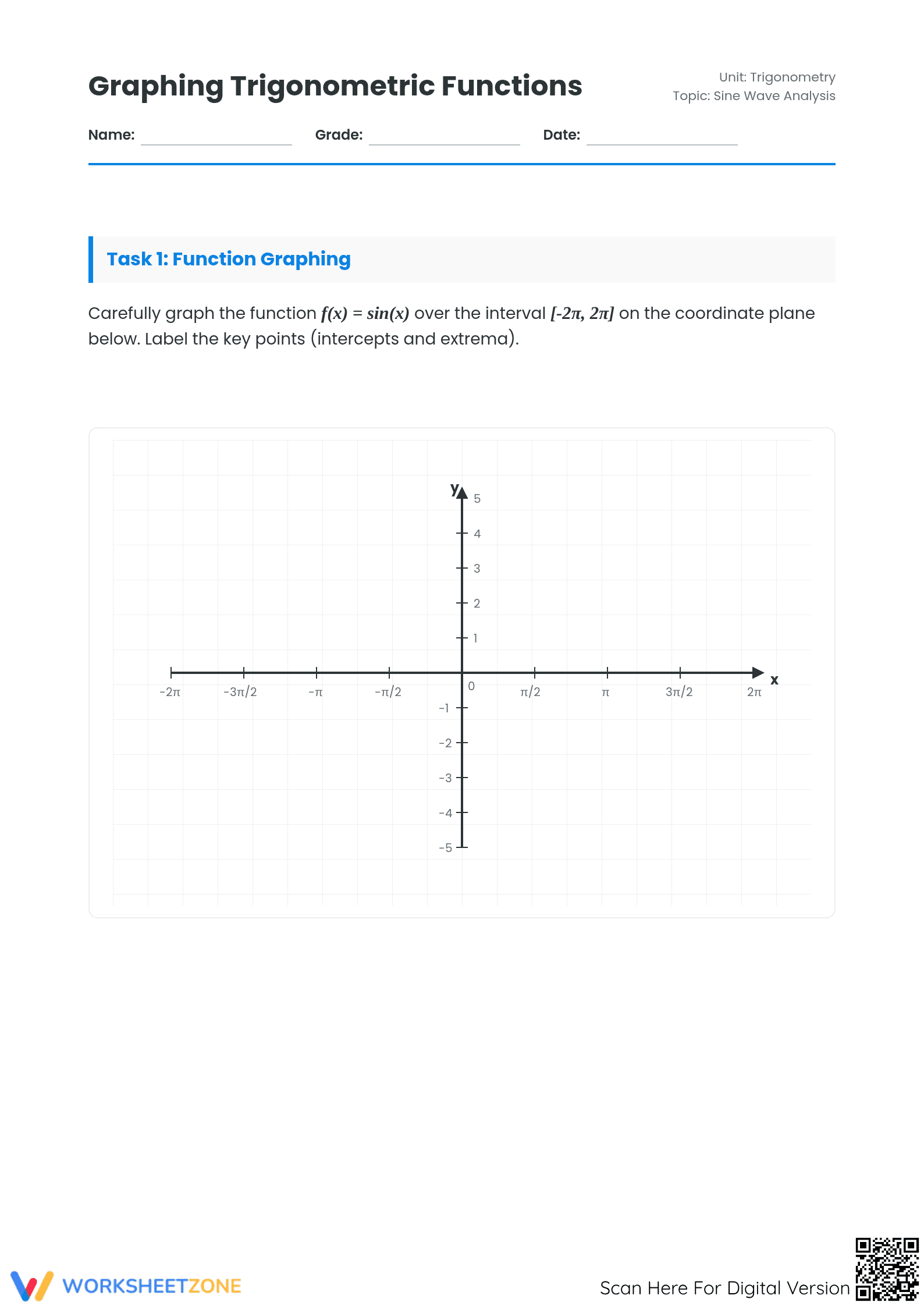
What's Inside: This resource consists of a 2-page PDF designed for high school mathematics. Page one features a large, labeled coordinate plane with an interval from -2π to 2π, specifically formatted for plotting trigonometric points. Page two includes a wave identification task that challenges students to distinguish between sine and cosine behaviors. A comprehensive answer key is included to facilitate quick grading and student self-correction.
Zero-Prep Workflow
- Step 1: Print (30 seconds). The 2-page PDF is optimized for standard black-and-white printing without requiring complex margins.
- Step 2: Distribute (1 minute). Hand out the worksheet as a warm-up or guided practice during the trigonometry unit.
- Step 3: Review (5 minutes). Use the provided answer key to check for common errors in labeling extrema and intercepts.
Total teacher prep time is under 2 minutes, making this an ideal resource for busy classrooms or unexpected sub plans.
Standards Alignment: This worksheet is primarily aligned with HSF-IF.C.7.E, which requires students to graph trigonometric functions, showing period, midline, and amplitude. It also supports HSF-TF.B.5 by reinforcing the visual characteristics of periodic models. Both standard codes can be copied directly into lesson plans, IEP goals, or district curriculum mapping tools.
How to Use It: Assign this worksheet immediately after introducing the unit circle to help students transition from circular motion to linear graphing. It serves as an excellent formative assessment; observe if students correctly place the intercepts at multiples of π and the extrema at odd multiples of π/2. Expected completion time is 20 to 30 minutes.
Who It's For: This resource is designed for Algebra II, Pre-Calculus, or Trigonometry students who are beginning their study of periodic functions. It is particularly helpful for visual learners who need a structured grid to understand wave oscillations. Pair this with a sine wave anchor chart or a Desmos graphing activity for a complete instructional cycle.
According to the RAND AIRS 2024 report on secondary mathematics instruction, visual representation of periodic functions is a critical bridge between algebraic manipulation and real-world modeling. This worksheet addresses the HSF-IF.C.7.E standard by requiring students to translate the abstract sine function into a concrete visual graph over a specific interval. By focusing on the interval from -2π to 2π, students develop a deeper understanding of periodicity and symmetry. Research from Fisher & Frey (2014) suggests that scaffolded identification tasks, such as the wave segment analysis included here, significantly improve student retention of trigonometric properties compared to rote memorization of unit circle coordinates alone. This resource provides the necessary structured practice to move students from basic recognition to independent graphing mastery. The inclusion of a full answer key allows for immediate feedback, which is essential for correcting misconceptions regarding amplitude and phase shifts early in the trigonometry unit.


