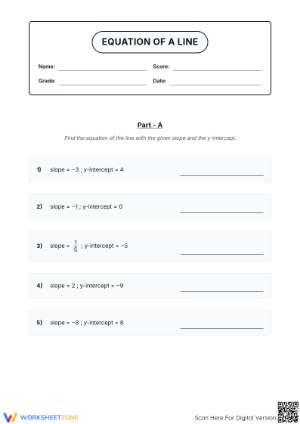
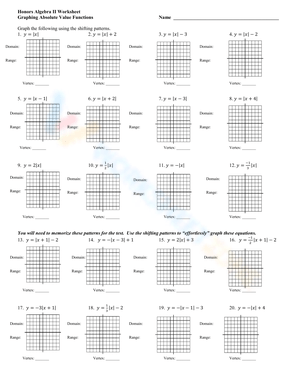
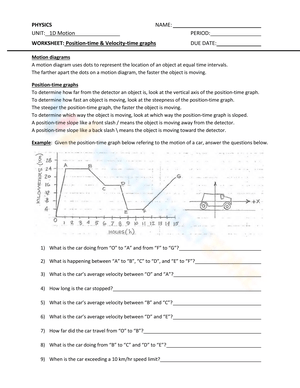
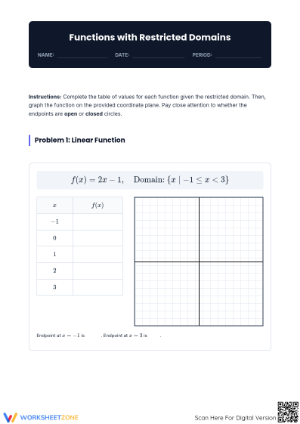
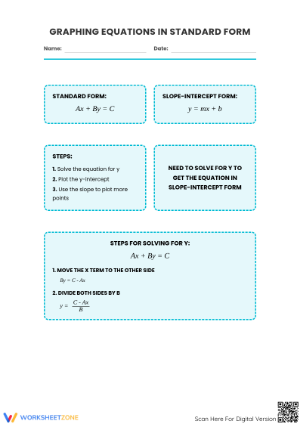
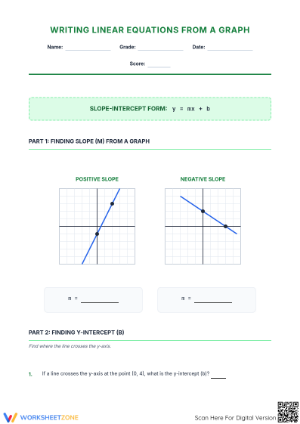
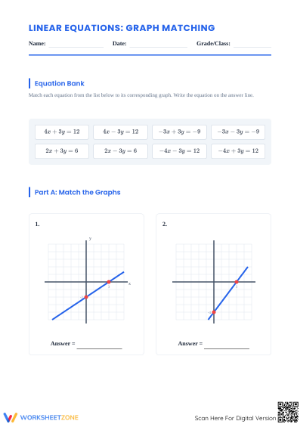
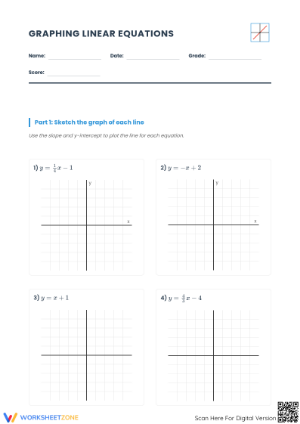
These 11th grade linear equations worksheets pdf resources give teachers a ready set of practice materials for the stage of algebra where students move past two-variable substitution and into three-variable systems, linear modeling, and systems of inequalities. The set covers operations that trip up even capable algebra students — not because the concepts are new, but because the procedural demands multiply fast at this level. Each worksheet targets a distinct skill, so teachers can assign selectively based on where a class has stalled rather than moving everyone through the same sequence at the same pace.
What's Inside the Set
The worksheets address five skill areas that define advanced linear equation work in an eleventh-grade algebra course:
- Three-variable systems by elimination and substitution — students reduce 3x3 systems to 2x2 systems step by step, which requires tracking which variable they've eliminated and which equation pairs they've already used
- Real-world modeling with two and three unknowns — students read multi-sentence scenario problems, define variables explicitly, write and solve the system, then interpret the answer in context
- Graphing systems of linear inequalities — students graph two or more inequalities on the same coordinate plane, shade the correct region, and verify whether given points satisfy the system
- Error analysis problems — each worksheet in this category presents a complete but flawed solution to a three-variable system; students locate the error, explain it in writing, and produce the correct answer
- Linear programming introduction — students translate constraint conditions into inequalities, graph the feasible region, and evaluate an objective function at each vertex point
Student Mistakes That Surface in Three-Variable Work
The most predictable error in three-variable elimination is what classroom teachers tend to call the "same pair" mistake. A student eliminates x by combining equations 1 and 2 correctly, gets a 2x2 system in y and z, and then — instead of using a fresh pair to generate a second independent equation in y and z — goes back to equations 1 and 2 again. The result is two identical equations, and the student concludes the system has no unique solution when it actually has one. The underlying cause is that students apply the two-variable elimination pattern they already know without tracking the structural requirement that each second-step equation must come from a different pairing of the original three.
A second consistent error shows up in the shading step on graphing tasks. Students who correctly draw both boundary lines still shade the wrong region about a third of the time, even after using the "test a point" strategy. The specific failure: a student picks a test point that sits on one of the boundary lines. That point satisfies a non-strict inequality (less than or equal to) and the student shades accordingly — but a boundary point doesn't identify which interior region to shade. The error analysis worksheets address both of these patterns directly, using worked examples that students diagnose and correct rather than problems they solve from scratch.
Standard Alignment
These worksheets address CCSS.MATH.CONTENT.HSA-CED.A.3, which requires students to represent constraints using systems of equations or inequalities and interpret solutions as viable or nonviable options in a modeling context. They also target CCSS.MATH.CONTENT.HSA-REI.C.6, covering systems solved exactly and approximately with up to three equations and three unknowns, and CCSS.MATH.CONTENT.HSA-REI.D.12, which covers graphing solution sets for systems of linear inequalities. In classroom terms, these standards fall in the second semester of a typical Algebra II sequence — or at the start of a Pre-Calculus course that reviews advanced linear systems before moving into polynomial functions. The 11th grade linear equations worksheets pdf set maps directly onto that instructional window, which makes alignment with most district pacing guides straightforward.
How to Build These Worksheets Into Your Lesson Planning
The error analysis worksheets earn the most from students when assigned early in a unit — day two of a three-variable systems sequence is a strong placement, before students have automated the procedure. At that stage, reading someone else's elimination steps critically requires students to understand the logic behind each move, not just recognize the visual pattern. Teachers who wait until students feel confident find that students skim past flawed steps because the work looks superficially right at first glance.
For the modeling worksheets, a brief period of protected individual reading and variable-definition time before any paired or group work prevents the most common breakdown point. The step where students fail most consistently is variable definition — they assign letters without writing what those letters represent, then lose track midway through a three-equation setup. Five minutes of individual thinking before any conversation catches most of that. The graphing worksheets, which require careful boundary-line construction and deliberate shading decisions, fit a 20- to 25-minute sustained practice block after direct instruction, when students need time to work without interruption.
Test Preparation Value
Both the SAT and ACT include linear systems questions, and the problem types across this set mirror what students encounter on those exams. The SAT tends to embed system problems in real-world contexts, requiring students to read a scenario, construct the equations themselves, and then solve — rather than beginning from a system already written out. That setup-from-context skill is exactly where students lose time in a testing situation, and the modeling worksheets build it directly. Incorporating one timed modeling worksheet per week during the six weeks before a major testing window builds reading-to-equation speed without turning the algebra course into a dedicated test-prep session.
Adjusting the Set for Different Learner Levels
Across the 11th grade linear equations worksheets pdf set, difficulty spans from two-variable modeling with clean integer solutions through three-variable elimination systems and into linear programming problems that require graphing a feasible region and evaluating an objective function at each vertex. That range lets teachers select the difficulty tier that fits their course level and pull challenge problems for individual students who need extension.
Students who struggle with the three-variable worksheets almost always do so because they lose track of which operations they've applied to which equations — not because the algebra itself is out of reach. Requiring students to number each step and label the equation pairs used in each reduction often resolves the confusion without any change to the problem content. Students who need a lower entry point do well starting with the two-variable modeling worksheets, which build the same organizational habits — defining variables, writing equations, interpreting results in context — that three-variable problems eventually demand, but with simpler solving mechanics in the middle steps.
Frequently Asked Questions
Do these worksheets include answer keys for three-variable system problems?
Yes. Each worksheet comes with a full answer key. For three-variable elimination problems, the keys show each reduction step — including which equation pair produced each new equation — so teachers and students can trace exactly where a solution diverged from the correct procedure.
What is the best way to sequence these worksheets within a unit?
Start with the two-variable modeling worksheets to reinforce variable-definition habits before the procedural complexity increases. Move to three-variable elimination worksheets once students are solid on the two-step reduction logic. The error analysis worksheets work well in the middle of the unit — when students have enough familiarity with the procedure to read it critically but haven't yet stopped paying attention to individual steps. Linear programming fits at the end, drawing on both the inequality graphing work and the multi-step algebraic reasoning the earlier worksheets develop.
Are these appropriate for a standard Algebra II course or only for honors sections?
The three-variable elimination and linear programming worksheets are pitched at an honors or advanced Algebra II level. The two-variable modeling worksheets and systems-of-inequalities graphing worksheets fit a standard Algebra II course well. Most teachers use the 11th grade linear equations worksheets pdf set selectively — assigning the difficulty tier that matches their course expectations and reserving the more complex worksheets for students who need the additional challenge.