Introduction to Graph Theory PDF Worksheets for 11th Grade
These introduction to graph theory pdf worksheets for 11th grade arrive at a pedagogical moment most high school math teachers recognize: students who can fluently manipulate quadratic equations and graph linear functions have almost never been asked to think about vertices, edges, or the discrete structures that model networks. This set gives them a first encounter with those ideas through problems that make the structures visible and workable from the opening exercise.
What the Set Covers
Each worksheet targets a specific concept in the progression from foundational vocabulary to structural analysis. The resources move through:
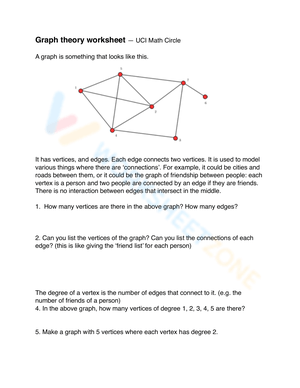
- Vertices, edges, and degree — labeling graph components, counting degrees, and working with the Handshaking Lemma (the sum of all vertex degrees equals twice the number of edges)
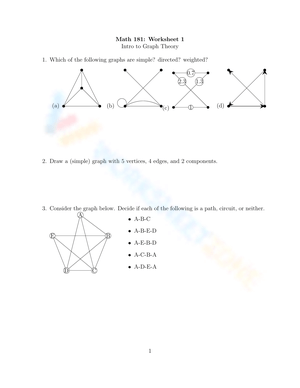
- Simple graphs and multigraphs — distinguishing between graphs with at most one edge between any vertex pair and those with multiple edges or loops
- Directed and undirected graphs — reading and constructing both types, with directed graphs introduced through one-way routing scenarios that give the arrows immediate meaning
- Adjacency matrices — translating a drawn graph into its matrix representation and reconstructing a graph from a given matrix
- Eulerian paths and circuits — applying degree-parity rules to determine whether an Euler path or circuit exists, then tracing it through the graph
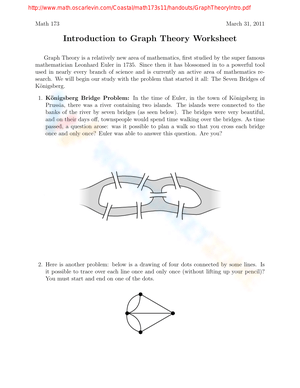
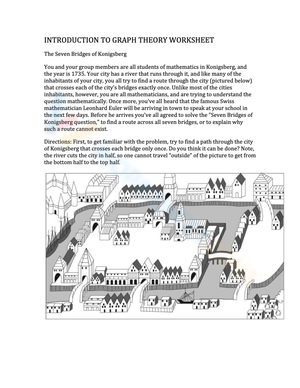
- The Königsberg Bridge Problem — working through the historical problem as a concrete application of Eulerian circuit theory
Hamiltonian circuits appear in the later worksheets, primarily to draw a sharp contrast with Eulerian paths. Students need explicit work on the distinction — "traverse every edge once" versus "visit every vertex once" — because conflating the two is one of the most consistent errors in student work on this topic.
Common Misconceptions to Anticipate and Address
The most persistent difficulty is definitional. Students have used the word "graph" to mean a coordinate plane for years, and when they encounter a vertex-edge structure called a graph, genuine confusion follows. On the first worksheet, expect students to ask where the axes belong. This is not carelessness — it reflects deeply ingrained prior instruction. Naming the conflict directly ("mathematicians reused a word that already meant something in your life, and in this unit it means something different") works better than simply redirecting individual students as the question surfaces repeatedly.
Degree counting breaks down in two predictable places. First, when a loop connects a vertex to itself, it contributes 2 to that vertex's degree, not 1. Students who count the loop as a single connection will get every Handshaking Lemma calculation wrong and will produce incorrect degree sequences throughout the unit. Second, students working with directed graphs often count total incident edges rather than separating in-degree and out-degree, which produces answers that look plausible but are structurally wrong. Both errors appear clearly on the degree-counting worksheets, which makes those early assignments useful as diagnostic tools before moving to path problems.
Eulerian path tracing reveals a gap between knowing a condition and executing it. A student who can correctly state "exactly two odd-degree vertices means an Euler path exists" will sometimes still trace a path that revisits an edge, particularly on graphs with six or more vertices. The worksheets pair the parity-check task with a tracing task on the same graph specifically to surface that gap while students are still in the foundational unit — before that gap causes problems on more complex material.
Building These Worksheets Into Your Unit Plan
Graph theory typically enters 11th grade in one of three settings: a discrete mathematics elective, a computer science course with a mathematics component, or a brief unit within pre-calculus or mathematical reasoning. In all three, the most effective opening move is grounding the vocabulary in physical space before any abstract diagram appears. A workable day-one activity is asking students to sketch the hallways connecting classrooms in your building, mark intersections as vertices, and label hallway segments as edges — then ask degree questions about specific intersections. Ten minutes of that makes the vocabulary land faster than a definition slide ever does.
For teachers using these resources as introduction to graph theory pdf worksheets for 11th grade within a two-week unit, a practical sequence is to use the vocabulary and degree-counting worksheets as guided class practice, then assign the adjacency matrix worksheet as independent follow-up the next day. Eulerian path worksheets work well in pairs — the trial-and-error nature of tracing paths is less frustrating with a partner, and students naturally defend their reasoning about degree parity when working together. For the tracing work specifically, laminating a copy and letting students use dry-erase markers before recording final answers removes a meaningful source of frustration. Students who have redrawn a path three times are still working; students who have erased through paper are often done.
Standard Alignment
Graph theory is not a named content domain in the Common Core State Standards for high school mathematics. In practice, these worksheets sit most naturally under the Standards for Mathematical Practice — specifically MP.4 (Model with Mathematics) and MP.7 (Look for and Make Use of Structure) — rather than a content standard code. Teachers in states with dedicated discrete mathematics elective standards, including Texas (TEKS Discrete Mathematics for Problem Solving) and certain New York elective frameworks, will find the worksheets align directly to the graph theory strands in those documents. For courses with computer science integration, the CSTA K–12 CS Framework's 9–12 standards on algorithm design and network concepts also map cleanly to the Eulerian path and adjacency matrix work. If your course does not carry a specific discrete math standard code, documenting through the Mathematical Practice standards is the honest and straightforward path.
Adjusting These Worksheets for Different Learner Levels
Students who struggle with abstraction need a spatial anchor longer than their peers. Keeping problems in map-based formats — street grids, campus layouts, transit networks — until degree counting feels automatic gives those learners a physical referent that supports the reasoning. A word bank on the vocabulary worksheet also helps students who process new terminology slowly; removing it once the terms are established takes no time at all. Neither modification requires reworking the core problems.
For students ready to extend, the adjacency matrix worksheet opens a substantive path forward. If A is the adjacency matrix of an undirected graph, the entry in row i, column j of A² gives the number of walks of length 2 between vertex i and vertex j. Students who have covered matrix multiplication can verify this by hand on a small three- or four-vertex graph, then generalize the pattern. That connection — between graph structure and matrix powers — genuinely prepares students for college-level discrete math or theoretical computer science rather than simply covering extra material. The introduction to graph theory pdf worksheets for 11th grade in this set carry enough structural support at the base level to make that extension workable without redesigning any exercises from scratch.
Frequently Asked Questions
Is this content appropriate for all 11th graders, or mainly students in advanced math?
The foundational skills — labeling vertices and edges, counting degrees, applying the Handshaking Lemma — are within reach for students in standard-level math courses. The adjacency matrix work and Eulerian circuit analysis require systematic reasoning but not calculus or advanced algebra. The biggest variable is whether students have encountered mathematical proof conventions before. If they haven't, the Handshaking Lemma is better treated as an empirical pattern to verify and explore than as a theorem to apply immediately.
How do I handle the vocabulary conflict when students already know "graph" to mean something specific?
Name it on the first day rather than letting students discover the collision mid-lesson. A brief explanation — that graph theorists borrowed a word already in use elsewhere in mathematics — gives students a reason for the confusion rather than a reason to feel lost. Some teachers use "network" alongside "graph" as a bridge term for the first week. The redirect needs patience; students who keep sketching axes are responding to years of prior instruction, not ignoring the current lesson.
What is the difference between an Eulerian path and a Hamiltonian path?
An Eulerian path traverses every edge in a graph exactly once. A Hamiltonian path visits every vertex exactly once. The definitions sound parallel, but the underlying mathematics is quite different — Eulerian paths have clean degree-parity conditions for existence, while determining whether a Hamiltonian path exists is computationally hard in the general case. These introduction to graph theory pdf worksheets for 11th grade address the two concepts on separate worksheets rather than combining them in the same exercise, giving students enough independent practice with each condition before comparing them directly.
Can these worksheets serve a formative assessment role rather than just practice?
Yes, and several work especially well in that function. The degree-counting and Handshaking Lemma exercises make effective exit tickets — a four-vertex graph with one loop takes most students under three minutes to analyze, which fits cleanly at the end of a class period. The adjacency matrix worksheet reveals a specific and informative error when used as a quick check: students who fill in only the upper triangle for an undirected graph have not yet understood that undirected edges produce symmetric matrix entries. That error is visible at a glance and tells you exactly what needs revisiting before the class moves to directed graphs.
Clear All