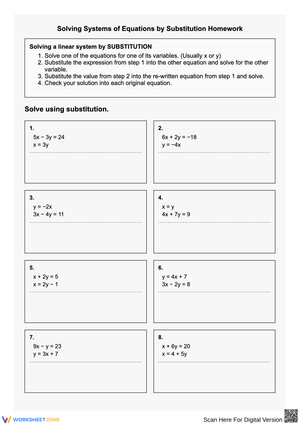
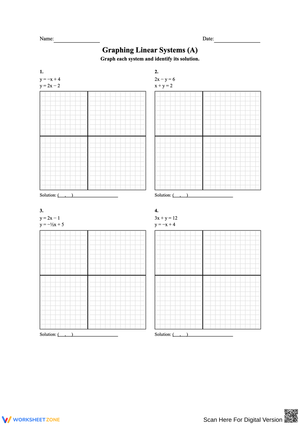
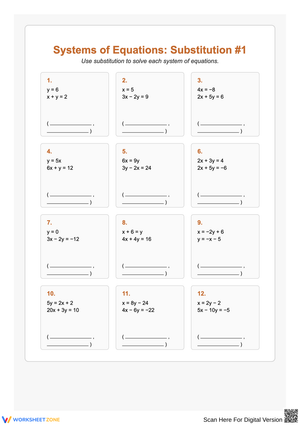
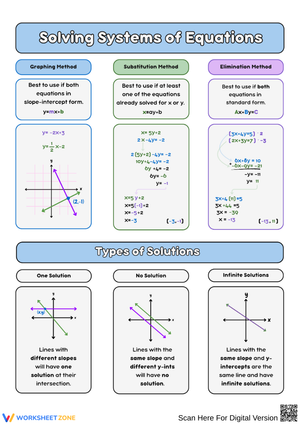
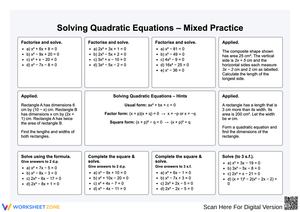
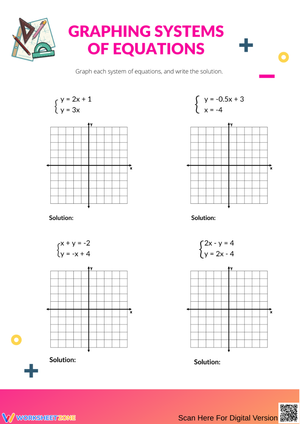
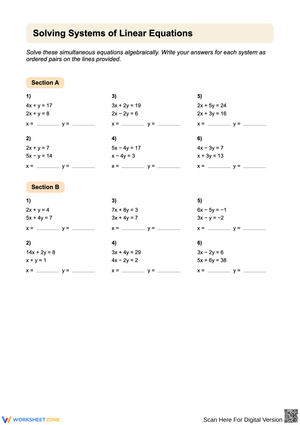
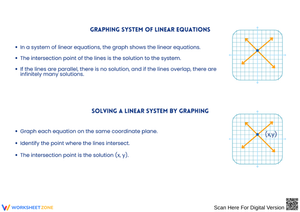
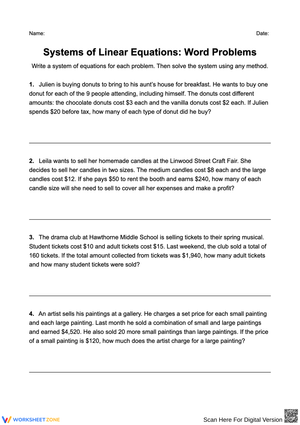
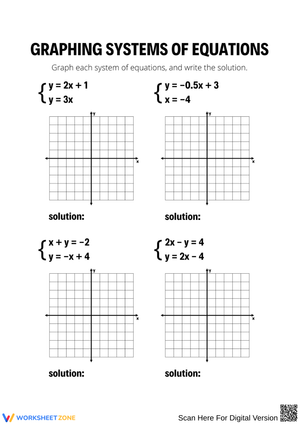
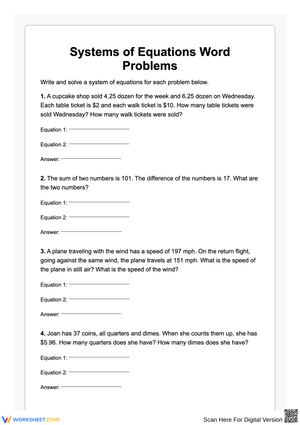
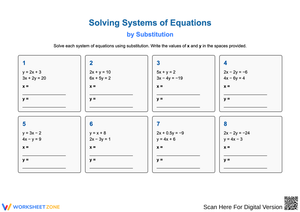
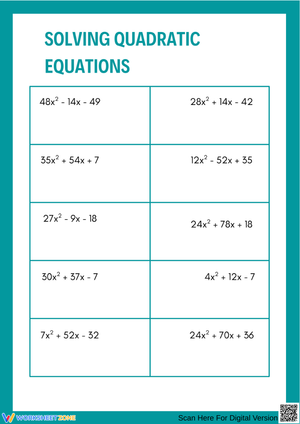
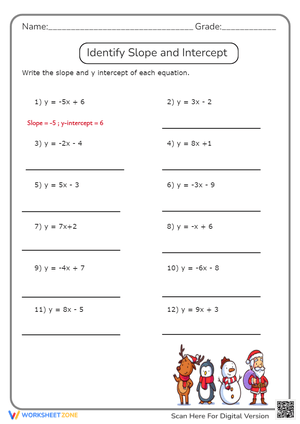
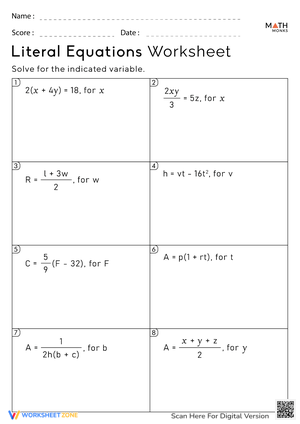
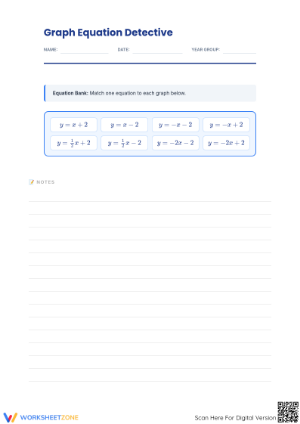
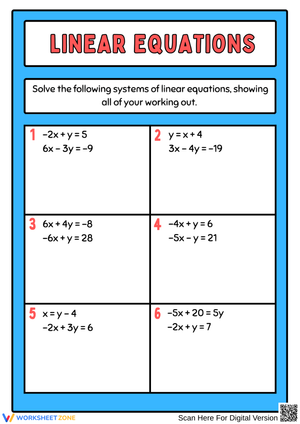
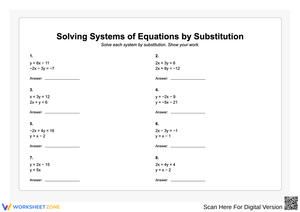
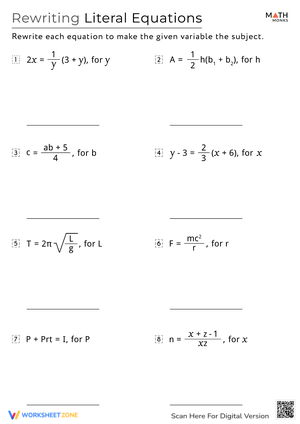
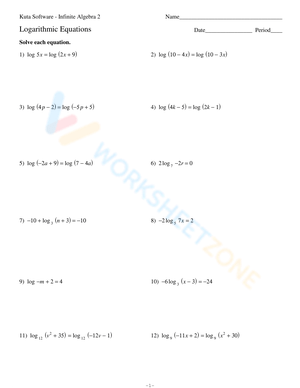
These 11th grade equations worksheets pdf resources give algebra teachers practice sets that cover the full range of equation types students encounter in junior-year math — rational, radical, exponential, and logarithmic. Each worksheet targets a specific equation family, so teachers can assign exactly what a class needs without hunting through a broader unit. Answer keys include complete step-by-step work, not just final values.
What the Set Covers
Rational equations ask students to clear denominators, solve the resulting polynomial, and then check every solution against domain restrictions. That last step — the verification — is where most class time gets spent. Students who handle the algebra correctly will still report a solution that makes a denominator zero, because nothing in the clearing process itself signals that the value is inadmissible.
Radical equations require isolating the radical term before raising both sides to eliminate it. The squaring step is clean when students see it in isolation, but it regularly produces extraneous solutions. Worksheets in this section include problems built specifically to generate them, so students develop the checking habit before it costs them on a test rather than after.
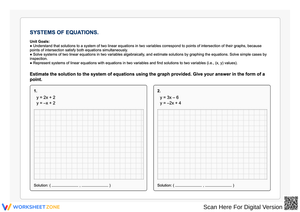
Exponential and logarithmic equations represent the steepest conceptual jump of the three families. Students must move comfortably between exponential and logarithmic forms, apply log properties to equations where the variable sits in the exponent, and use the change-of-base formula when the base is not 10 or e. Several worksheets in this category pair algebraic solving with graphical interpretation, connecting solutions to the coordinates of intersection points on a graph.
Standard Alignment
Three standards in the Common Core High School Algebra domain apply directly to this set. HSA-REI.A.1 requires students to explain each algebraic step as a logical consequence of the previous one — a demand that goes beyond getting the right answer. Worksheets in the rational and radical categories include a "justify each step" column where students write a brief reason beside every manipulation, pulling this standard out of the grading rubric and into daily practice.
HSA-REI.A.2 explicitly addresses rational and radical equations in one variable and asks students to produce examples of how extraneous solutions arise. These worksheets treat that as a recurring feature of the work rather than an end-of-unit exception — verification steps are built into the problem format so students encounter the issue every time they solve. HSA-REI.D.11 connects equation solving to graphical representation, asking students to recognize that x-coordinates of intersection points correspond to algebraic solutions. Several worksheets integrate both methods within the same problem set.
Frequent Errors to Watch For in Student Work
The most persistent error in rational equation work is not algebraic — it is conceptual. Students find a value that satisfies the cleared equation and record it as the answer without returning to the original expression. When x = 3 makes a denominator zero in the original problem, it is not a valid solution, but a student who just completed four correct algebraic steps feels certain it must be. Worksheets with an explicit "check" row built into the layout reduce this error more reliably than verbal reminders do.
With radical equations, the problem shifts to the squaring step. Students who correctly isolate the radical term will sometimes expand (√x + 2)² as x + 4, treating the square and the square root as simple inverses and ignoring the cross terms entirely. The resulting equation is wrong from that line forward, and the error is easy to miss in a room of thirty students unless intermediate steps are written out visibly. These worksheets include blank lines for each algebraic manipulation specifically to make that step reviewable.
In logarithmic equations, students frequently misapply the product rule, writing log(a + b) = log a + log b — confusing addition inside a single argument with a product of separate arguments. This misconception is stubborn and tends to reappear even after direct instruction. It is worth addressing explicitly when introducing the logarithm worksheets rather than assuming prior coverage resolved it.
How to Work These Worksheets Into Your Weekly Planning
The most useful deployment of these worksheets is as formative checkpoints woven throughout instruction, not as end-of-lesson homework. A rational equations worksheet used as an exit ticket — four problems, last eight minutes of class — tells you which students are clearing denominators correctly and which are distributing the LCD across only part of the equation. That information shapes tomorrow's lesson in a way that grading homework rarely does.
The error-analysis approach works particularly well with this content. Present students with a completed worksheet that contains one deliberate algebraic mistake — perhaps a step where the student solved a radical equation correctly but skipped the verification — and ask pairs to find the error, explain why the step is mathematically wrong, and write the corrected version. Students who argue with their partner about exactly where the breakdown occurred are doing the most productive math in the room.
For review weeks, pull two or three problems from different worksheets — one rational, one radical, one exponential — and give them as a mixed warm-up without labeling the equation types. Students who must identify the equation family before choosing a strategy are building the categorization skill standardized tests demand, since problems on those exams arrive without any sorting already done for them.
Adjusting These Worksheets Across Different Skill Levels
Students who struggle with algebraic mechanics benefit most from worksheets that include intermediate-step blanks. Those structured formats reduce the number of decisions a student has to make at once and make errors easier to locate during review. For these students, start with rational equation worksheets before introducing radicals, since the LCD strategy connects to fraction work from earlier grades. Expecting a student to check for extraneous solutions in a radical equation before they can reliably clear a denominator sets them up to fail at two skills simultaneously.
Students who move through procedural work quickly can be pushed into constructing their own equations rather than solving given ones. Asking a student to write a rational equation that produces a specific extraneous solution requires understanding the structure of the equation family at a level well above solving. The 11th grade equations worksheets pdf set includes enough variety across difficulty levels that most teachers can find appropriate problems for both ends of the range without rebuilding anything from scratch.
For students who arrive still shaky on polynomial factoring — which rational equation work depends on directly — pair these worksheets with brief factoring review before assigning independent practice. A student who cannot factor a quadratic reliably will hit a wall partway through a rational equation problem. The worksheet will produce frustration, not practice.
Frequently Asked Questions
Do the worksheets include problems that generate extraneous solutions, or are all solutions valid?
Both types appear across the set. Several worksheets are built so that some problems produce extraneous solutions and others do not — students cannot develop the verification habit if every answer they calculate turns out to be admissible. The answer keys identify which problems generate extraneous solutions and explain why each one fails the domain check.
Can these be used alongside regular coursework for SAT or ACT preparation?
The 11th grade equations worksheets pdf resources align directly with the algebra content both tests emphasize. Rational equations appear regularly on the SAT's math section; logarithmic equations show up in the harder algebra items on the ACT. The emphasis on verifying solutions is especially relevant for test prep, because both exams routinely include answer choices that correspond to extraneous solutions. Teachers can pull specific problems by equation type without disrupting their regular unit structure.
Are answer keys detailed enough for students to use for self-assessment?
Yes. Keys show complete algebraic work from the first step through the verification check. For rational equations, the key shows the LCD, the cleared equation, the solved value, and the domain check. For radical equations, the key shows the isolation step, the squaring, and the verification against the original. When a student's final answer is wrong, a step-by-step key tells both student and teacher exactly where the work broke down — which is far more useful than a circled wrong answer with no context.
How should the three equation types be sequenced across the school year?
Rational equations come first because the LCD strategy is the most concrete approach and connects to prior fraction work. Radical equations follow, since both types involve checking for extraneous solutions and students carry that verification habit forward. Exponential and logarithmic equations belong later in the year, once students have worked with function transformations and are ready to think about inverse relationships. This order matches the sequence most Algebra 2 textbooks follow, so aligning these 11th grade equations worksheets pdf resources to an existing pacing guide should require minimal restructuring.