


























0
Views
0
Downloads

0.0
0
Save
0 Likes
Share
Trauma Activation Timeline Worksheet
0 Views
0 Downloads
Paste this activity's link or code into your existing LMS (Google Classroom, Canvas, Teams, Schoology, Moodle, etc.).
Students can open and work on the activity right away, with no student login required.
You'll still be able to track student progress and results from your teacher account.
Information
Description
What It Is:
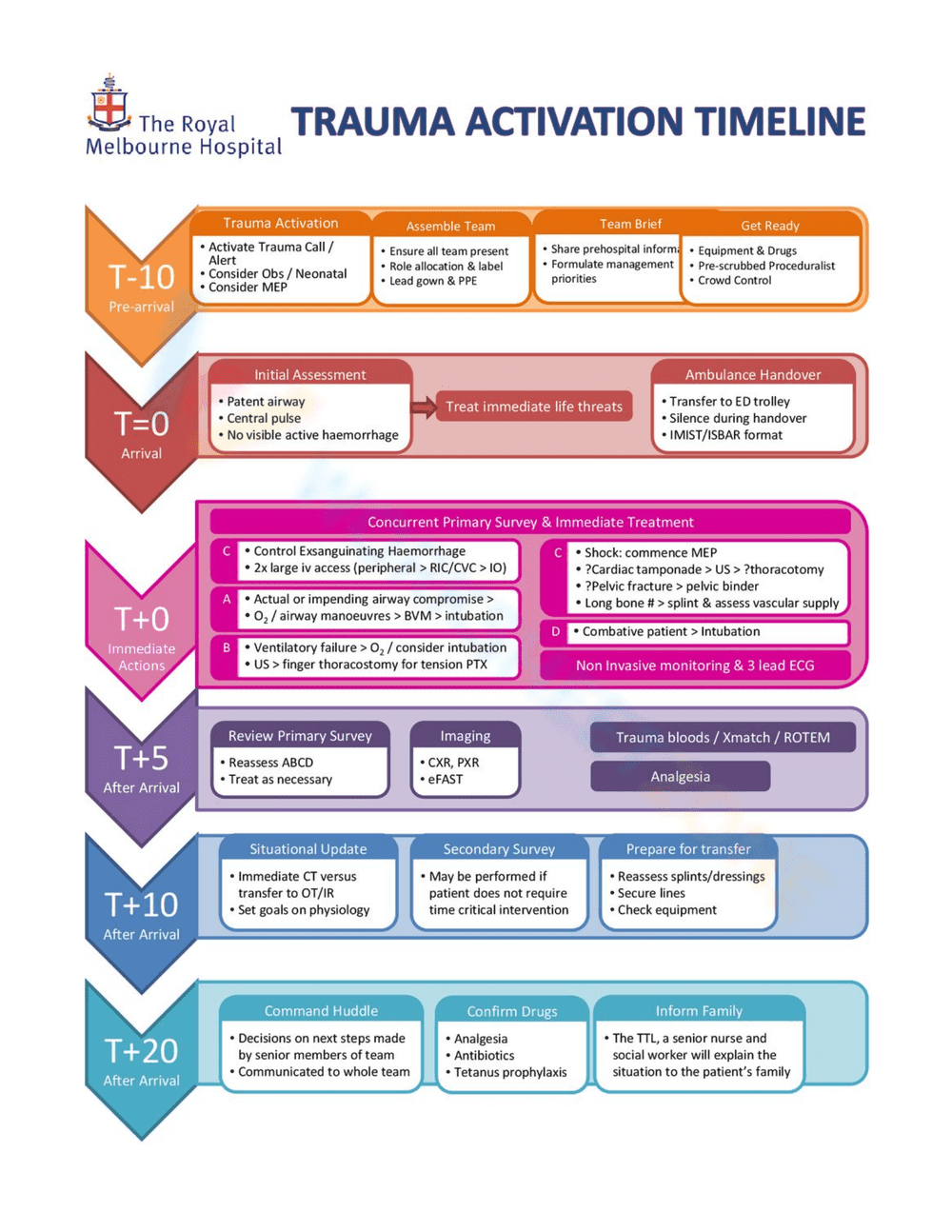
This is a trauma activation timeline worksheet outlining the steps and procedures to follow from pre-arrival (T-10) to 20 minutes after arrival (T+20) at The Royal Melbourne Hospital. It details actions for trauma activation, team assembly, team brief, and getting equipment ready. It covers initial assessment, ambulance handover, concurrent primary survey & immediate treatment including controlling exsanguinating hemorrhage, airway management, ventilation, shock management, and non-invasive monitoring. Further steps include reviewing primary surveys, imaging (CXR, PXR, eFAST), trauma bloods/kmatch/ROTEM, situational update, secondary survey, preparing for transfer, command huddle, confirming drugs (analgesia, antibiotics, tetanus prophylaxis), and informing the family.
Grade Level Suitability:
This worksheet is not suitable for traditional grade levels. It is designed for medical professionals, specifically doctors, nurses, and paramedics involved in trauma care. The medical terminology and procedures require advanced knowledge of anatomy, physiology, and emergency medicine.
Why Use It:
This worksheet serves as a quick reference guide and checklist for healthcare professionals during a trauma activation. It helps ensure that all necessary steps are taken in a timely and organized manner, improving patient outcomes and streamlining the trauma response. It promotes effective communication and coordination within the trauma team.
How to Use It:
Use this timeline as a guide during a trauma activation. Start at the top (T-10) and work down the flowchart, completing each step in order. Check off each task as it is completed to ensure nothing is missed. Adapt the timeline to the specific needs of the patient and the resources available.
Target Users:
The target users are medical professionals, including emergency medicine physicians, trauma surgeons, nurses, paramedics, and other healthcare staff involved in the management of trauma patients in a hospital setting.
This is a trauma activation timeline worksheet outlining the steps and procedures to follow from pre-arrival (T-10) to 20 minutes after arrival (T+20) at The Royal Melbourne Hospital. It details actions for trauma activation, team assembly, team brief, and getting equipment ready. It covers initial assessment, ambulance handover, concurrent primary survey & immediate treatment including controlling exsanguinating hemorrhage, airway management, ventilation, shock management, and non-invasive monitoring. Further steps include reviewing primary surveys, imaging (CXR, PXR, eFAST), trauma bloods/kmatch/ROTEM, situational update, secondary survey, preparing for transfer, command huddle, confirming drugs (analgesia, antibiotics, tetanus prophylaxis), and informing the family.
Grade Level Suitability:
This worksheet is not suitable for traditional grade levels. It is designed for medical professionals, specifically doctors, nurses, and paramedics involved in trauma care. The medical terminology and procedures require advanced knowledge of anatomy, physiology, and emergency medicine.
Why Use It:
This worksheet serves as a quick reference guide and checklist for healthcare professionals during a trauma activation. It helps ensure that all necessary steps are taken in a timely and organized manner, improving patient outcomes and streamlining the trauma response. It promotes effective communication and coordination within the trauma team.
How to Use It:
Use this timeline as a guide during a trauma activation. Start at the top (T-10) and work down the flowchart, completing each step in order. Check off each task as it is completed to ensure nothing is missed. Adapt the timeline to the specific needs of the patient and the resources available.
Target Users:
The target users are medical professionals, including emergency medicine physicians, trauma surgeons, nurses, paramedics, and other healthcare staff involved in the management of trauma patients in a hospital setting.


