




























Views
Downloads
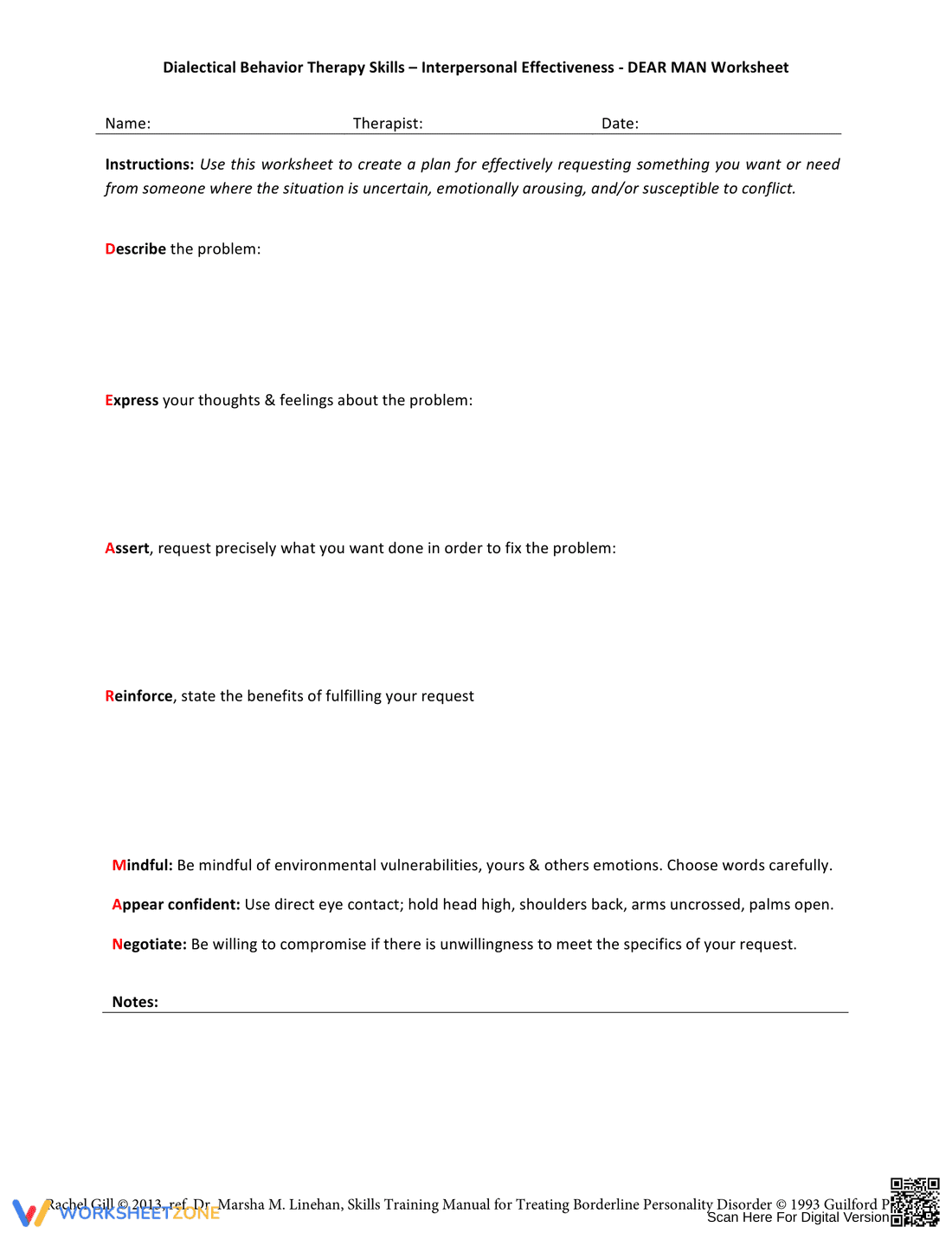

DEAR MAN Worksheet: Essential Interpersonal Skills Guide

Paste this activity's link or code into your existing LMS (Google Classroom, Canvas, Teams, Schoology, Moodle, etc.).
Students can open and work on the activity right away, with no student login required.
You'll still be able to track student progress and results from your teacher account.
This Grade 9 interpersonal effectiveness worksheet provides a structured framework for students to master the DEAR MAN communication technique. By following the seven guided prompts, learners develop the ability to express their needs clearly and assertively while maintaining positive relationships. This tool transforms abstract social skills into a concrete, actionable writing exercise that prepares students for real-world conflict resolution.
At a Glance
- Grade: 9 · Subject: English
- Standard:
CCSS.ELA-LITERACY.W.9-10.4— Produce clear writing appropriate to task, purpose, and audience- Skill Focus: Assertive Communication
- Format: 1 page · 7 tasks · No answer key · PDF
- Best For: Social-emotional learning and communication
- Time: 15–20 minutes
The worksheet consists of a single, focused page that breaks down the DEAR MAN acronym into seven distinct writing tasks. Each section includes a brief instructional cue to guide student responses. The layout provides ample white space for students to draft their scripts, along with a dedicated notes section for feedback. This structured format ensures that students do not skip critical steps in the communication process.
Zero-Prep Workflow
This resource is designed for immediate classroom implementation with a total teacher prep time of under 2 minutes. First, print the single-page PDF for your group. Second, distribute the worksheet during a social-emotional learning block, allowing approximately 15 minutes for students to draft their responses. Finally, review the completed plans through peer role-play to provide immediate feedback on the clarity and tone of their requests.
Standards Alignment
This resource aligns with `CCSS.ELA-LITERACY.W.9-10.4`, which requires students to produce clear and coherent writing in which the development, organization, and style are appropriate to task, purpose, and audience. By requiring students to tailor their language to a specific interpersonal goal, the worksheet reinforces rhetorical awareness. Both standard codes can be copied directly into lesson plans, IEP goals, or district curriculum mapping tools.
How to Use It
Use this worksheet during the guided practice phase of a lesson on assertive communication. It is particularly effective when students are facing a specific, real-life conflict, such as requesting a grade review. Teachers should observe whether students can distinguish between describing facts and expressing feelings, as this is a common point of confusion that requires instructional intervention.
Who It's For
This worksheet is ideal for high school students in English classes or those receiving support through counseling services. It serves as an excellent companion to an anchor chart on interpersonal effectiveness or a direct instruction lesson on conflict resolution. The scaffolded nature of the acronym makes it accessible for students who struggle with verbalizing their needs under emotional stress.
The DEAR MAN acronym is a cornerstone of Dialectical Behavior Therapy (DBT), specifically within the Interpersonal Effectiveness module developed by Dr. Marsha Linehan. This worksheet facilitates the practical application of these psychological principles in an educational setting, aligning with CCSS.ELA-LITERACY.W.9-10.4 by requiring students to produce clear, coherent writing tailored to a specific audience and purpose. According to Fisher & Frey (2014), structured scaffolds like the DEAR MAN framework are vital for developing self-regulation and social-emotional literacy in adolescents. By breaking down complex social interactions into seven discrete, manageable steps—Describe, Express, Assert, Reinforce, Mindful, Appear confident, and Negotiate—students move from reactive emotional responses to proactive, goal-oriented communication. Research indicates that explicit instruction in these communication strategies significantly reduces interpersonal conflict and improves student self-advocacy within the classroom environment. This resource provides the necessary structure for students to rehearse difficult conversations before they occur, ensuring they can articulate their needs effectively and respectfully.


