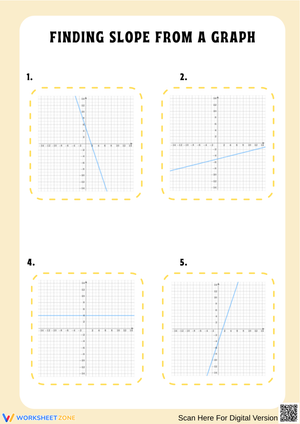
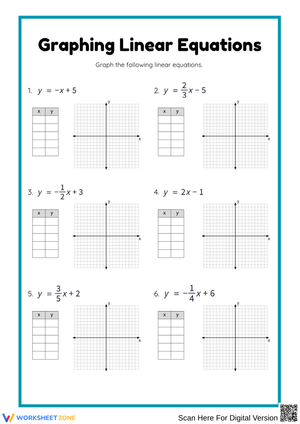
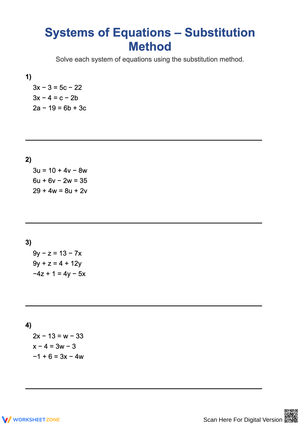
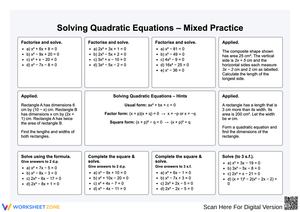
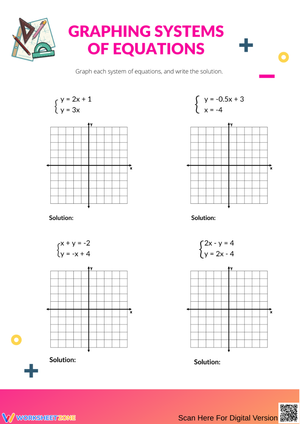
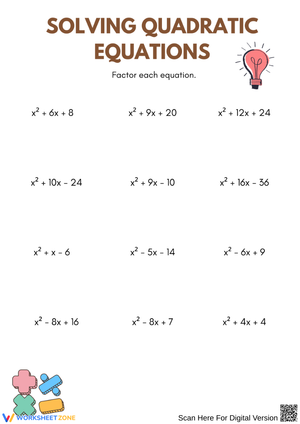
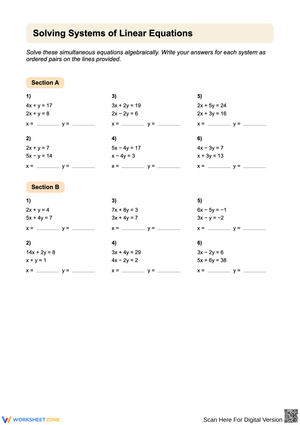
These equations worksheets for 10th grade target the three equation families that anchor high school algebra: quadratics solved by factoring, completing the square, and the quadratic formula; linear systems handled algebraically and graphically; and radical equations where verifying every answer is part of the required work, not an afterthought. Each worksheet focuses on a distinct skill, so teachers can assign them to match exactly where a class sits in the unit sequence — or pull a single worksheet to address a gap identified after a quiz.
Skills Addressed Across the Set
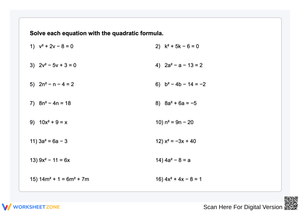
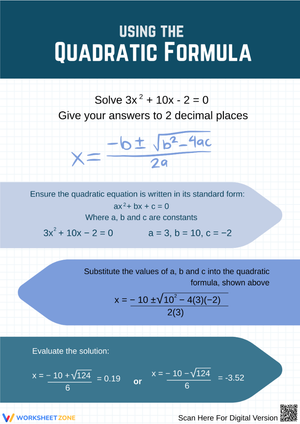
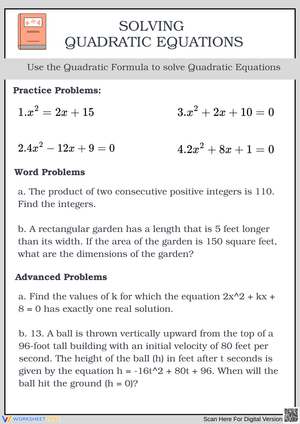
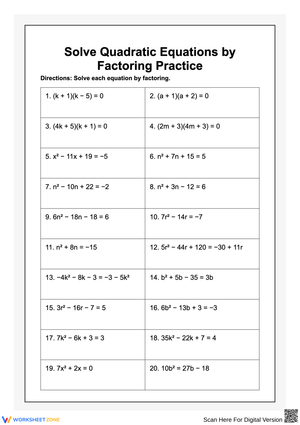
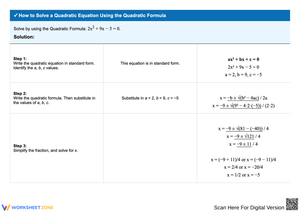
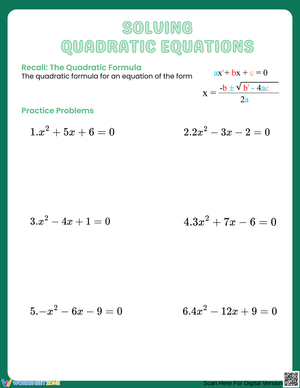
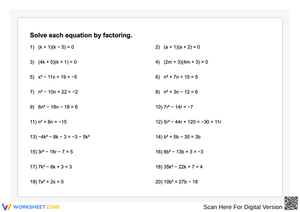
Quadratic equations receive the most coverage. Students work through factoring trinomials where both the leading coefficient and constant vary, then move to completing the square on expressions that do not factor cleanly. A dedicated quadratic formula worksheet includes discriminant analysis: students predict whether solutions are real or complex before solving, which forces engagement with structure rather than rote execution. This prediction step surfaces a misconception that appears constantly in 10th-grade work — students who can apply the formula correctly still write that a negative discriminant yields "no real solutions" but then attempt to continue solving, unsure whether that outcome terminates the problem.
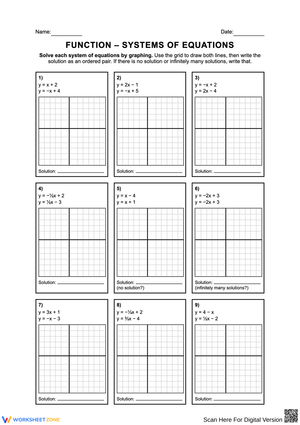
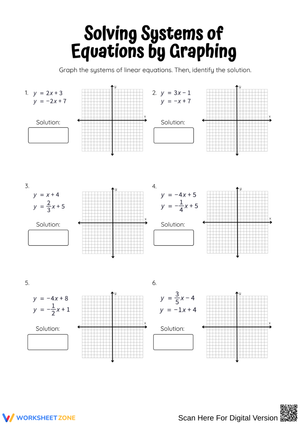
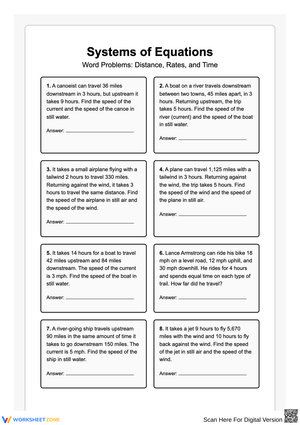
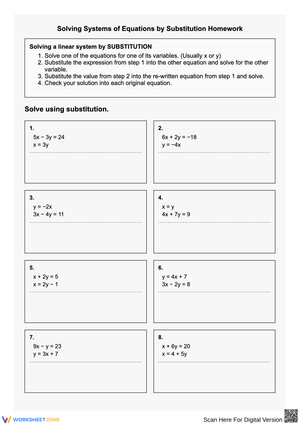
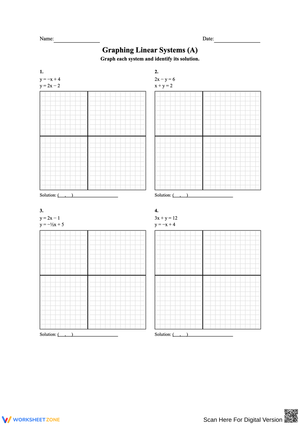
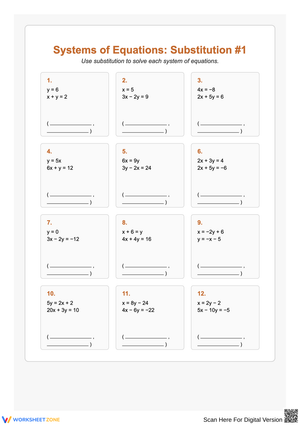
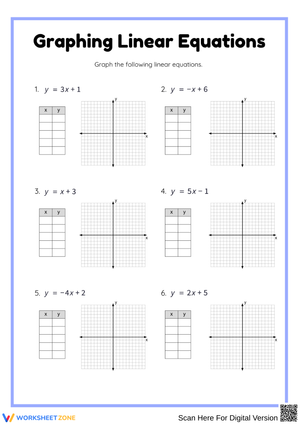
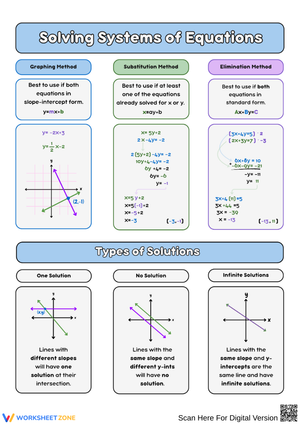
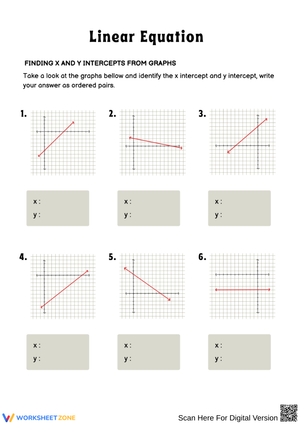
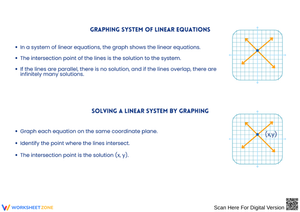
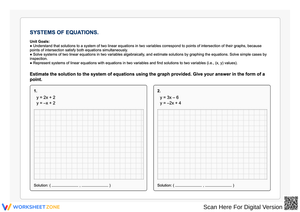
The linear systems worksheets pair each algebraic method — substitution and elimination — with a graphing component. After solving on paper, students plot both lines and mark the intersection, confirming the ordered pair. Word problems requiring students to define variables and construct the system from scratch appear on every systems worksheet; buying-and-selling scenarios and rate-comparison contexts work particularly well because the quantities are transparent enough for students to sanity-check their own answers before moving on.
Radical equation worksheets include a mandatory check column. Every problem requires students to substitute their answer into the original equation — before squaring was applied — and confirm it satisfies the radical expression. Extraneous solution problems are distributed throughout each worksheet rather than clustered at the end, preventing students from developing the habit of ignoring verification until the final problems appear.
Frequent Student Errors Worth Watching For
The most persistent error in quadratic work is structural, not computational. Students who correctly factor x² + 5x + 6 as (x + 2)(x + 3) = 0 will then write x = 2 and x = 3 rather than x = −2 and x = −3. They apply the zero-product property correctly in isolation and then drop the sign in translation. These worksheets include a side column asking students to write each zero-product step explicitly — "(x + 2) = 0 → x = −2" as a separate line — which makes the sign flip visible before it compounds into a wrong answer that looks plausible.
In elimination problems, students routinely multiply one equation's variable coefficient without adjusting the constant on the same side, producing an equation inconsistent with the original system. Students who skip the substitution check never catch it. The elimination worksheets include a substitution verification prompt after every problem for exactly this reason.
Radical equations produce the most counterintuitive error pattern: students obtain an extraneous root, substitute it back, find it does not satisfy the original equation, and then write it as the answer anyway — because it felt right to arrive at a number. The explanation in student work often reads, "I got √4 = 2, which is close." These worksheets require students to write out a full substitution sentence rather than just circle a result, so the mismatch is unmistakably explicit.
Building These Worksheets Into Your Instructional Week
The most effective placement for an independent practice worksheet is the 12-to-15-minute window after direct instruction closes. That window is long enough for students to attempt five to eight problems on their own but short enough for the teacher to circulate the full room, note error patterns, and pull a small group before the period ends. Collecting the worksheet at the door — rather than at the start of the next class — produces real-time data for tomorrow's mini-lesson without the 24-hour delay.
Adding a method-selection column alongside each problem transforms routine computation into a metacognitive exercise. Before solving, students write which method they plan to use and a brief justification: "completing the square — b-term is odd, so factoring would require fractions." The 90-second overhead per problem measurably reduces the pattern of students attempting to factor equations that do not factor cleanly and then abandoning the problem. It also makes grading faster, because a teacher can scan the method column and spot faulty reasoning without reading every calculation step.
Rotating formats across the week prevents the practice from going mechanical. Three formats that work well together:
- Solve-and-show-work: standard independent practice for building fluency on a new equation type, best placed early in the week while the method is fresh
- Error analysis: pre-worked problems with planted mistakes, effective on Fridays — students who have spent four days building a procedure are positioned to recognize when it breaks
- Partner relay: one partner solves odd-numbered problems, the other solves evens, then they trade papers and verify before discussing any discrepancies
Standard Alignment
These equations worksheets for 10th grade address three standards within the Common Core State Standards for Mathematics, High School Algebra domain. HSA.REI.B.4 covers solving quadratic equations by factoring, completing the square, and the quadratic formula, and explicitly calls for recognizing when each method is appropriate — which is why the method-selection column maps directly to what the standard actually assesses, not just what it names. HSA.REI.C.6 addresses solving systems of linear equations both algebraically and graphically, including contexts where students construct the system rather than receive it pre-formed. HSA.REI.A.2 governs radical and rational equations with explicit attention to extraneous solutions — the standard names this concept directly rather than leaving it to teacher discretion. In most district pacing guides, these three standards fall in units two and three of the sophomore year, after linear functions review and before quadratic modeling enters the picture.
Adjusting the Worksheets for a Range of Learner Levels
Each worksheet exists in three versions that share the same equation type and layout but differ in problem parameters. The entry-level version uses integer coefficients, leading coefficients of 1, and trinomials with small factor pairs. The intermediate version introduces non-unit leading coefficients, systems with fractional solutions, and radical equations requiring two-step setup. The advanced version presents problems in unfamiliar arrangements — a quadratic set equal to a non-zero expression, a system embedded in a word problem with extraneous given information — and asks students to justify method selection in writing rather than in a prompted column. Offering equations worksheets for 10th grade in three difficulty tiers lets teachers differentiate within the same class period without making the split visible; the worksheets look structurally identical at a glance.
For students still developing fluency with integer arithmetic, a reference card listing perfect square trinomials through (x + 12)² and factor pairs through 144 reduces cognitive interference during factoring work. That reference redirects limited working memory toward the algebraic reasoning each worksheet is actually assessing, rather than arithmetic that is not the lesson's target.
Frequently Asked Questions
How do these worksheets handle extraneous solutions in radical equations?
Every radical equation worksheet includes a dedicated verification column. Students write the full substitution sentence — not a checkmark — and approximately one-third of the problems in each worksheet are selected to produce an extraneous root. That distribution prevents students from treating verification as a perfunctory step reserved for the final few problems. The habit has to hold across the entire worksheet, not just the items that feel difficult.
What is the recommended teaching sequence for the quadratic worksheets?
Begin with factoring, since it builds directly on polynomial multiplication from ninth grade. Follow with completing the square, using problems where the leading coefficient is 1 and the b-term is even so the arithmetic stays manageable while the method is new. Introduce the quadratic formula last, framed explicitly as the tool for everything factoring and completing the square handle poorly. This progression moves from familiar to abstract and gives students a genuine decision process rather than a single procedure applied indiscriminately to every problem they encounter.
Can these worksheets support end-of-year exam preparation?
The equations worksheets for 10th grade in this set reflect the problem formats that appear on state assessments aligned to Common Core, including free-response items requiring full written work and multiple-choice items that reward method efficiency over brute-force computation. The discriminant analysis questions on the quadratic worksheets directly anticipate the conceptual-reasoning items in the college-and-career-ready tier of standardized exams. The mixed-review sections — which cycle back to earlier equation types in the final three to five problems of each worksheet — provide built-in spaced retrieval practice, which makes them especially useful in the weeks immediately before testing.
What distinguishes the systems worksheets from standard drill practice?
The graphing component built into every systems worksheet. After solving algebraically, students plot both lines and mark the intersection, which catches arithmetic errors in elimination and substitution before they become entrenched. That step also reinforces the understanding that algebraic and graphical representations describe the same relationship — a conceptual connection that pays dividends in precalculus and beyond.













 Interactive Worksheet Maker
 Quiz Maker
 Word Search Maker
 Crossword Puzzle Maker
 Word Scramble Generator
 Sentence Scramble Generator
 Handwriting Worksheet Generator
 Name Tracing Generator
 Fill In The Blank Generator