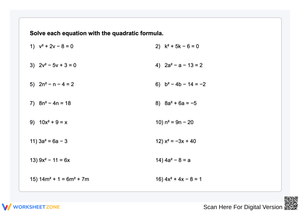
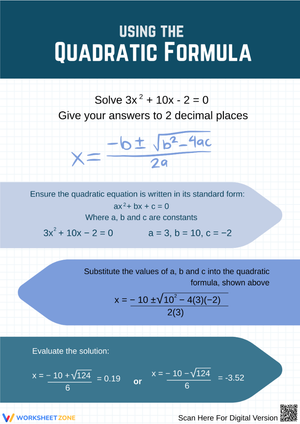
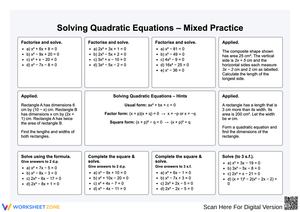
These 10th grade quadratic formula printable worksheets give algebra teachers a ready sequence of practice problems that carries students from first contact with the formula through discriminant analysis, exact-form simplification, and genuine method selection. Each worksheet is a standalone exercise — teachers pull what fits the lesson, not what falls next in a packet.
What Each Worksheet Covers
The set addresses five distinct skills, each treated in its own worksheet rather than bundled together:
- Converting to standard form. Before identifying a, b, and c, students rewrite equations presented in non-standard arrangements. The other worksheets assume this step has already been practiced.
- Full formula application. Students substitute coefficients, evaluate the discriminant, and simplify to exact form — the complete procedure from equation to final answer.
- Discriminant analysis. Problems ask students to calculate b² − 4ac and interpret the result without finishing the full calculation, building the habit of reading an equation analytically before computing.
- Radical simplification. Exercises isolate the step where students reduce expressions like √48 to 4√3, then reduce the full fractional result — the skill most likely to collapse under pressure during the formula.
- Method selection and word problems. Mixed exercises ask students to decide between factoring, taking square roots, and applying the formula. Application problems connect the algebra to projectile motion and area contexts.
Student Errors Worth Anticipating Before You Hand These Out
The most persistent error involves the sign of b. When an equation contains a term like −5x, students identify b = −5 correctly, then write −b = −5 in the formula. They forget that −b means the opposite of b, so −(−5) = 5. The error propagates invisibly — the arithmetic still proceeds and produces a wrong answer that looks plausible. These worksheets include problems where b is explicitly negative so the issue surfaces in practice, not on the unit exam.
A second consistent error is partial division. After evaluating −b ± √(b² − 4ac), students divide only the radical portion by 2a and leave the integer term in the numerator undivided. The result looks like a fraction but carries the wrong value. Seeing this on a returned worksheet tells you the student hasn't internalized that the fraction bar is a grouping symbol — the entire numerator is divided. Catching it through a worksheet, where you can mark exactly where the expression broke, is far more efficient than catching it on a test.
Why the Discriminant Gets Its Own Worksheet
Grade 9 algebra focuses on factoring and simple square-root equations — cases where the solution structure is either obvious or quickly tested. By Grade 10, students encounter quadratics that resist factoring, and the discriminant is what tells them why: if b² − 4ac is not a perfect square, no rational factorization exists. Teaching students to compute the discriminant before running the full formula builds the habit of reading an equation analytically first. More practically, a student who finds a negative discriminant during a real-number unit stops immediately and writes "no real solutions" rather than carrying a square root of a negative number through five more steps. That interruption is worth a dedicated worksheet.
Standard Alignment
These worksheets address HSA.REI.B.4, which requires students to solve quadratic equations using multiple methods including the quadratic formula. Specifically, HSA.REI.B.4b calls for students to recognize when the formula is the appropriate tool, evaluate the discriminant to determine the nature and number of solutions, and express answers in exact simplified form. In most pacing guides, this standard sits in the second semester of Algebra 2 or the core semester of an integrated Grade 10 course — typically after students have solid command of factoring and completing the square, so the formula arrives as a generalization of methods already in place rather than an isolated procedure.
Building These Worksheets Into Your Lesson Plans
The discriminant worksheet works well as a warm-up on the day after introducing the formula — five minutes at the start of class where students predict how many solutions each equation has without fully solving. That prediction habit carries forward into every subsequent quadratic problem. The full-formula worksheets make effective guided practice during the initial lesson: work two problems at the board, then release students to complete four independently. The method-selection worksheet belongs near the end of the unit, not at the beginning — students need real experience with each method before they can compare them meaningfully.
These 10th grade quadratic formula printable worksheets also integrate well into station rotations. One station handles discriminant-only problems, a second covers radical simplification in isolation, and a third presents full equations requiring the complete formula. Students who finish early at any station move to the word-problem worksheet, which requires interpretation — deciding which root is physically meaningful — rather than additional computation practice.
Adjusting the Worksheets Across a Range of Learners
Students who struggle with fraction operations should not start on the radical-simplification worksheet. A more productive entry point for those students is integer-coefficient equations where the discriminant is a perfect square — the formula produces clean integer answers, so the simplification step doesn't obscure the procedure. Once substitution becomes automatic, introduce non-perfect-square discriminants gradually.
These 10th grade quadratic formula printable worksheets present enough structural variation that advanced students benefit most from the method-comparison problems rather than additional full-formula repetition. Students who solve reliably using the formula should be asked to explain in writing why they would factor a particular equation instead. That explanation reveals whether they understand the relationship between the discriminant and factorability — a level of fluency that procedural accuracy alone does not show.
Frequently Asked Questions
When should students use the quadratic formula instead of factoring?
A practical classroom rule: if a student spends more than sixty seconds searching for a factor pair without success, the formula is faster. More precisely, if b² − 4ac is not a perfect square, the equation has no rational factors, and the formula is the only path to an exact answer. Teaching students to check the discriminant first gives them a decision rule that holds across every quadratic they will encounter.
How should teachers handle a negative discriminant during a real-number unit?
Instruct students to write "no real solutions" and connect it to the graph — the parabola does not cross the x-axis. These 10th grade quadratic formula printable worksheets label discriminant problems by solution type, so teachers can assign only real-solution problems at the start of the unit and introduce negative-discriminant cases once the class is ready, without having to sort through the set manually.
What is the most effective way to help students simplify radicals inside the formula?
Treat radical simplification as a separate skill before embedding it in the formula. A student who cannot simplify √72 to 6√2 independently will not manage it mid-formula under time pressure. The radical-simplification worksheet in the set practices this in isolation — students factor the radicand, extract perfect squares, and reduce the full fractional expression — before any quadratic equation appears in the problem set. That separation reduces cognitive load at the moment when students most need their attention on the formula itself.













 Interactive Worksheet Maker
 Quiz Maker
 Word Search Maker
 Crossword Puzzle Maker
 Word Scramble Generator
 Sentence Scramble Generator
 Handwriting Worksheet Generator
 Name Tracing Generator
 Fill In The Blank Generator