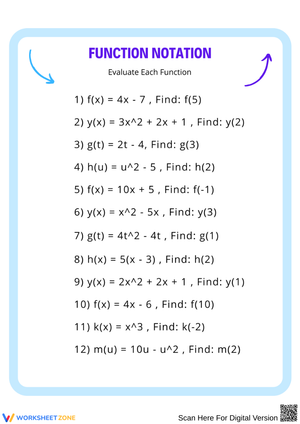
These algebra printable worksheets for 10th grade target the concepts that define this stretch of high school math — quadratic functions, polynomial operations, complex numbers, and rational expressions — with each worksheet focused on a single skill so teachers can reach for exactly what the lesson demands. The set is built for classroom realities: clean problem formatting, adequate workspace for multi-step solutions, and answer keys that show every intermediate step rather than listing final values alone.
The Specific Skills These Worksheets Build
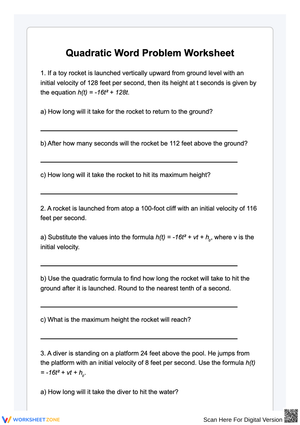
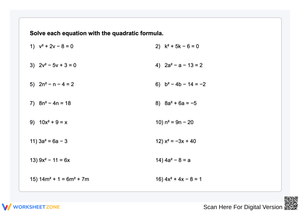
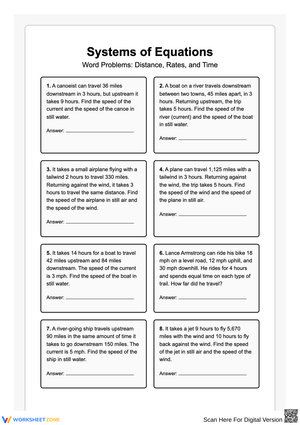
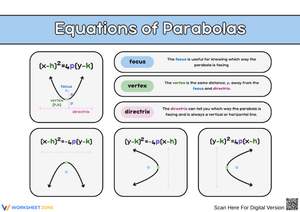
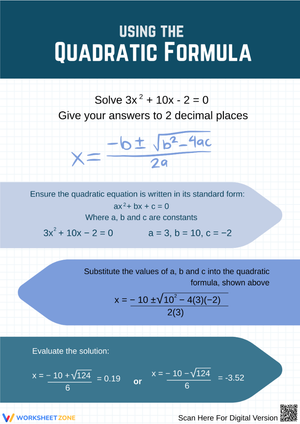
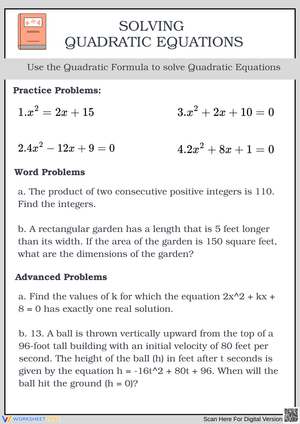
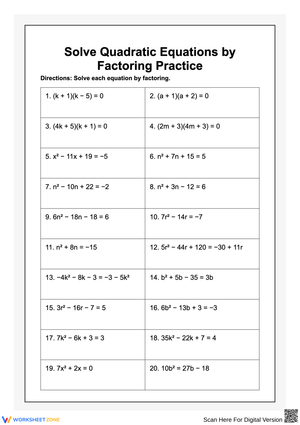
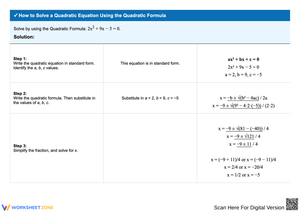
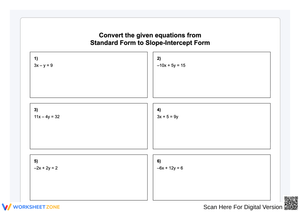
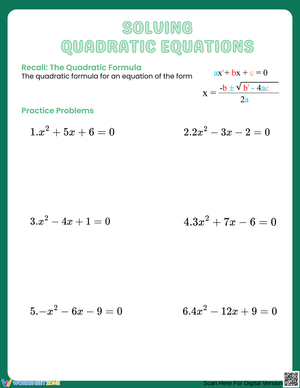
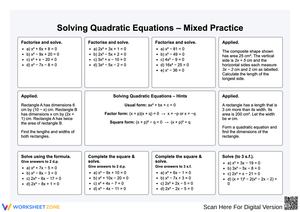
Quadratic functions anchor the set. Students factor trinomials with leading coefficients greater than 1, complete the square to rewrite equations in vertex form, and apply the quadratic formula — including cases where the discriminant is negative and the solution involves complex numbers. Polynomial worksheets move from binomial multiplication through multi-term distribution and into long division and synthetic division. One worksheet addresses a gap that consistently trips students: synthetic division with a missing-degree term, where the student must insert a placeholder zero before dividing. Without that placeholder, the columns shift and every subsequent step fails.
- Quadratic functions: factoring, completing the square, quadratic formula, discriminant analysis
- Polynomial operations: multiplication, long division, synthetic division including missing-term cases
- Complex numbers: arithmetic with i, simplifying powers of i, and multiplying conjugates
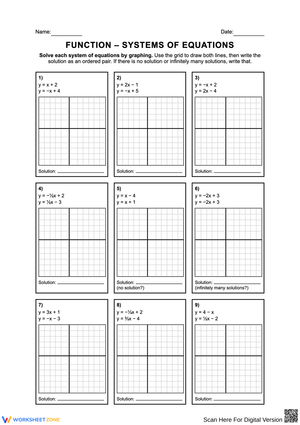
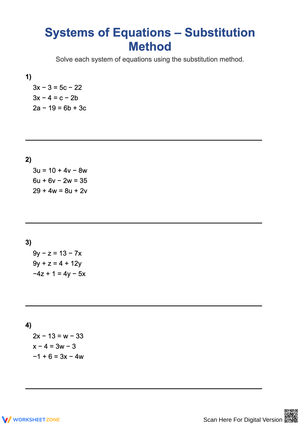
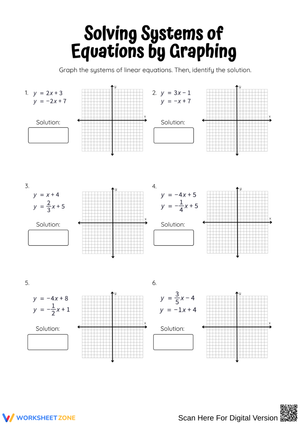
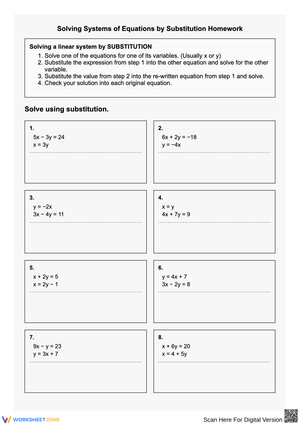
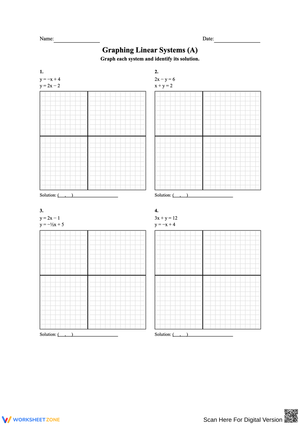
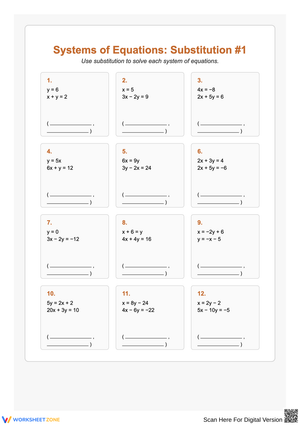
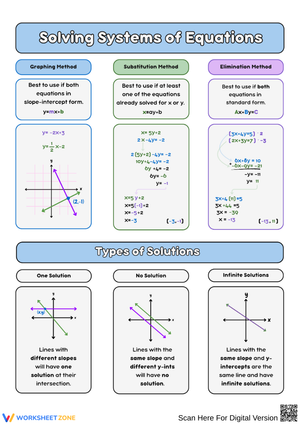
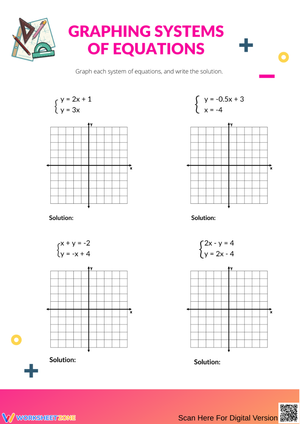
- Systems of equations: linear-quadratic systems solved algebraically and by graphing
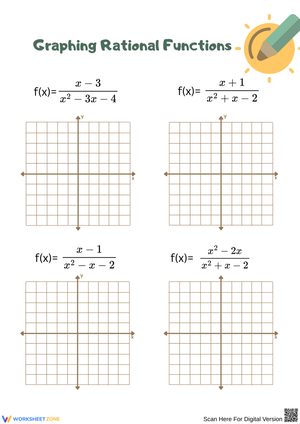
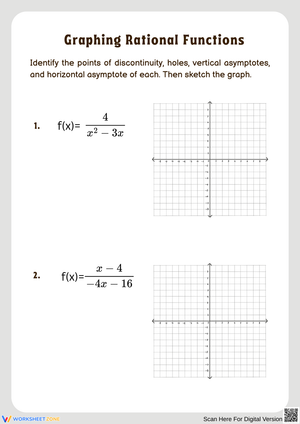
- Rational expressions: simplifying, multiplying, dividing, and adding with unlike denominators
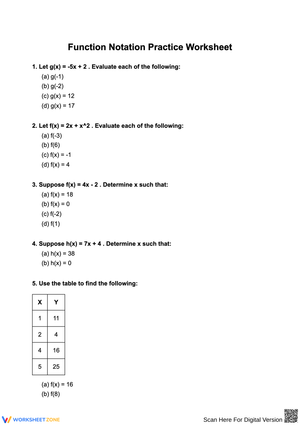
- Function transformations: vertical and horizontal shifts, reflections, and dilations applied to parent functions
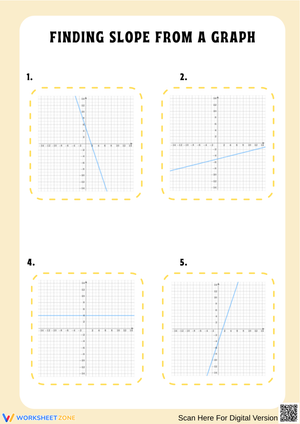
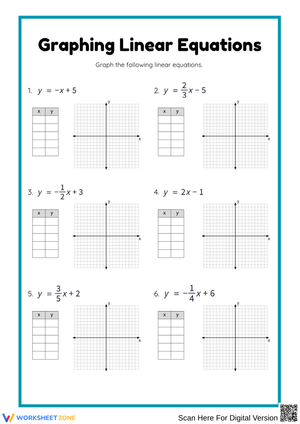
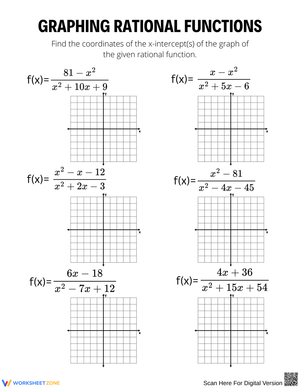
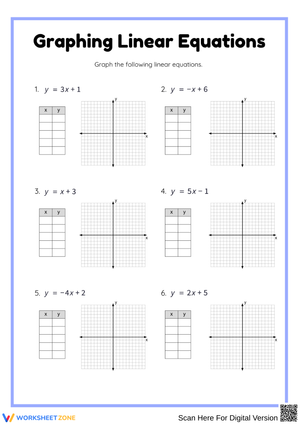
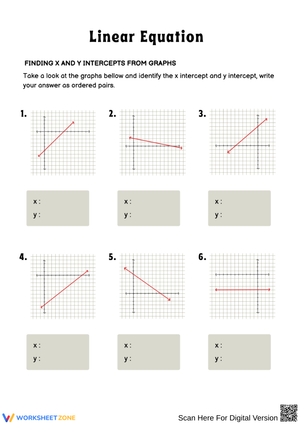
Graphing worksheets include pre-printed coordinate planes scaled for the relevant domain. A student graphing a parabola with vertex at (−3, −7) needs working room, and tight pre-printed grids make that possible without the five-minute detour of hand-drawing axes.
Common Misconceptions Worth Anticipating Before the Lesson
A predictable cluster of errors appears every year in 10th grade algebra, and identifying them early saves instructional time. The most common completing-the-square mistake: students add (b/2)² to one side of the equation but not the other, producing a square that looks correct but yields a vertex that does not match the graph. They have executed a procedure that almost works, and they have no idea why the answer is wrong. A related error surfaces with the quadratic formula — students compute −b/2a to locate the vertex's x-coordinate, then substitute that value back into the formula rather than the original equation, generating a result they cannot interpret.
Complex number multiplication produces its own recurring mistake. Students who distribute two binomials correctly will still write i² as +1 rather than −1, collapsing imaginary and real parts into the wrong sum. This error appears with striking regularity even after direct instruction. One worksheet in the set uses an error analysis format: a completed multiplication problem contains exactly that mistake, and students must find it, explain the error in writing, and rework the problem. Acting as the reviewer of flawed work forces engagement with the procedural logic in a way that standard problem sets do not.
Standard Alignment
These algebra printable worksheets for 10th grade map to the Common Core State Standards for High School Algebra. Quadratic and polynomial work aligns to HSA-APR.B.3 (identifying zeros of polynomials to sketch a rough graph) and HSA-REI.B.4b (solving quadratics by factoring, completing the square, and the quadratic formula). Rational expression work falls under HSA-APR.D.6. Systems of equations align to HSA-CED.A.1 and HSA-REI.C.7. In instructional terms, these standards cluster in the second semester of most 10th grade sequences, after linear functions have been consolidated — which is precisely where this set fits in a typical year's pacing.
How to Build These Worksheets Into Your Lesson Plans
The warm-up block is the most reliable entry point. Two or three problems from a factoring worksheet at the start of class activate prior knowledge before the day's new concept arrives, and the written work shows exactly which step is breaking down before instruction begins — far more useful than asking the class whether anyone did the homework. Station rotations work well for the polynomial and rational expression worksheets, where each skill is genuinely discrete. A student moving from a synthetic division station to a rational expression station to a graphing station practices three separate procedures without the fatigue that settles in during a long single-skill problem set.
For the last ten minutes of a Friday block, a two-problem review worksheet from two weeks prior functions as low-stakes retrieval practice with no new instruction required. That spaced retrieval window is where retention actually builds — not in the initial lesson, but when students reconstruct a procedure they have not used in several days. Collecting completed worksheets mid-unit also gives teachers a concrete artifact for formative assessment: a stack of factoring worksheets reveals immediately whether students are factoring out the GCF first or jumping straight to trial and error, and that pattern shapes the following day's opening review.
Differentiating the Set Across Ability Levels
For students who have not yet consolidated factoring with leading coefficients other than 1, the quadratic worksheets are most productive when every problem begins with a = 1. Once that is solid, the full problem set follows. This is not about reducing rigor — it is about sequencing the increase in complexity so each step is buildable on the one before it. Students who freeze when confronted with an unfamiliar problem form often stall because they have been moved to abstract cases before the underlying procedure is reliable.
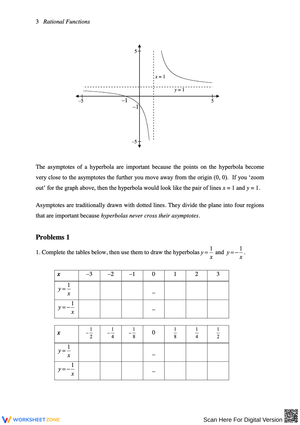
On the other end, the rational expressions worksheets include extension problems where students identify restrictions on the variable, simplify compound fractions, and connect the simplified expression to the behavior of its graph. These are genuinely harder tasks — not additional repetitions of the same item type — and they push students who have mastered simplification into reasoning about what the expression represents. Algebra printable worksheets for 10th grade that extend in both directions give a single teacher something meaningful to assign to every student in the room without running parallel lesson plans.
Frequently Asked Questions
Do the answer keys show full worked solutions, or just final answers?
Every key in this set shows the full solution. For completing the square, that means the key shows the half-coefficient step, the addition applied to both sides, the factored perfect square trinomial, and the final values of x. This level of detail matters when a student's answer is wrong and the teacher needs to locate exactly which step failed without reworking the problem independently.
How many problems does each worksheet include?
Problem counts vary by skill and complexity. Factoring worksheets carry 16–20 problems, because fluency in that procedure builds through repetition on manageable items. Rational expression worksheets with multi-step simplification run 8–12 problems, since each requires substantially more workspace and time. The algebra printable worksheets for 10th grade set is sized so each worksheet fits a 15–25 minute focused practice window rather than filling an entire class period.
Can these be used with a curriculum that does not follow Common Core?
Yes. The skill groupings — quadratics, polynomials, complex numbers, rational expressions, systems, transformations — appear across virtually every Algebra 2 sequence regardless of the standards framework a district uses. Because each worksheet is organized by concept rather than unit number, they fit into most pacing guides without rearrangement.
Are graphing worksheets included in the set?
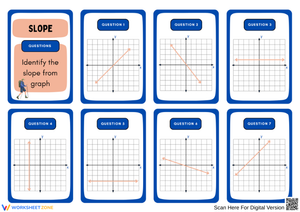
They are. Each graphing worksheet includes pre-printed coordinate planes in a scale appropriate for the function being graphed. The function transformation worksheets use a side-by-side format: the parent function is graphed on the left plane, and students complete the transformed function on the right. Seeing both on the same worksheet makes the shift or reflection visually explicit in a way that a single unlabeled grid does not.













 Interactive Worksheet Maker
 Quiz Maker
 Word Search Maker
 Crossword Puzzle Maker
 Word Scramble Generator
 Sentence Scramble Generator
 Handwriting Worksheet Generator
 Name Tracing Generator
 Fill In The Blank Generator